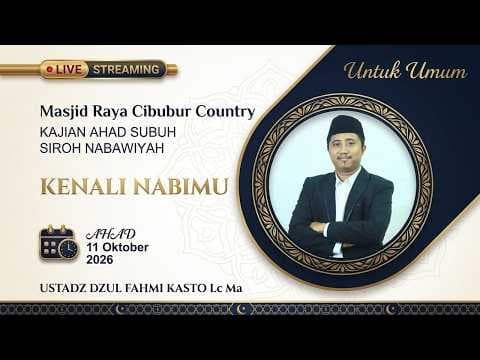
Transkrip diambil dari YouTube. Klik timestamp biru untuk melompat ke posisi tersebut di pemutar.
- Peace be upon you, and Allah's mercy
- and blessings. All praise is due to
- Allah, we praise Him, we seek His help,
- and we ask for His forgiveness. We seek
- refuge in Allah from the evil of our
- souls and from the badness of our deeds
- . Whoever Allah guides, none can
- misguide him. And whoever He lets go
- astray, none can guide him. I bear
- witness that there is no god but Allah,
- alone, with no partner. And I bear
- witness that our master Muhammad is His
- servant and messenger. Whatever Allah
- wills happens, and whatever He does not
- will does not happen. There is no power
- and no strength except with Allah. To
- proceed. Brothers and sisters,
- listeners of Silaturahim radio and
- viewers of Silaturahim TV, who are
- greatly honored by Allah. Praise be to
- Allah, tonight we can reconnect through
- the literal translation study. Last
- Friday night, we reached verse 34. And
- tonight, we will begin with verse 35
- until it is time for Isha. Surah
- An-Nahl. Let us begin tonight's study
- by reciting the prayer for seeking
- knowledge together. In the name of
- Allah, the Most Gracious, the Most
- Merciful. My Lord, increase me in
- knowledge. O Allah, benefit me with
- what You have taught me, teach me what
- benefits me, and grant me knowledge
- that will benefit me. Amen. We begin
- verse 35. I seek refuge in Allah from
- the accursed Satan. In the name of
- Allah, the Most Gracious, the Most
- Merciful. And the polytheists said, "If
- Allah had willed, we would not have
- worshipped anything other than Him.""We
- would not have worshipped anything
- other than Him, neither we nor our
- forefathers.""Nor...""...our
- forefathers...""...nor would we have
- forbidden...""...nor would we have
- forbidden anything without Him.""Thus
- did those before them. Are the
- messengers responsible for anything but
- clear notification?" The literal
- meaning: "Waqala" means and said, "
- alladzina asyroqu" means those who are
- polytheists. "Lau sya Allah" means if
- Allah had willed, "ma abadna" means we
- would not have worshipped, "min dunihi"
- means other than Him, "min syaiin"
- means anything. "Nahnu" means we, "wala
- abauna" means nor our forefathers. "
- Wala harramna" means and we would not
- have forbidden, "min dunihi" means
- without Him—meaning without His
- permission, Allah. "Min syaiin" means
- anything. "Kadzalika" means thus, "
- fa'ala" means did, "alladzina min
- qoblihim" means those before them. "
- Fahal alar rusuli" means and is it upon
- the messengers, "illal balag" means
- except to convey. "Almubin" means clear
- . Ah, so this is......the statement of
- the polytheists to defend their
- polytheism. They said, as mentioned by
- Allah in this verse 35, "And the
- polytheists said, if Allah had willed,
- we would not have worshipped anything
- besides Him, neither we nor our
- forefathers.""And we would not have
- forbidden anything without His
- permission.""That is what those before
- them did." Is that the duty of the
- messengers? Is the duty of the
- messengers not only to convey the
- message of Allah clearly? So that is
- their excuse for why they worship other
- than Allah. Because it was indeed
- willed by Allah. Why do they forbid
- what is made lawful by Allah? So their
- excuse is that this is by Allah's
- permission. That kind of speech is not
- new. Their ancestors also said the same
- thing, saying if Allah did not will it,
- we and our parents would not be
- polytheists. That is clearly a false
- statement. So Allah indicates that it
- is not Allah's will that they are
- polytheists. It is not Allah's will
- that they forbid something. The proof
- is that Allah sends the messengers. Who
- provide guidance to them. Now, the 36th
- verse below it refutes their statement
- gently. Allah says, "And We have
- certainly sent into every nation a
- messenger, [saying], 'Worship Allah and
- avoid Taghut...'" Among them are those
- whom Allah guided, and among them are
- those upon whom error has rightfully
- been decreed. So travel throughout the
- earth and observe. And We have
- certainly sent to every nation a
- messenger, saying, "Worship Allah and
- avoid Taghut (false idols)." Among them
- were those whom Allah guided, and among
- them were those who were rightfully
- destined for error. So travel through
- the earth and observe......how was the
- end......the consequence or the outcome
- of those who denied Allah and His
- messengers. "The overall meaning of
- this verse is: and We have certainly
- sent a messenger to every nation to
- call out," Worship Allah and avoid
- Taghut. "Then among them are those who
- were given guidance by Allah and there
- are also those who remained in error.
- So walk upon the earth and observe the
- end of those who denied Allah. So this
- is Allah’s rebuttal. They are not
- polytheists because of Allah’s will.
- The proof is that Allah sent the
- messengers. The messenger’s mission
- and duty was to invite them to worship
- Allah and avoid Taghut. Sir, if they
- say that being a polytheist is
- Allah’s will, that is wrong. Here,
- Allah explains it clearly. Now, among
- them are those who want to follow the
- messenger, so they are given guidance
- by Allah. Among them are those who do
- not want to follow the Messenger. So be
- it, Allah has decreed error for them.
- Those proofs are already clear. Go to
- the face of the earth, upon the earth.
- See how the consequence for those who
- deny Allah will surely be destruction.
- Next, Allah says," In tahris 'ala
- hudahum fa innallaha la yahdi man
- yudillu wa ma lahum min nasirin. "If
- you are eager (you very much want),
- meaning the Messenger of Allah, peace
- be upon him, for their guidance, then
- indeed Allah does not guide those who
- are lost, those who are already astray,
- and they have no helpers. None. We mean
- the overall meaning of verse 37. If you
- , Muhammad, greatly hope for them to
- receive guidance, then indeed Allah
- will not guide those whom He lets go
- astray. And they have no helpers for
- themselves. Why are they led astray by
- Allah? Because they indeed desire to be
- astray. Given guidance by the Messenger
- , they refuse. Well then, please just
- continue in your error. And it is
- impossible for those who are in error
- to be helped by Allah. No. This is
- Allah’s promise, Allah’s warning.
- There is no helper at all for those who
- have strayed from the path of Allah.
- Furthermore, Allah states," Wa aqsamu
- billahi jahda aimanihim. "" La
- yab'athullahu man yamut. "" Yamin. "And
- they swear by Allah with their most
- earnest oaths. What is their oath?
- Allah will not resurrect those who die.
- Dead? Nay, but Allah will surely
- resurrect them; it is a promise upon
- Him, and it is true. So the promise of
- Allah is true. But most of mankind do
- not know. The overall meaning of verse
- 38. And they swear by Allah with their
- strongest oaths. That Allah will not
- resurrect those who die. That is not
- the case. Allah will surely resurrect
- them as a true promise from Him. But
- most of mankind do not know. Now, this
- is proof that their deviation is not
- because of Allah. Because they truly do
- not believe in the Day of Resurrection,
- they are polytheists, associating
- partners with Allah Subhanahu wa ta'ala
- . So that is the reason their claims
- are clearly refuted by Allah. Now, if
- they say there is no Day of
- Resurrection, the answer is" Yes, there
- surely is. "This is the promise of
- Allah. Only most of mankind do not know
- ; they do not want to accept faith,
- they do not want to accept the
- existence of the Day of Resurrection.
- Furthermore, Allah states in verse 39,
- and we will read it along with verse 40
- because it is short. liyubayyina
- liyubayyina laadzi yakhtalifuna fi
- waliya'lamalladina kafaru
- waliya'lamalladzina kafaru annahum kanu
- kadzibin. Innama quluna lisaiin idza
- aradnahu an naquula lahu kun fayakun.
- The literal meaning is: liyubayyina He
- intends to explain to them alladzina
- yakhtalifuna that which they differ in,
- fi regarding it, waliya'lam and so that
- those who disbelieve might know,
- annahum that they kanu were kadzibin
- those who denied the Day of Judgment.
- Innama, only, quluna our word lisyaaiin
- to a thing, idza aradnahu. If We intend
- it, what is our word? Annaquula. That
- We say to it, lahu, kun. Be, fayakunu
- then it becomes. The overall meaning of
- verses 39-40. That He may explain to
- them what they differed about and so
- that the disbelievers may know that
- they were liars. Verse 40. Indeed Allah
- says, our word, that is, for something
- when We intend it, We only say" Be, "
- and it becomes. Now, why did Allah
- create the Day of Judgment? First,
- Allah will explain what they differed
- about. In this world, there is still
- much dispute. Later at the end, the Day
- of Judgment will settle what is true
- and what is false. And why did Allah
- create the Day of Judgment? To prove
- that the disbelievers lied regarding
- their claim that there will be no Day
- of Judgment. So, this is the verse that
- explains why Allah brings about the Day
- of Judgment. Up to that point, brothers
- , the issue concludes one theme, then
- we continue to another theme in verses
- 41 and 42. Walladzina hajaru fillahi
- mim ba'di maa dhulimu lanubawwi'annahum
- fid dunya hasanah, wala ajrul akhirati
- akbar lau kanu ya'lamun. Alladzina
- shobaru wa' ala robbihim yatawakkalun.
- Walladzina hajaru: And those who
- emigrated for the sake of Allah, mim
- ba'di ma dhulimu after they were
- oppressed or tortured,
- lanubawwi'annahum We will settle them
- in this world hasanatan, in a good way,
- wala ajrul akhirah and indeed the
- reward of the Hereafter is greater.
- Kanu if only they knew. alladzina,
- those who sabaru are patient, ala
- rabbihim and upon their Lord
- yatawakalun they rely. The overall
- meaning of walladzina hajaru and so on.
- Verses 40 and 21. We mean 41 and 42.
- And those who migrate for the sake of
- Allah after they have been wronged, We
- will surely provide them a good place
- in this world, and the reward in the
- Hereafter is greater if they only knew,
- namely those who are patient and only
- upon Allah they rely. Furthermore,
- Allah explains about those who migrate.
- The reason for the migration is because
- they were oppressed. And for those who
- were oppressed and then migrated, they
- will obtain a good place in this world.
- And it was proven by the Muhajirin
- after they migrated from Makkah to
- Madinah. They became leaders and each
- of them became a role model for the
- righteous until now. That is the reward
- or recompense for migration in the
- world. Meanwhile, in the Hereafter,
- they will receive an even greater
- reward. Now, this is it, my brothers.
- Ibn Mundhir narrated from Umar bin
- Khattab that he gave something to one
- of the Muhajirin. When he gave to one
- of the Muhajirin, he said," Take this
- gift, may Allah bless you in this gift.
- "This is what Allah promised you in
- this world. While what is kept for you
- in the Hereafter is far better." Then
- he recited this verse, alladzina
- shobaru wa 'ala rabbihim yatawakalun.
- So after they migrated, their needs
- were met again, just as they had enough
- when they were in Makkah. Now, when
- Umar gave to the Muhajirin, he would
- say, "Accept this." Yes, this is the
- result of our migration. Then he would
- recite this verse. This is what is
- given by Allah to those who are patient
- and to those who rely on Him. So
- brothers, if you want to get a good
- reward in this world and an even better
- one in the Hereafter. What are the
- requirements? Migration. Second,
- patience. And third, relying on Allah
- subhanahu wa ta'ala. This, my brothers,
- is what was conveyed by Allah in Surah
- An-Nahl from verse 35 to 42. Hopefully,
- we can all understand it and we can all
- practice it so that our life is hasanah
- in this world and the reward is even
- greater in the Hereafter. That is all,
- brothers and sisters who are loved by
- Allah Subhanahu wa ta'ala. Jazakumullah
- for all your attention. I apologize for
- all my shortcomings. And finally, let
- us end our study this evening by
- reciting the kafaratul majelis prayer
- together. Subhanakallahumma wabihamdika
- ashadu alla ilaha illa anta.
- astaghfiruka wa atubu ilaik.
- Assalamualaikum warahmatullah
- wabarakatuh.