Transkrip diambil dari YouTube. Klik timestamp biru untuk melompat ke posisi tersebut di pemutar.
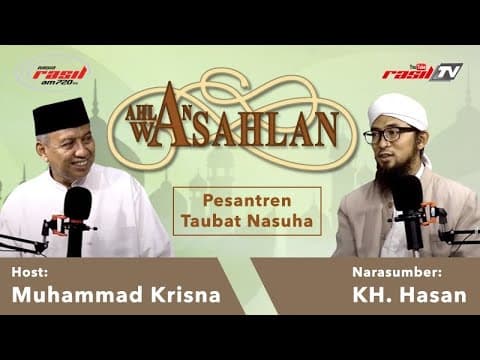
- Berasil TV for a unified Islam. Ahlan
- wasahlan.
- In the name of Allah, the Most Gracious
- , the Most Merciful. Peace be upon you,
- and Allah's mercy and blessings. O
- Allah, send prayers upon our master
- Muhammad and the family of our master
- Muhammad. Praise be to Allah, we meet
- again today, Tuesday, October 2nd, 2018
- , or the 23rd of Muharram 1440 Hijriah.
- As usual, Radio Silaturahim and Rasio
- TV, through YouTube, return to present
- the Ahlan wasahlan program. We are
- featuring an Ustadz who is also an
- entrepreneur. He was born in uh, where
- was it? in Asahan on June 19, 1971, in
- North Sumatra, right? Okay. Uh, he went
- to elementary school there, too, at SDN
- Desa Manis, SD Negeri Manis, Desa Manis
- , right, in '84. Then in '87, Madrasah
- Tsanawiyah Almanar Pulau Raja, then
- Madrasah Aliyah Almanar Pulau Raja,
- IAIN North Sumatra Medan, IAIN North
- Sumatra Medan, UIN Jakarta. Then he was
- active in plantations, and also active
- in IDKU. And his biography is very long
- , if I read it all it could take until
- this afternoon. Already present here is
- Mr. Legisan or Ustadz Legisan Sugimin
- Samtafsir. Legisan Sugimin Samtafsir.
- Peace be upon you, Ustadz Legisan.
- And peace be upon you, and Allah's
- mercy and blessings.
- I have just heard the name Legisan for
- the first time. Could it be interpreted
- as something? Legisan Sugimin Samtafsir
- . It's a name given by parents, Ustadz.
- So
- perhaps there is a certain meaning.
- In Javanese, "legi" means sweet. "
- Legi" is sweet.
- Ah, yes, "-san" is just a term of
- endearment.
- Oh.
- Sugimin.
- Ah, Sugimin is my father's name,
- Sugimin.
- Samtafsir.
- Samtafsir is my grandfather's name.
- Oh, I see. So there is North Sumatra
- and Central Java in there, right?
- Masyaallah.
- He is an uh, entrepreneur preacher. Uh,
- Pak Ustadz, even if we just go into the
- bathroom,
- Yeah.
- we are already surrounded by non-Muslim
- products starting from
- uh, toothpaste, soap, everything,
- up to clothes, up to
- what are all the Muslim products? Why
- is it like that? Well, firstly, in my
- opinion, there is nothing wrong with us
- using products made by non-Muslims.
- It means in muamalah, trade is allowed,
- it's called helping one another
- but it has become so widespread, the
- problem is that almost everything is
- like that.
- Yes. Ultimately, we really must think,
- uh, if all products must be made by
- non-Muslims, then we just become a
- party that can only consume.
- Yeah. We are in the consumer position
- constantly, right?
- Yes. Now, this consumer position is a
- spending position. And, a spending
- position is, well, spending. Spending
- means we are exhausting our money, our
- wealth. So, if we never produce,
- we will never have a surplus in life.
- What does that mean? In the long run,
- the Muslim community will experience a
- deficit
- because they never have a surplus.
- Hm.
- They never make a profit.
- Shoppers never make a profit, right?
- Spending, buying continuously means
- just paying out, paying out. So, in the
- short term, there is no problem
- shopping with them, but in the long
- term,
- we will experience an economic deficit,
- so
- The Muslim community, Muslims, whether
- in Indonesia or even globally, will
- experience weaknesses in the long run.
- Why is that? Because, as mentioned, we
- are only, shall we say,
- consumption-driven. Hmm.
- We should be production-driven. Yeah.
- Now, if we are encouraged to produce,
- we will become stronger.
- Yeah.
- We have assets, we have products, and
- we have a surplus.
- Uh, we have profits, right? Production
- means you can eventually profit from
- products sold to the public, sir.
- What causes the Muslim community to
- have fewer entrepreneurs compared to
- non-Muslims? We are very few; everyone
- becomes an employee, a teacher, or
- something else.
- Why are there so few? No.
- Perhaps regarding Indonesia, my
- understanding is that it's been
- hereditary since we gained independence
- ; in fact, even before independence, we
- were colonized by the Dutch. The Dutch
- categorized society into three, right?
- So, the indigenous people, the '
- inlanders', generally went into the
- agricultural labor sector and the
- public sector. Meanwhile, the Chinese
- and other immigrants went into business
- . Whereas the Europeans were the
- nobility,
- the ones who controlled politics. Now,
- once we became independent, it turns
- out this did not undergo a
- transformation.
- Now, when we entered the Old Order,
- well, in the Old Order, we were still
- busy with ideological battles. But once
- we entered the New Order, it turned out
- that the major economic players did not
- massively involve the lower classes,
- the general public,
- but instead used a growth concept where
- the strong were built up first with the
- hope that a trickle-down effect would
- emerge later.
- Now, this gave rise to conglomerations.
- And those conglomerations were
- eventually people who were chosen.
- Those chosen people were those who
- already had a foundation, and it turns
- out most were not Muslims. So, in the
- end, productive and strategic economic
- sectors have not been controlled by
- Muslims to this day.
- Such processes have not changed
- significantly. If we look at the
- educational traditions and training
- conducted by the Muslim community, look
- at how minimal training aimed at
- developing entrepreneurship and
- corporations is.
- Hmm. Most of it is directed towards,
- let's say, dimensions, sectors, or
- realms like politics or youth
- organizations, not aimed at building
- entrepreneurship.
- And then, on the side of the Islamic
- boarding schools (pesantren),
- we see that pesantren in Indonesia have
- a very small portion dedicated to
- entrepreneurship, let alone developing
- corporations.
- Hmm.
- So, ultimately, the sector...
- It isn't really taught or directed that
- way in the yellow books (kitab kuning).
- Perhaps it is taught, but it should be
- taught, as the Prophet's Hadith talks a
- lot about trade. The Quran itself talks
- about trade.
- Now, we are actually not poor in such
- concepts.
- But their elaboration, related to the
- development of social history in our
- society, has caused our focus on
- thinking about Muslim entrepreneurship
- to be small.
- Hmm. So, this has become a tradition in
- pesantren. Well, Islamic boarding
- schools ultimately dedicate more of
- their portion to discussing books of
- jurisprudence.
- Hm.
- However, muamalah jurisprudence is
- lacking.
- Hm.
- So, there was a time when a figure
- jokingly remarked. Our clerics
- shouldn't just talk about, let's say, '
- marriage is my sunnah, marriage is my
- sunnah.' Okay, everyone knows that
- marriage is the Prophet's sunnah, but
- also that 'trade is my sunnah.'
- That trading is also the Prophet's
- sunnah.
- Building a corporation is also the
- Prophet's sunnah. Even the Prophet did
- it since he was 12 years old. This
- should be implemented by all Muslim
- education in Indonesia so that by
- junior high age they are taught
- entrepreneurship.
- But that hasn't happened yet.
- Wow, there are many agricultural
- hadiths too, right?
- There are many hadiths about
- agriculture, right? Yes, there are so
- many.
- Hm.
- And even the privilege of Islam is,
- Subhanallah, the teachings of Islam are
- truly extraordinary and perfect. If we
- talk about agriculture, fisheries,
- livestock, plantations, God's guidance
- is clearly there. God's guidance is so
- clear in regulating how a farmer, a
- plantation owner, or a livestock owner
- should make their spirituality, their
- Islam, their piety, and their faith the
- foundation
- for operations in fisheries,
- agriculture, plantations, and the
- corporate world. So nothing is actually
- left out. The elaboration of our
- Islamic teachings should be an
- elaboration for building companies,
- building organizations, building the
- economy, and building corporations for
- the Muslim community. Because that
- elaboration is lacking, it seems as if
- business is not an Islamic affair.
- Corporations are not an Islamic affair.
- Yes. If it's the big ones, those are
- usually for state affairs.
- I mean, let's look at it now.
- How many Muslim entrepreneurs are there
- in Indonesia?
- Very few, right?
- Very few. Well, if there are any, it
- must be very few. Then how many
- companies are owned by Muslims in
- Indonesia? Very few. Is it because
- Even though we are the majority?
- Right? Yes, we are 87%Muslim, so we
- should be. At least 50%of corporations
- in Indonesia should be owned by Muslims
- . Hm.
- But why not?
- Is the fate the same in other Islamic
- countries?
- It's just the same as Indonesia.
- Because the fate of the world's Muslim
- community is essentially the same.
- Hm.
- When the Ottoman Empire collapsed, the
- Muslim community was divided into 57
- countries that are now joined in what
- is called the OIC, the Organization of
- Islamic Cooperation. And we know, sir,
- that the Muslim world today in those 57
- countries is middle-low income, sir.
- Hm.
- Yes, where are the industries owned by
- Muslims in the world? It is very
- difficult for us to find, sir. If there
- are any, it's just one or two, right?
- So, what does that mean? It's not just
- Indonesia, but Muslims worldwide are
- experiencing the same thing. After the
- colonial era ended, we are just
- starting to rise. But once we began to
- rise within the nation-state, we were
- separated and split into 57 countries.
- Well, the cooperative relationship
- between Islamic countries is small, sir
- . Very low.
- Why? Because of the barriers of the
- nation-state itself.
- Well, regarding the economic dimension
- in those countries, we know that since
- the colonial era ended, global
- development theory has been based on
- developmentalism, where development
- must be driven by developed countries.
- Now, developed countries have the
- intention of helping developing
- countries, namely Muslim countries.
- However, they have an interest that if
- they advance these newly developing
- countries, they must remain in a
- position where they continue to survive
- . A friend of mine shared a
- sociological perspective that this
- theory is like riding an escalator. If
- you ride an escalator,
- they are already at the top.
- H
- We are at the bottom.
- Hm. We can't catch up, right?
- We can't. Even if we are both moving,
- we will never be on equal footing. So,
- developmentalism means they will pull
- us forward, but they will stay ahead.
- So, what does that mean? Development in
- these developing countries will also
- further advance the developed countries
- . The ones that used to be Europe,
- which colonized these Muslim countries,
- right? Now, if we look at the world
- today, there is America, China, then
- Europe, then Japan, South Korea. These
- are countries that have already
- advanced too far compared to Muslim
- countries. So, how can Muslim countries
- try to move to follow them? Well, there
- must be a grand strategy created by the
- Muslim community. World-class, yes. If
- we are in Indonesia, of course, we talk
- about the strategy of movement or
- development for Muslims in Indonesia.
- Iwan, we are still on the Alam Salalan
- program. We have invited Ustaz Legisan
- Sugimin Samtafsir. He is a preacher and
- an entrepreneur. Surely, he doesn't
- just point out the weaknesses of the
- Muslim economy, but also provides the
- way out. Please, for those who want to
- share, we are waiting at 08111999720.
- For WA or SMS or direct calls at
- 0218451512. We will also read out the
- mobile number of our speaker, Ustaz
- Legisan Sugimin Samtafsir, later. He is
- a preacher and entrepreneur. Later, he
- will also share his concept on how to
- start a business from upstream to
- downstream. How it has already been
- practiced. We are waiting for your
- response to this program. We are
- waiting. Welcome.