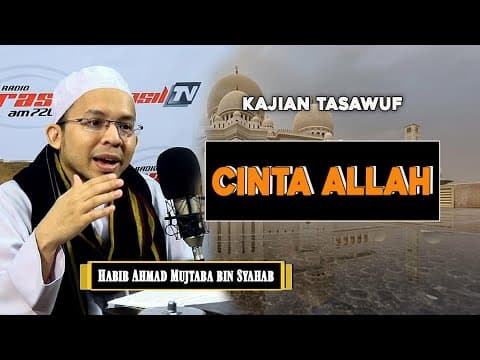
Transkrip diambil dari YouTube. Klik timestamp biru untuk melompat ke posisi tersebut di pemutar.
1:52 Bismillahirrahmanirrahim. wasam 1:58 asalibihi waman yaumiddin. Peace be 2:04 upon you warahmatullahi wabarakatuh. 2:05 Brothers and sisters who are blessed by 2:06 Allah subhanahu wa taala. How are you? 2:08 May wherever you are, you are always 2:10 under the protection and mercy of Allah 2:13 subhanahu wa taala. Alhamdulillah, 2:15 brothers and sisters, welcome to the 2:18 Sufism study event with me, Isa Alkaf, 2:20 Atep, Yusuf Subangkit at the operator's 2:24 desk, and alhamdulillah, Habib Ahmad 2:27 Mustab bin Syahab is accompanying us. 2:29 Peace be upon you warahmatullahi 2:30 wabarakatuh, Habib. 2:31 Waalaikumsalam warahmatullahi 2:32 wabarakatuh. 2:32 How are you? Healthy, Habib? 2:34 Healthy, Habib. Alhamdulillah. 2:35 Masyaallah. How was last night, Habib? 2:37 Attending the isbat session. J 2:39 Ram, Habib. Masyaallah. Masyaallah. Hey 2:42 , hopefully it goes well, Habib. 2:45 For those of you who are fasting today, 2:47 happy fasting. For those who are 2:49 fasting tomorrow, get ready for 2:50 tomorrow's fasting. 2:52 If it was played this morning, Habib ee 2:54 recorded SBT, sahur bertama with 2:57 figures. Masyaallah. 2:58 This morning ee recorded it with K. H. 3:02 Misbahul Munir. 3:03 Oh, naam. Naam. 3:04 Masyaallah. You can 3:06 Oh, I know you know. Masyaallah. You 3:08 can watch the missed ones on YouTube. 3:12 So Kia Misbal Munir, Habib, 3:14 founded an Islamic boarding school in 3:16 the middle of what ee North Jakarta 3:18 Tanjung Priok. So in the middle of 3:21 people busy with trontons or all sorts 3:23 of things, there is an Islamic boarding 3:25 school nestled there. Heeh. 3:27 And the students, masyaallah, are 3:29 extraordinary, the students are small 3:31 children from the village there. 3:33 Masyaallah. That's a 3:34 good program, Habib. What's it called? 3:36 SBT. Sahur. 3:37 Sahur with figures. 3:39 Masyaallah. 3:39 Masyaallah tabarakallah. One 3:41 of them is Habib Mustaba, who will be 3:42 there to 3:43 tell you about 3:44 Yemen. Masyaallah. Yes, Bib. Because 3:47 during sahur-sahur, people usually 3:50 watch comedy shows, watch funny shows. 3:53 Poor Muslims, poor people. 3:56 May they be accompanied during sahur so 3:57 that they can get istifadah while sahur 3:59 . Insyaallah. 4:00 Insyaallah. Dear, Bib. Yes, even though 4:02 sahur is one of the times when prayers 4:05 are answered, Bib. Namely the last 4:06 third of the night, right? 4:07 Oh, the 4:08 last third of the night is the noble 4:10 time of qiyamullail. 4:12 If outside of Ramadan, Allah Taala 4:14 sends down His mercy in the last third 4:16 of the night. H 4:18 but in Ramadan from the beginning of 4:19 sunset. 4:20 Oh dog. The 4:20 mercy has started to descend until dawn 4:23 . 4:23 Until dawn, right? 4:25 Is there a special prayer, Bib, that we 4:28 can pray during sahur. Dear, sir. 4:30 Masyaallah, 4:31 what are they called? 4:33 There are azkar-adkar for what are they 4:34 called? It is obligatory for people who 4:38 are having sahur, especially busy 4:40 people who work hard, masyaallah. 4:43 How to be stronger in fasting? E among 4:46 the azkar that is recommended is to 4:49 read the letter of Alan Nasrah Habib a 4:51 lot. 4:52 Oh, 4:52 the letter of Alan Nasrah seven times, 4:54 eh, 4:54 during sahur. 4:55 God willing, you will be strong through 4:57 the day by fasting. 4:58 Ah, that's suitable for children who 5:01 are boarding, who eat noodles for sahur 5:03 . So besides noodles for sahur, eat 5:06 Alam Nasrah. Nasro 5:08 to be strong, Bib. Masyaallah. Poor 5:10 thing, Bib. Many children in Jakarta, 5:12 Sumar-Sumarana, live in boarding houses 5:14 , Bib. 5:14 Already boarding, can't go home, far 5:17 from their families. 5:19 Sahur is fried noodles. 5:20 Fried noodles. 5:23 You can try it, brothers and sisters 5:25 who are far from their families, eat 5:27 Alam Nasrah seven times for sahur to be 5:29 strong, to be more productive, yes. 5:31 Masyaallah. Masyaallah. What are we 5:33 discussing today, Habib? 5:34 Tib today, Habib, our theme is still 5:36 continuing yesterday's theme. Ee, among 5:38 the signs of a person who is Sufi is to 5:41 stay away from arguments. 5:43 Oh, come 5:44 on. Asimah assaminah is still at the 5:46 eighth mark. 5:47 Well, 5:48 stay away from debate. 5:49 Masyaallah, Ikhwan Akhwad. For those 5:51 brothers who want to see the book 5:53 directly, we can do it later. Please 5:56 send a request. The book is in Arabic 5:58 but must be seen, while listening to it 6:00 . The book Mahiyatut Tasawuf by Habib 6:04 Umar bin Muhammad bin Salim bin Hafid. 6:07 For friends who want it, you can send 6:09 it via WhatsApp. The request is at 6:11 0811999720. God willing, we will send 6:17 it via WhatsApp. Let's listen together, 6:19 brothers and sisters, to the 6:21 explanation of Habib Ahmad Musta bin 6:23 Syahab about the eighth characteristic 6:26 of 6:26 Sufism, namely avoiding debate. Please 6:29 Habib. 6:30 Bismillah. Tib. 6:32 Bismillahirrahmanirrahim. 6:33 Alhamdulillahi rabbil alamin. Allahumma 6:35 shalli wasallim ala sayyidina 6:36 Muhammadin wa ala alihi wasohbihi 6:38 ajmain. Subhanaka la ilma lana illa 6:40 maamtana innaka antal alimul hakim ala 6:43 innaka ant tawabur rahim. Allahumma ya 6:45 fattah ya alim ya fattah ya alim ya 6:47 fattah ya alim iftah alina fathan qiba. 6:49 Ya arhamar rahimin. Allahumma la sahla 6:52 illa ma jaaltahu sahla wa tajal hazana 6:55 sahla. Was wahin lafsin labawat la 7:13 yabahmatika ya arhamarahimin. Ya 7:17 arhamarahimin ya arhamarahimin. 7:19 Alhamdulillah, we always give praise 7:21 and thanks to the presence of Allah 7:23 Subhanahu wa taala for all His abundant 7:26 blessings. And alhamdulillah, ee, in a 7:29 few moments we will welcome the month 7:31 of Ramadan, or some, ee, brothers, some 7:34 , a, our Muslim brothers have welcomed 7:36 the month of Ramadan. Wahakada brothers 7:39 , and don't forget to, ee, regarding 7:41 the first night of the month of Ramadan 7:44 , it's amazing isn't it, ee, if their 7:46 language is Lailatun Nadrah, yes, that 7:49 night Allah Taala looks at his servants 7:51 . In several hadiths it is narrated 7:53 that Allah Taala looks at his servants 7:55 on the first night of the month of 7:57 Ramadan. And whoever Allah Taala looks 8:00 at, he will not be punished forever. 8:04 Wahak 8:05 ee ulama said it means ee he will be 8:07 protected from immorality or if he 8:09 falls into immorality he will 8:11 definitely be given taufik to be able 8:13 to repent. Wahakata is back. Among the 8:17 good deeds, this brother, Imam Khatib 8:19 Asyarbini, mentioned in his tafsir, 8:22 tafsir Munir Sirajil Munir mentioned 8:24 that among the practices of the salaf 8:26 salihin ee on the first night of the 8:29 month of Ramadan is that they pray four 8:31 rak'ahs of sunnah prayers. The sunnah 8:34 mutlq rakaat prayer and there they read 8:36 surah al-Fath. Inna fatahna laka 8:39 fathan mubina. It is divided into four, 8:42 the first harakat from 1 to 10. The 8:44 second, from 11 to 17, and the final il 8:46 until four rakaat are divided. That, he 8:48 said, is expected that whoever does 8:53 that, God willing, will pass the year 8:55 from Ramadan to Ramadan in a state of 8:58 prosperity, kept away from disaster. 9:01 That can be what it is called, khatib 9:05 fi asirajil munir fi tafsir hak ikhwan, 9:10 name. Okay, let's return to our 9:12 discussion and here we are still 9:14 discussing the eighth sign of the 9:16 characteristics of Sufism experts. And 9:19 here we are avoiding debate, avoiding 9:23 debate. In the last meeting, Ikhwani, 9:26 we discussed this matter in terms of 9:28 definitions. What is the definition of 9:30 debate? Which debate should we avoid? 9:33 And what is the difference between 9:35 debate? In Arabic, it is jidal, 9:37 jidal with mumarah and also the 9:39 difference with munadarah. 9:41 Well, munadarah is good. Munadarah 9:43 means ee exchanging ideas if our 9:45 language is 9:46 discussion. 9:46 Discussion. Wahak discussion with the 9:49 aim of seeking the truth. 9:51 It could be that the truth appears in 9:54 me or appears in him. When the truth 9:57 has appeared then all will follow that 9:59 truth in whoever it appears. Oh that's 10:02 called munadarah. that's good habib 10:04 wahak even many books written by our 10:07 scholars their language adabul 10:09 munadarah 10:11 adabul munadarah from the mutagadimin 10:13 or mutaakhirin tha kubrizadah 10:16 ee compose us that problem. also from 10:20 mutaakhirin ee Hasan Habannakah in his 10:23 book 10:24 Wahak also Muhammad Muhyiddin Abdul 10:26 Hamid H sahibun Nahwu also has a book 10:29 Adabul Munadarah Hasan Habak in his 10:34 book Dabitul Mak'rifah ala kullial is 10:36 good if munadarah 10:38 ah if munadarah what is discussed is 10:40 the mindset not attacking the physical 10:42 at all not attacking 10:43 figures 10:44 not attacking figures at all 10:46 if this language is add homem What? 10:48 Attacking personally. 10:49 Attacking personally. 10:50 So what is discussed is the topic, Bib 10:52 yes. 10:53 Yes. Hehe. The topic. That's right. The 10:55 maudu. 10:55 If Bib's munaqasyah is the same. 10:57 Same. Same. Habib. Munaqasyah, munarah 10:59 are also muhawarah. 11:01 Discuss. 11:01 Aji. That's the 11:03 same benchmark. When the truth emerges, 11:06 everyone will follow that truth. But if 11:09 jidal or mira is not jidal or mira, the 11:12 goal is not to seek the truth, the goal 11:14 is to bring down the opponent. H no 11:17 matter 11:17 what the way, this opponent must be 11:19 brought down 11:20 to seek justification. 11:21 Well, that's right, it's called seeking 11:23 justification instead of the truth, 11:24 Ma'am. Yes, 11:27 what is jidal called? Ee, he can be the 11:30 one who starts, he can be the one who 11:32 refutes. But if mira is always the one 11:34 who refutes, he doesn't start. 11:36 But both are the same, not good. 11:37 Because both are essentially to bring 11:39 down the opponent. 11:40 Well, this is what is being discussed 11:42 here. So the Sihin scholars do not want 11:45 to enter into an era of debate like 11:47 that. 11:48 Wow, here we discussed last week about 11:52 the verses of the Qur'an. Now we will 11:54 discuss the hadith, then the words of 11:56 the scholars or the words of the 11:58 righteous. Here, gal sayidil habib 12:00 waqala shallallallahu alaihi wihbihi 12:03 wasallam ma: gaumun "maa qumun ba'da 12:05 hudan kanu alaihi illa utul jadal." raw 12:08 ahmadmidzi waqala hasan sahih w maji 12:11 thabrani wal hakim waqala shah asnad 12:14 baginda wasam said that Maaun is not a 12:18 people who go astray after they are in 12:21 a state of receiving guidance, yes. So 12:24 there are people who were previously in 12:25 a state of guidance, in guidance but 12:27 they went astray. "There is nothing 12:30 like that but utul jadal." Because they 12:33 were given the opportunity to debate, 12:37 to fight. So what does that mean? 12:39 Because their departure from guidance 12:42 until they go astray is usually because 12:45 of debate. And the signs are like that. 12:49 The signs are that people were 12:50 previously good, they used to have 12:52 guidance, but now they are astray. Well 12:55 , the signs are definitely that people 12:57 like to argue. Well, that's the 13:00 brotherhood. So there's something like 13:02 that. There is guidance that Allah 13:04 Taala takes away from his servants. 13:06 Nauzubillah minzalik. Don't let this 13:07 happen to you. That's why these pious 13:09 people, even though they have become 13:11 pious people, have become saints, they 13:13 are still in a state of wajil and khauf 13:15 , the horror of Allah Taala taking this 13:17 away from them and they are not safe 13:21 from makrullah. Waman makrullah khirun 13:24 wak. They are always afraid because 13:27 Allah Taala might revoke His guidance 13:29 from a servant. It was once told by 13:32 Sayid Abdul Qadir Jailani 13:34 when he was walking with his students. 13:38 After that he saw someone who was drunk 13:42 . This drunk person called Sheikh Abdul 13:45 Jilani. Yes, he laughingly approached. 13:50 His students were confused. Hey, what 13:51 are you doing? Eh, called and whispered 13:54 who the way was. After that he spoke 13:56 again and then whispered again. Then he 13:59 cried. What happened that made him cry? 14:02 Why is our teacher crying in front of a 14:04 drunk person? When he came back, he 14:08 said, "Do you know what that person 14:10 said to me?" He said, the first time he 14:14 said, "O Abdul Qadir, is Allah Taala 14:17 able to move my current lowly state to 14:19 be like you, your noble one?" So I said 14:21 , "Yes, Allah Taala is able to do that. 14:24 Allah can and Allah Taala can will to 14:26 move you to be noble. After that, he 14:31 whispered again. Is Allah Taala able to 14:33 move your current highly state to be 14:35 like me who is lowly? He immediately 14:38 became silent and embarrassed. And I 14:41 cried and said," Yes, Allah Taala is 14:43 able and able and able. It is possible 14:45 that Allah Taala can move my state to 14:47 be like that. "The word becomes a 14:49 meaning, meaning that the pious people 14:51 have a higher level of wisdom, Habib, 14:53 the more afraid they are of having it 14:55 revoked from them. O word. Well, one of 14:59 the reasons is that Allah Taala revokes 15:02 His guidance when that person or group 15:05 enters the era of forbidden debate, 15:08 namely the jidal that seeks 15:10 justification, not the truth. When 15:13 people have entered the era of debate 15:15 with the aim of justification, okay, 15:17 then wait for the time when they will 15:19 go astray. 15:21 This is the meaning of this hadith, 15:22 iniul jadal. Ah, that's why when we 15:24 enter the era of debate, hati-hati kita 15:26 dalam berniat. Dalam niat kita apa? 15:28 Kita diskusi ini apa niatnya? Apakah 15:30 mencari pembenaran atau kebenaran? 15:33 Karena ngeri kalau seandainya kita 15:35 masuk diskusi dalam rangka ee bukan 15:37 mencari kebenaran tapi pembenaran itu 15:39 efek negatifnya kepada kita sebelum ke 15:41 yang lain. Lama-lama lama-lama akhirnya 15:44 dolla sesat. Nauzubillah minzalik wahak 15:47 . 15:48 Nah, ini hadisnya Habib. Kemudian di 15:50 sini sayidul habib membahas kalam shhin 15:54 armin jadalum. Berkatalah," Bilamana 16:01 Allah Taala berkehendak kepada a people 16:04 for get bad, yeah then what? Allah 16:08 Taala will give them, expand them to 16:10 debate. "Wamahumul amal. And Allah 16:14 Taala will prevent them from practicing 16:16 . Wahak. Well, this Habib, let's 16:19 discuss a little about what has been 16:21 quite viral these past few days. There 16:26 are several sciences, yes, the sciences 16:29 of speech, meaning just 16:31 talking, 16:34 right? Among them is the science of 16:38 monotheism. 16:38 Hm. 16:39 Right? That's why it's called ilmul 16:41 kalam. 16:41 Ah. 16:42 I right. Why ilmul kalam? Because it's 16:44 talking. 16:45 Right. Why is it like this? Because 16:48 talking is how to express the deeds? 16:50 There's no 16:51 such thing. But if it's ilmul akidah, 16:54 the science of monotheism is important, 16:56 good and important, very important. 16:57 That's 16:58 because it's related to our faith. 16:59 Indeed, faith is eh, how is it examined 17:02 ? Faith is something in the heart, 17:03 not outwardly practiced. 17:05 Well, the validation of faith is with 17:08 eh, the pattern of alkalam, with us 17:10 discussing. That's why it's called 17:12 ilmul kalam. But there is knowledge 17:15 that is actually not knowledge for 17:17 talking, it's knowledge for practicing. 17:20 But some people use it as knowledge 17:23 just for talking behind. Among the 17:27 victims is the science of Sufism. H 17:32 yes yes yes. 17:33 Well, so some people think that Sufism 17:36 is just a philosophy. By the way," Wow, 17:40 concepts. These concepts are about 17:43 people who talk about Sufism being cool 17:45 . That's 17:45 why it's like that, Bib. 17:47 But that's not even experience. That's 17:50 the 17:50 essence of Sufism, the science of 17:52 practice, 17:52 not the science of thought. H 17:54 bah. In fact, it's not just practice. 17:57 Practice that is based on alwaj. Alwajd 18:01 wzug. The feeling from the heart that 18:04 gives rise to practice, not thought at 18:07 all. Wow. No. Well. So I'm confused if 18:11 what is called Sufism is used as a 18:14 philosophy only, 18:16 ee, is used as a way of thinking. What 18:18 this means is, when we listen to 18:20 discussions with the title of Sufism, 18:23 wow, the discussion is high, the 18:25 language is very high. Ketti who hears 18:27 it is amazed, wow, that's really cool. 18:29 Well, like you said earlier, cool. 18:30 Really cool. Okay, but how do you want 18:33 to practice it? 18:35 You can't. Usually, cool things are 18:37 hard to put into practice. 18:40 Okay. That thought is extraordinary, 18:42 isn't it? I want to be like that. I 18:44 want to practice it. It's 18:46 already part of the philosophy of 18:47 science. 18:49 That means we can't, it's strange, why 18:50 would we want that? 18:52 Hey, if we're discussing Sufism, it's 18:55 better to discuss Sufism as practiced 18:57 in the daily lives of believers. 19:00 Hey, let's discuss the subtle aspects 19:02 of the heart. What do you mean? Instead 19:05 of discussing lofty matters or getting 19:08 into the philosophy of Sufism, let's 19:11 discuss how to purify the heart from 19:13 envy. For example, how to establish 19:17 patience, 19:18 resignation, trust, pleasure, and 19:21 gratitude. How can we instill that in 19:23 our hearts? The 19:25 term "purification of the heart from 19:28 envy, jealousy, or envy" or "eee bugut" 19:31 is discussed in detail. We need that 19:34 more than just discussing Sufism from a 19:37 mental perspective, Habib. 19:39 Masha Allah. Just like someone said to 19:42 me, the important thing is that my 19:44 heart is clean, the important thing is 19:45 that my heart is not suzon, not bad 19:47 towards others, but I have no 19:49 experience 19:50 in guarding my heart. It's useless to 19:52 pray without guarding everything. Right 19:55 . Absolutely right. Definitely. 19:56 Definitely. So, the practice is there, 19:58 it must be there, and the matter of 20:00 purifying the heart is also there. Well 20:03 , these two are actually inseparable. 20:05 Right. Like you said earlier. So it's 20:08 strange if someone claims their heart 20:09 is clean but their deeds are not right. 20:11 That's proof that their heart is not 20:12 clean. Mangki is 20:14 truly ala kullial. Well, this is what 20:18 Sayidina Aluzai said, "When Allah Taala 20:21 wills evil for a people, then Allah 20:24 Taala will open for them the door of 20:26 speech, but Allah will close for them 20:29 the door of practice." That means I 20:33 like to talk, like to chatter if that's 20:35 the language. Like 20:36 to criticize, like to discuss good 20:39 ideas, but their deeds are few, their 20:42 practices are few. Well, this is what 20:44 Imam Auzai'i said, meaning they were 20:45 already careful, it was scary if it 20:47 seemed like Allah Taala wanted evil for 20:48 them. Okay. After that, Imam 20:50 Al-Ghazali's opinion was in Ihya an 20:53 ahlil asril awal. Imam Ghazali told in 20:56 Ihya Ulumuddin about what is it called? 20:59 The people who were in al-asril awal in 21:00 the first era, meaning the era of the 21:02 Prophet sallallahu alaihi wasallam and 21:03 his companions. Waha he said this, kana 21:07 yastadu minhum anakir ala manana 21:10 yaftahu baban minal jadali wal mumarah. 21:14 In the past, they protested a lot. To 21:18 whom were they protesting the most? To 21:22 those who opened the door to debate. 21:26 Whenever there was someone among them 21:28 who opened the door to debate, meaning 21:30 they had started to start in terms of 21:32 what is called talk and arguing to seek 21:35 justification, it was immediately 21:37 protested by most of those who were 21:39 there at that time. That was the nature 21:41 of the people in the era of the 21:43 companions and also in the era of the 21:44 tabiin. In fact, that's why we hear a 21:48 lot of words from Sayidina Ibnu Abbas, 21:51 but from some of our friends, they also 21:54 leave kati. If you want to stay in 21:56 harmony with your friend, don't do 21:58 jidal with him, yes, if it's munazarah, 22:01 that's okay. 22:02 But if it's jidal, don't. Said, gal "La 22:04 yaji minhu, fi" said gal ibn abbas. 22:08 wamuidan kalam Imam Malik, we will 22:11 discuss Malik's words, he said. Imam 22:14 Ghazali also said, "Wamin sunnati" 22:20 Among those who are sunnah, the correct 22:24 path is jadal, abandoning debate in 22:27 fidakwah, in preaching to the sunnah, 22:30 wahak, to what is right. So W means 22:34 this, one of the truths is that you 22:37 abandon debate in inviting people to 22:40 the truth. 22:41 Ah, if you invite someone, just invite 22:42 them. But if you argue to get people to 22:45 the truth, don't, don't, don't argue. 22:47 What we mean by arguing here is arguing 22:49 which is prohibited. Arguing that seeks 22:51 justification rather than truth. If 22:53 arguing to find the truth, it's okay, 22:55 it's still impossible. But arguing to 22:57 find justification is prohibited. So we 22:59 shouldn't preach in the wrong way. So, 23:03 do ee alamr bil maar'ruf, right. Amr 23:08 bin Mar'ruf must be with makruf, right. 23:11 Calling people to goodness must be done 23:14 well. 23:14 The goodness of the revelation of 23:16 al-munkar forbids evil, but it must be 23:19 done with makruf, and 23:21 bil makruf with good. Ah, not nahi bil 23:25 munkar, nahil munkar bil munkar. Oh no. 23:29 It forbids evil, but with evil, it is 23:32 also not permitted like that. 23:35 Everything must be done with makruf, 23:36 whether it's amr bin ma'ruf or nahi ail 23:39 munkar. So, here's an example. We 23:41 invite people to pray in congregation 23:43 at the mosque. Okay. But in the right 23:46 way. Oh, we encourage people, "Come on, 23:48 brothers, pray at the mosque, the 23:50 reward is this and that." But don't do 23:53 it the wrong way. What do you mean? If 23:56 we say something like, "Come on, what's 23:58 it called? Ee ee pray in the mosque. 24:01 Whoever prays in the mosque we will 24:03 give a gift." What's the gift? The gift 24:04 is alcohol. 24:06 Well, that's wrong. 24:07 Calling to goodness in the wrong way, 24:10 with munkar. or nahil munkar bil munkar 24:15 ur lagi habib 24:17 we violate munkar but with munkar too 24:20 oh that's dangerous 24:22 we see a drunk person for example drunk 24:24 we immediately kill him in 24:27 example like this 24:29 this is munkar too you kill him said 24:31 can't nahi anil munkar must be in the 24:34 right way everything must be with 24:37 makruflah meaning 24:38 masyaallah 24:39 lailahaillallah He is why he said win 24:42 sunahul jadal fidakwah sunnah. Among 24:45 the right things is leaving debate in 24:48 da'wah towards the truth of essence. 24:52 But in quotation marks sunah here if it 24:55 is obligatory what? 24:56 No. What is meant by sunnah here means 24:58 the right path. 24:58 Oh on the path not sunah sunah aks is 25:01 obligatory or not? Nam 25:04 wunan is taken from sanan atariq. Okay. 25:08 G Imam Malik said Imam Malik bin Anas, 25:11 "Aljidal fiddin laisa bisai." Aljidal 25:15 fiddin debate in religion, even though 25:17 it is laisa bis, has no benefit, 25:20 meaning it is nothing in our language. 25:22 Whereas in religion, it is syif, let 25:24 alone outside of religion. 25:25 He 25:26 debates. Well, what else is usually 25:29 busy, such as presidential elections 25:31 and all kinds of elections, what is it 25:33 called, 25:33 government, what is it called? 25:35 Presidential Election. 25:36 Yes, Presidential Election. 25:37 Elections are usually on TV, those AP 25:39 debate shows. 25:40 Yes, that's right. 25:41 Wow, there's no need to watch it. No 25:44 need to watch it. But it's exciting, 25:46 Beb. 25:46 But it's exciting, Beb. Yes, 25:52 Subhanallah. Subhanallah. 25:54 Well, he said, "Fiddin in religion is 25:57 also useless. What, ee, when we debate 26:00 to find justification in religion, 26:02 laisa bai, has no benefit at all." 26:05 Lailahaillallah. Allah, this is every 26:08 assembly is good. And this is in fact 26:10 in matters of religion, even in matters 26:12 of religion, every assembly we attend, 26:15 sometimes we leave the assembly with a 26:17 calm heart, with a cool heart. Wow, 26:20 this assembly like this, don't stay 26:22 away, approach the ustaz who brings 26:25 calm to the heart, who makes us aware 26:28 of our shortcomings. In fact, but there 26:31 are assemblies with the name of the 26:33 assembly, with the name of the assembly 26:35 , there are assemblies that, ee, we 26:37 leave the assembly stuffy. Meaning we 26:42 leave with hatred. What does that mean? 26:44 We leave the assembly able to see the 26:49 badness of others, but can't see our 26:52 own. 26:53 Wow, avoid that kind of assembly. 26:55 In fact, it harms us. Where it harms us 26:57 , the 26:58 assembly should make us aware of our 27:00 shortcomings and cover our eyes rather 27:03 than the shortcomings of others. That 27:05 is the essence of a good assembly. But 27:07 if it opens our eyes to see the 27:09 shortcomings of others and closes our 27:12 eyes to see our own shortcomings, well, 27:14 stay away from such assemblies. Wahak 27:17 lailahaillallah tayib. At the end, here 27:21 we present the hadith and then there 27:24 are several wasaminaahuum verses. Ahmad 27:32 Bukhari Muslim, finally, he said, "When 27:37 you see people who are looking for 27:40 things that are impossible from the 27:44 Qur'an and mutasyabihat verses, if our 27:48 language is 27:49 verses that are still rudimentary. 27:52 Faulaikalladinaallahu fahdaruhum. Then 27:55 they are the people who Allah Taala 27:57 name them. Be careful of them. H 28:02 advance the Koran. What is the problem 28:25 of harat mutasyabihat? 28:46 These are people who are looking for 28:51 almutasyabihat minal verses. Well, what 28:56 is meant by almutasyabihat minal verses 28:58 ? cleric. More than 10 agal. Ah, so The 29:13 verses of the Koran are muhkamat in 29:16 their language. Muhkamat verses that 29:18 have 29:18 clear meanings. 29:20 But there are also verses that are 29:22 mutasya mutasyabihat. 29:24 What's the end? 29:25 Faamalladina fi qulubihim za 29:30 there are people whose hearts have 29:32 disease. Hey. 29:34 So they will always look for verses 29:36 that are mutashabihat. What is ibigal 29:42 slander for? For the sake of reviving 29:45 slander, 29:47 division between the Ummahwili. 29:51 So, they are trying to explain that 29:53 wamuallah is actually 29:56 also warun fil. E, there is a mistake 29:58 there, what is it called? Whether it is 30:00 a waqf or this, the meaning is 30:01 extraordinary. what's the end of it if 30:25 they will say amanna we believe, this 30:28 is all from Allah Taala, so what is it 30:31 called? Yes, here Allah Taala explains 30:33 that there are two types of the Qur'an, 30:35 there is muhkamat, there is 30:36 mutasyabihat. People whose hearts have 30:40 disease, they will always look for 30:43 mutashabihat. 30:45 Question, what is mutashabihat? Wow, 30:49 this is a lot of opinions scholars. 30:52 Some say that the mutasyabihat verses 30:54 are verses whose meaning is unknown. 30:56 Like what? Awail suar huruf mugattaah. 31:00 Alif lam mim, alif lam ro. like that. 31:03 Alif lam mim sad like that. That's a 31:05 mutasyabihat verse. 31:05 He. Let's 31:06 not discuss what it means. Some say 31:09 that. But the majority of scholars 31:13 discuss mutasyabihat verses as verses 31:16 that concern the attributes of Allah's 31:19 essence. What are the attributes of 31:23 Allah's essence? O arrahman 31:27 al-Arsyistawa, for example, ebq 31:31 wajhuika wajh, there yadullah fauq 31:35 aidihim, 31:36 verses that mention Allah's essence or 31:40 attributes that are a bit confusing, 31:43 what does this mean, it's called a 31:46 mutasyabihat verse. 31:48 Well, what did the Prophet sallallahu 31:50 alaihi wasallam say? Well, if you see a 31:52 group that likes to discuss this only, 31:55 discussing 31:56 mutasyabihat verses. 31:57 Mutasyabihat. Well, they are the ones 31:59 that Allah Taala named fahdaruhum. Be 32:02 careful of them. 32:03 Oh, but what is the wisdom of Allah 32:04 Subhanahu wa taala sending down the 32:06 mutasyabit verse? 32:07 Right. Well, that's it, Bib. What is 32:10 the wisdom? Testing. 32:12 Testing wama yamu takwilahu illallah. 32:14 No one knows the true takwilah of 32:16 illallah. Look at the scholars of 32:18 knowledge and those who are ribs in 32:19 knowledge. Here there are opinions of 32:21 scholars of knowledge whether wau is 32:23 wau istinfiah 32:25 or wau atifah wau atf. 32:28 Heeh. 32:29 Some say wau is wau atf and arasun 32:31 filim they also know the meaning. 32:34 Wahak. Some say not only Allah knows 32:37 the meaning. 32:38 There are two opinions, ee mazhab 32:40 takwil and mazhab tafwid in our 32:42 language. So both of them start from 32:45 this wau. If we say wau is wau atf 32:47 means it exists, it means it is a 32:49 mazhab takwil. Like Ibn Abbas among the 32:51 companions and also most of the 32:53 scholars of al-Khalaf they are a sect 32:54 of takwil. They interpreted the verses. 32:58 But when it comes to the Salaf sect, 33:00 most of the Salaf sects and some of the 33:02 Khalaf sects, they say wau istinafiah 33:05 or maybe wau haliah. Only Allah knows 33:07 the meaning. How do we submit it to 33:09 Allah Taala. This is a test for us. 33:12 Yaqu ami we just believe lillahi taala 33:16 what does it mean? Wallahuam. What does 33:19 arrahmanwa mean? What does yadullahim 33:22 mean? Wallahuam is a school of tafwid. 33:25 But they agreed that what was meant was 33:28 not hands like this and not a face like 33:31 a human. 33:32 I see. So what does that mean? 33:35 Wallahuam. That's the name of the 33:36 tafwid school of thought. Waqumun 33:38 fawadu in what is it called? Stay away 33:40 from monotheism. But some of their 33:43 groups interpret it. Well, after they 33:47 ee what directs the verse, what is 33:49 meant is not a hand like this and not a 33:52 face like a human. So what does hand 33:54 mean? The meaning of hand is power. The 33:57 meaning of face is substance. The 34:00 meaning of istawa is palace. Wow that's 34:03 it They are called takwil schools. 34:06 Wahak. Both of them, whether tahfid or 34:09 takwil, they will say aman bihibina, 34:12 the school of thought that is not 34:14 permitted, which is considered wrong is 34:17 when they interpret it in its outward 34:19 form, oh my God's hand means like this, 34:22 it means Allah has a hand like this, 34:25 well, that's what is not permitted, 34:27 so tawid and takwil are both 34:29 permissible, it is 34:30 permissible, 34:31 what are the two patterns, 34:34 oh yes, 34:35 we can use the tafwid pattern or the 34:37 takwil pattern. 34:38 H, originally, the tafwid pattern is 34:41 safer. 34:41 H, 34:42 but for today's era, it is said that 34:44 the takwil pattern is safer. So, when 34:47 we interpret toan with takwil, we have 34:49 to take a far-reaching meaning with 34:52 this, what is it called? 34:53 What is the name of the Ligarina 34:55 musawir? Can the hand be interpreted as 34:57 power? Oh, it can. For example, this is 34:59 how the martyrs are from Arabic kalam. 35:01 Can istawa be istaula? Yes. 35:04 Wahak. Oh, it must be based on it. It 35:07 must be 35:08 based on literary basis In Arabic, 35:10 based on other just evidence. 35:12 Wow, the Prophet (peace and blessings 35:14 of Allaah be upon him) said here that 35:17 they are ee fahdaruhum, be careful with 35:19 those 35:20 who are addicted. 35:22 If we see people who are addicted, why 35:25 look for verses like that? There are 35:28 many in the Quran. Ah, this is what is 35:31 being discussed. Discuss the matter of 35:33 ee siar alanbiya almutakaddimin. 35:37 Discuss the many mawaidah that are only 35:39 discussed there. Allah has hands, Allah 35:42 has a face. This is the evidence. Why 35:44 are you so fond of this kind of 35:46 language? Well, this is the sign. 35:48 Yes. I 35:49 faruhum said the Prophet (peace and 35:50 blessings of Allaah be upon him). 35:51 La ilahaillallah. 35:52 O Allah. 35:54 Ala kullial. That's why when we enter 35:57 into matters like this, it's called ee 36:00 kalam. 36:01 Just mere words 36:03 enter the realm of the jidal. 36:06 In the realm of the jidal, it's already 36:08 pounding around. The practice is not 36:09 There is. 36:10 Yes, 36:11 the practice is just cool, bro. Just 36:14 cool. But where do I see at the end 36:17 here Sayidul Habib ee closes with abat 36:20 syiir. This is Habib's beautiful 36:22 two-stanza poetry abiyat. He talked 36:24 about the nature of his family. Their 36:40 nature is that Shihinah will not speak 36:44 cruel words. Inqu when they say they 36:51 will not reply to the arguments of 36:53 people who argue with them a lot even 36:56 though they are debated a lot but they 36:59 don't argue. Their nature is also 37:03 manalq minhum sayidahum. When you meet 37:07 one of them, you will think that this 37:11 is their leader. Ee mlun necromancy 37:15 like necromancy, like what? Allati 37:17 Yasri Biari stars are a guide when 37:20 people walk in the dark of night. Where 37:23 did people go when they walked at night 37:25 ? If you're in the desert, where do you 37:27 go? The sign is a star. Oh, come here. 37:29 Oh how clean the path is. 37:31 So what is the name of the star? 37:34 People's traffic signs used to be 37:37 right and left, yes, that's the star of 37:39 the pious people in the world, they are 37:41 the signs leading to Allah subhanahu wa 37:43 taala, 37:44 so this is the first ajib and when we 37:46 see this ajib habib among the nature of 37:49 these pious people who are already 37:51 masyaallah, 37:52 when you meet them, you will definitely 37:54 say," Uh, that's the greatest. That's 37:57 it. "Meet another one. Wow, this is the 37:59 greatest. Heeh. 38:00 Keep going like that. Ah. Well, that is 38:03 indeed a sign of a perfect person. 38:05 Masyaallah. 38:05 Every time we meet 38:07 H 38:07 wah doesn't mean we compare. Wow, this 38:10 is also important, Aunt. It's not good 38:12 for us to compare between pious people, 38:14 between scholars. What else? 38:16 Heeh. 38:17 Yes. 38:18 How is this scholar the same? Wow, this 38:20 is not good. This is better. Oh no. 38:22 Don't. 38:24 Don't be cold. 38:24 Each has its own style. Yes, that's 38:26 right. Each person has their own style. 38:28 Happiness. Their own way. Yes, that's 38:30 right, Bang. Let's not compare between 38:33 scholars or between Asfia. We don't 38:36 know the true nature of their things, 38:37 right? 38:38 Well, let the wahak be seen as perfect 38:41 to all. Whoever does good deeds, 38:44 whoever invites us to goodness, 38:47 look at them with perfection. 38:50 Whoever looks at others with perfection 38:51 , then Allah Taala will perfect him. 38:53 Anji. But another thing, whoever views 38:56 others with shortcomings, Allah will 38:59 also diminish him. 39:00 Oh Allah. 39:00 What is it called? Ee manifest 39:02 shortcomings in him. There is shame in 39:05 the end. 39:06 Rasulullah sallallahu this is the end 39:07 of our discussion for today. 39:08 God willing, 39:09 ee distances debate or distances 39:11 disputes between jazakumullah khairan 39:13 ja. Perhaps your brothers and sisters 39:16 would like to ask, please send your 39:18 questions to 0811999720 via WhatsApp or 39:23 if you want to call directly, you can 39:25 also call 0218451512. We will be back 39:29 in a moment. wa wasaturadduna ilaimil 40:41 ghaibi wasyahadah fayunabbiukum bimaa 40:48 kuntum ta'malun Truly a blessing for 41:08 those who have received the attention 41:10 of Allah and His Messenger. If 41:13 attention from superiors, officials, 41:16 and people in power alone can make us 41:20 happy. What if that attention came from 41:24 the creator of the universe and his 41:27 most beautiful creation, namely the 41:30 Prophet? What else do we seek in the 41:34 world besides those two things? This 41:42 attention can only be obtained if we Do 41:45 good deeds in any form. It can be with 41:49 energy, wealth, thoughts, and so on. 41:54 However, the most pleasing deed to the 41:57 Prophet was to fight for his teachings, 42:01 continue his struggle, and preach in 42:04 his path. We invite the brothers and 42:11 sisters who listen to Radio Silaturahim 42:14 and viewers of Rasil TV to join us in 42:17 fighting with Radio Silaturahim by 42:19 donating to the following account 42:22 number. The brothers and sisters who 42:51 are blessed by Allah subhanahu wa 42:53 ta'ala are still accompanying us in the 42:55 study of Sufism with Habib Ahmad 42:57 Mujtaba bin Syahab studying the book 42:59 Mahiyatut Tasawuf by Habib Umar bin 43:01 Muhammad bin Salim bin Hafid. For the 43:04 brothers and sisters who want to join, 43:05 please send your questions to 43:07 0811999720 or call directly to 43:12 0218451512. There are so many messages 43:17 coming in. Send greetings to Habib 43:19 Mustabani, there is Abdul Rasyid, there 43:21 is Mr. Herman, there is Abu Abdillah, 43:23 there is Mrs. Susmiati. Masyaallah, 43:26 there is Mr. Asep In Bogor, there is 43:30 Mr. Imam Pratomo, there is Mrs. Eri, 43:32 there is Mrs. Hati, there is Mrs. 43:34 Anggit, there is Mrs. Aisyah in 43:37 Jatimulya, there is Mrs. Hani in West 43:39 Jakarta, there is Kadar Risman, there 43:42 is Mrs. Rahmi, there is Mr. Slamat, 43:44 there is Mr. Sunan, there is Mrs. Anisa 43:47 Kubar, there is Mrs. Hajah Lasmti, and 43:50 many more sisters who cannot, I 43:52 apologize, mention them one by one. If 43:55 I mention them one by one, maybe we 43:57 will just finish the Eid broadcast. 44:01 Masyaallah, O Allah. Masyaallah. Habib 44:04 is like this, Habib. In fact, we are 44:06 advised to avoid debate, but sometimes 44:10 temptations come from people who attack 44:14 Islam, so what is our attitude, Habib? 44:17 If smart people don't put forward their 44:20 arguments, this community will 44:23 gradually lead their opinions to that. 44:26 For example, recently someone said that 44:29 300 verses of the Quran were removed. 44:32 Then a few months ago someone said," 44:35 Yes, there are many strange Habibs. 44:38 Habib probably knows it himself, Khona 44:40 probably knows it himself too. "Well, 44:42 what is our attitude as Muslims? 44:45 Oh my, masyaallah. Not avoiding debate. 44:49 How? 44:49 Awesome, Habib. Awesome. Really awesome 44:51 . 44:52 Okay. Bismillahirrahmanirrahim. Ee now 44:54 this is a very important discussion, 44:56 Habib. Very important, ladies and 44:57 gentlemen. 44:58 Ee good. That's right. What we are 45:04 discussing is about us avoiding debate, 45:07 avoiding disputes, 45:08 avoiding ee seeking justification 45:11 instead of the truth. Tib. But if there 45:14 are some groups who are actually what 45:17 is called ee aljahil in Arabic. 45:22 Ah, that's why when Allah Taala 45:23 characterizes people who worship 45:27 mercy and honor and are always ignorant 45:35 . That's cool, Habib. Really cool. So 45:38 ee the talk that we often hear on the 45:41 media or in this and that, like the 45:44 issues you mentioned earlier, in 45:46 our language, aljahilun aljahilun 45:50 subhanallah, how come things like that 45:52 are highlighted, even though they are 45:57 usually for 45:57 increase ratings but 45:58 increase ratings or cover up hot issues 46:01 , finally closed with issues that are 46:04 religious in nature, in the end, it's 46:07 usually like that. E actually we are 46:09 here, Ikhwan ee if we ee want to be 46:11 comfortable, then 46:13 don't respond, wadi, just let it be, it 46:15 will die alone. 46:15 H 46:16 that must be because he is indeed 46:17 looking for what is it called? Looking 46:19 for come on, who wants to ngerod, who 46:21 is this so that the 46:22 more he is served, the higher the 46:24 rating, the more he likes it and goes 46:27 viral and more 46:28 Heeh. 46:29 Oh, it will go everywhere, right? 46:31 But that doesn't mean we keep quiet, we 46:33 keep quiet, it's over. Sometimes if we 46:35 keep quiet, there are people who listen 46:36 and end up being influenced by it. Well 46:38 , this is dangerous, right, 46:41 in what is makruf in a story that is 46:43 makruf in some arar. Among the mistakes 46:45 is when a scholar keeps quiet about his 46:47 knowledge. 46:49 Wak Nabi sahu alaihi wasallam said that 46:51 the end of this era is subba ashabi 46:54 when cursed my friend. Ah then 46:57 falyadhar then show your knowledge. 47:01 Then the people who Those with 47:02 knowledge must display their knowledge. 47:03 Okay, this is also an allusion to every 47:06 slander that occurs. Whenever there is 47:08 slander, then the learned should not 47:10 remain silent. Wow, show your knowledge 47:13 . 47:13 Well, wow. An allusion from that hadith 47:16 . Here, Habib, perhaps we can divide it 47:19 into several levels. The level of 47:23 scholars explains, right? 47:25 H 47:26 explains this incorrectly. Why? Because 47:29 1 2 3 is the duty of the scholars. We 47:32 have a duty as laypeople who cannot 47:34 refute with scientific arguments. 47:37 What is our duty? Ee, don't listen to 47:39 the words of ignorant people like that. 47:42 Wow. 47:43 And we refer to our scholars. 47:45 Wow. Well, we can't, what's called, 47:48 fight them with resistance either. 47:50 Even though we don't have knowledge, 47:51 the main thing is we fight back. How do 47:52 we fight back? 47:53 Right. That's 47:54 the duty of the scholars. They explain 47:56 with the knowledge they have, and our 47:59 duty as laypeople is 48:01 ee, don't respond to them, even on 48:02 social media, don't respond. Well, 48:04 yesterday it went up again, getting 48:06 worse. 48:07 Farhan yes, 48:08 the more farcing 48:11 that's why wa marwi maru must be taken 48:14 care of ignorant greetings barked by 48:20 expert dogs like that 48:23 barking dogs we bark too yes both dogs 48:25 means 48:26 ben ya Allah 48:28 really dogs dogs let them be hit let 48:30 the dogs bark the caravan pass 48:33 dogs But it must be explained properly. 48:35 H 48:35 if you have knowledge, arguments that 48:37 you can put forward, 48:39 bismillah and good explanation is a 48:41 jihad fisabilillah. 48:42 He heeh. 48:43 But if we don't have knowledge, then 48:45 leave it to those who have knowledge 48:47 and it is not permissible for those who 48:49 have knowledge to remain silent. They 48:52 are not obligated to explain. That's 48:55 it. That's the summary. 48:56 Masyaallah. So the point is to divide 48:57 the tasks, honey. 48:59 If we don't have knowledge, if we have 49:01 knowledge, explain it. Don't 49:04 let those who don't have knowledge 49:06 think they have it, 49:08 in the end it's like people who want to 49:10 go to war without training but already 49:12 say bismillah war, 49:13 in the end they attack blindly, in the 49:16 end they harm their own friends and so 49:19 on, 49:19 more or less like that Masyaallah 49:21 Masyaallah 49:22 means stay here 49:24 ee means don't serve that's the 49:26 language don't serve people like that 49:30 Heeh ee e what is the name of your 49:32 energy and effort and thoughts 49:35 ee don't let it be insulted by maladin 49:38 about such lowly things. 49:41 If we treat it means we have insulted 49:43 our thoughts, insulted our reason, 49:45 insulted our spirit. That's what our 49:47 minds and thoughts should think about 49:49 high things, what our ancestors 49:51 thought-god you have insulted yourself. 49:53 It means 49:53 just dirtying the heart. 49:54 Just dirtying the heart with that 49:55 language, right. Oh God. Masyaallah. 50:00 Ah, there are so many of these 50:02 greetings. But why is watching people 50:04 debate? Is it fun? 50:05 Fun? 50:07 Why is that? Is it in accordance with 50:11 lust? Right, I 50:13 have this, what is it called? Ee 50:15 definitely. Right. Ee it is fun, it is 50:18 fun. 50:18 Heeh. 50:18 Actually, there are benefits sometimes. 50:20 But with the condition that we seek the 50:22 truth, not justification. Moreover, if 50:25 we look at the pattern of scholars 50:27 debating, it is very insightful us, 50:30 Habib. Wow, it's amazingly open. We 50:32 didn't know this gap before. Oh, that 50:34 means there's a gap that needs to be 50:36 closed. How do we answer a question 50:38 like this? 50:39 If we don't dare to, what's it called? 50:43 Opening our arguments, it's as if you 50:46 still doubt the truth that exists 50:48 within you. 50:49 H 50:50 your belief in the truth that you 50:52 believe in. What do you believe in? You 50:56 dare to explain it and you dare to be 50:59 judged and you answer that, then you 51:01 are called a person who is right 51:04 and sure of the truth that he has, 51:06 but if you don't want to, just let it 51:08 be, why do you frown when someone 51:10 explains it, because I can't answer, 51:12 that's a 51:12 sign that you still don't doubt the 51:14 truth that you believe in now, 51:15 ah, 51:16 so it's important for us to look at 51:19 good, quality debate patterns that seek 51:22 the truth, 51:23 heeh Well, so that we know what the 51:25 sides of the problem are called 51:27 perfectly. Right, left, front, back, 51:30 where are the shortcomings? There's 51:31 something lacking, how do we answer 51:33 this matter. 51:33 He. 51:34 But earlier, we were looking for the 51:36 truth. But if the debate only Hey, I'm 51:38 just saying that it's fun to see people 51:41 talk cool like that. 51:42 Wow. Oh 51:45 yeah. 51:46 Masyaallah. 51:47 Insyaallah. Well, for example, last 51:50 month there was a comment on Rasil's 51:53 YouTube channel about, eh, Islam 51:55 teaches violence. He gave examples of 51:58 verses from the Quran, he gave verses 52:00 from the Quran about war and so on. 52:03 Things like that, if you don't answer 52:04 them, other people will be influenced. 52:06 Well, that's what it is. It's 52:09 very important and obligatory to answer 52:11 . 52:12 Knowledgeable people must answer it. 52:13 It's 52:14 very clear, Habib. Where is the 52:15 violence in the Quran? Where are the 52:17 verses? Let's discuss them one by one. 52:19 Heeh. Heeh. There's 52:19 no such thing in the Quran, Bibuhlah. 52:25 There's none. 52:26 In Arabic, it's itch. He. There's 52:29 only itch. What is it? Itch mufa'alah. 52:32 Mutual. 52:33 Hmm. 52:35 So there's no starting, no. There's 52:38 only 52:38 protecting yourself. 52:41 Well, 52:42 there's one verse in the Quran. Hum. 52:47 Back to where? Humnyaum. So kill them. 52:50 Hum. Back to the beginning of the verse 52:51 . 52:51 What is the beginning of the verse? 52:53 What is the beginning of the previous 52:55 verse? Hum. So where does the home 52:56 return to? The hum. 52:57 Oh, to the previous verse. Let's try 52:59 this, the only sentence with qatala. 53:09 Because they are the previous page. 53:12 Okay. 53:13 Previously, it was not waktuum but 53:15 waqatilu. 53:15 Well, 53:16 waqatilu 53:18 fibil 53:18 fibilillahi allina. This means hum 53:22 returns to alladina yuqatilukum. It 53:24 means the same as to waqtuluhum. Which 53:26 means hum goes to where? Yuqatilu too. 53:28 Oh 53:29 yeah. What does it mean? What's the 53:31 difference? Qatala with muq with qatala 53:33 . If qatala kills. So this is 53:36 how doraba and doraba are. Heaba Zaid 53:40 Amr. Zaid hit. So Amr was silent 53:44 being beaten by Zaid. 53:45 Heeh. 53:45 But if doraba beats each other. 53:49 Heeh. 53:49 Both are hitting and being hit. I 53:52 just called 53:53 hitting. In our language, 53:54 hitting. Hitting each other. 53:56 Hitting each other. 53:57 If itch Zaidun Amron. Zaid killed Amr. 54:00 Amr was silent with Zaid killed. 54:02 H. 54:03 It's itchy. But if it's not itchy. Amar 54:06 is not silent. 54:07 Amar also defends. What does that mean? 54:09 This is all in the Qur'an proving that 54:12 Islam does not attack. 54:13 H 54:14 yes. Islam only protects. 54:17 Protects. Yes. 54:18 The proof is that Allah does not order 54:21 us to start a war. 54:22 He. 54:23 Kill them. Nothing. 54:25 Kill each other. 54:26 That's it. That means they are ready 54:28 what is it called? they started first 54:31 then we started after. ee even if they 54:35 start with a real war or ee we what is 54:37 it called ee what is it called 54:39 understand than e their tactics this 54:42 will be a war 54:43 they will be strong will surrender us 54:45 from now on we what is it called what 54:47 is it called start first it can be like 54:49 that okay it falls into the category of 54:51 mugatalah also it's a 54:52 long discussion long hab extraordinary 54:54 Sheikh Muhammad Rahman Butti has a good 54:56 discussion on that matter 54:57 good very good also on what is it 54:59 called it happened story in the time of 55:02 Sayidina Umar bin Abdul Aziz There was 55:04 a person from what is it called the 55:06 story of Fah Maru if I'm not mistaken 55:08 Fah Maru in the story of people ee what 55:11 is it called the Muslim warlord 55:13 attacked directly without warning, 55:15 finally ee was ordered to retreat again 55:17 and hand over the country to them again 55:20 . Even though the country had become an 55:21 Islamic country 55:22 because the way they entered was wrong. 55:25 Imagine C even though the country was 55:27 Islamic 55:27 because the way they entered was wrong 55:29 because they, the Muslims, entered 55:30 without warning. 55:31 Hm. But in git language, ee entered 55:34 immediately, what is it called, early 55:36 in the morning, they were already the 55:39 enemy, there was no preparation for war 55:41 . 55:42 Ee Sayidina Umar bin Ab asked why they 55:43 attacked them without any preparation 55:45 from them? Oh they, they, if they 55:46 prepare, we will lose. They have a big 55:49 military. That's why we attacked 55:51 without being wrong, that's the way. 55:53 Going out and leaving again, handing it 55:54 over to them. Finally, everyone 55:57 converted to Islam because of that 55:59 morality. 55:59 Oh God, it's a long story, it's long. 56:02 Masyaallah. 56:02 What's the point? In the Quran, in our 56:04 history. 56:04 Heeh. In the 56:06 Quran, the prefix wafil hadith and also 56:08 through history, there is no story of 56:11 ee starting 56:12 h 56:12 wahak al issues like this. 56:15 Ah yes, yes, it 56:15 must be answered. 56:16 Absolutely. Masyaallah. Masyaallah. 56:20 That's why you should often listen to 56:22 the results so you can gain knowledge. 56:24 So it's not easy to be directed, Bib. 56:26 It's 56:26 not easy to carry. 56:27 Allahu Akbar. 56:28 Especially Saturday morning. Insyaallah 56:30 . Here are some greetings from Mrs. 56:33 Mameh in Bekasi. Peace be upon you. 56:36 Mrs. Mameh and I in Jatiwaringin would 56:39 like to respond and ask a little about 56:42 losing friends. Is human fever or not 56:47 by discussing mutasyabihat verses. 56:50 Heeh. 56:50 So that several Muslim theologians were 56:53 born who discussed the power of God, 56:55 such as Jabariyah and Muktazilah. Okay. 56:58 Does their thinking violate religion, 57:00 like Jabariyah, who argued that 57:02 positive and negative human attitudes 57:05 come from God? While Muktazilah should 57:08 only be human endeavor, God no longer 57:11 plays a role. Please explain and 57:13 respond to this matter. Thank you. 57:15 Wasalam. 57:16 Okay. This is a deep and good question, 57:19 Habib. Extraordinary. Actually, it's 57:21 quite different from the matter of 57:23 al-mutasyabihat. If mutasyabihat is the 57:25 definition of mutasyabihat, namely 57:27 verses in the Qur'an 57:28 which 57:29 discuss the substance of Allah or the 57:32 attributes of Allah which need to be 57:35 interpreted and which we cannot take in 57:38 their true meaning. We have to go back 57:40 to the majaz. Wahak 57:42 is called the mutasyabihat verse. But 57:44 what Mrs. ee asked was about 57:50 Jabariyah. Jabariyah and Muktazilah. 57:52 This is in their language a matter of 57:55 alkasf wal endeavor. If in the language 57:57 of the science of monotheism, 57:58 wahakab, it's different, it's not 58:00 included in the discussion of 58:02 mutasyabihat, but it's also a very 58:05 important discussion, it's 58:07 important to discuss Habib. 58:08 Yes 58:09 What is the verse called ee regarding 58:11 jabariyah or muktazilah, this is 58:14 discussed by tauhid scholars in the 58:16 matter ee af'alul ibad if our language 58:19 is af'alul ibad. That servant, eh, that 58:22 servant's actions, who created him like 58:25 that. Yes, if we are ahlus sunnah wal 58:28 jamaah, the one who created it is Allah 58:29 Taala. Wallahu khalaukum walun. Allah 58:33 created you and everything you do. So 58:35 our deeds are the creation of Allah 58:36 Taala. That's it. 58:37 But from here a question arises. If our 58:40 deeds are created by Allah, the 58:41 question is, why do we go to heaven? If 58:44 we do good, 58:45 then why do we go to hell? If we do bad 58:47 , 58:47 yes, it's 58:47 all from Allah. H 58:49 strange, it doesn't do anything. 58:50 H 58:51 ah that's the question, right? 58:52 Heah 58:53 ah discussed by Jabariyah. So what else 58:58 does Jabariyah mean? So it's as if 59:02 humans are like 59:04 dolls. 59:05 Ee dolls 59:07 have no will, rob humans are like in 59:10 the old term Heeh. 59:12 plastic 59:13 that has no power to move at all. He 59:16 moves only in the direction of the 59:18 winds that move him. That's how humans 59:20 are. 59:21 This is the danger of this school of 59:22 thought. Why? Then why are humans 59:25 accountable for their actions? Even 59:26 though they have no power at all. 59:28 As if they were forced. So what is 59:30 Jabariyah? Jabariah jabr. 59:32 Meaning coercion. 59:33 As if he was forced to do that. Then 59:35 why is he accountable? The question 59:37 that we said it to them and the 59:39 Muktazilah said it to them. 59:40 On the other hand, 59:42 Muktazilah said," Well, that means 59:44 humans are punished for their actions. 59:47 Why? It must be humans who create their 59:51 actions, you know. That's right. Yes. 59:54 So humans create their actions. 59:56 When they create good actions, Allah 59:58 Taala gives them a reward. 1:00:00 And when they create bad actions, Allah 1:00:02 gives them sin. Why? Because they 1:00:04 themselves did it. 1:00:05 Right? They themselves underline it. 1:00:07 They themselves created 1:00:09 their actions. 1:00:10 This is dangerous too. H 1:00:12 runs away from musykilah tapi masuk ke 1:00:14 musykilah lain. Lari dari jurang jatuh 1:00:16 ke jurang yang lain. 1:00:17 Iya. 1:00:18 Muskilahnya apa lah? Kalau begitu 1:00:20 berarti ada yang sang pencipta selain 1:00:22 Allah 1:00:23 di alam semesta ini. He. 1:00:25 Manusia sendiri. 1:00:26 Iya. 1:00:26 Jadi ketika kita naik mereka berkata 1:00:28 seperti ini gerakan tanganku k aku yang 1:00:31 menciptakannya. 1:00:32 H. 1:00:33 Ya kan ada beberapa cerita dari 1:00:34 Sayidina Ali dan juga dari Sayidina Abu 1:00:36 Hanifah. 1:00:37 Jadi engkau yang menciptakan semua 1:00:38 amalmu. Iya aku menciptakan. Coba kau 1:00:40 berdiri. Siapa yang menciptakan yang 1:00:42 menciptakan This? Me alone. Try lifting 1:00:44 one leg. Who created this? Me alone. 1:00:47 Try lifting the other leg. Both are 1:00:48 standing. Heeh. 1:00:49 Can't. What does that mean? Can't. Why 1:00:53 can't? If you could create all your 1:00:55 deeds, you would be able to lift both 1:00:57 your legs now. 1:00:58 The proof is that you can't lift these 1:01:00 other legs. 1:01:02 Yes. Laugh. So we can't say that human 1:01:05 deeds are created by humans. Can't. H 1:01:08 because there will be another creator 1:01:10 besides Allah Taala in this universe. 1:01:12 It's clear in the Quran. 1:01:16 So what is the middle way? 1:01:17 H. 1:01:18 We say that humans are forced by Allah. 1:01:20 Allah who creates their deeds is wrong. 1:01:23 We say that humans create their deeds 1:01:25 therefore they are also wrong. So what 1:01:27 about Ahlussunah wal Jamaah in the 1:01:29 middle here? He. 1:01:33 Between farh wa wadam. He 1:01:36 Ahlussunah here is laban kharibin. I, 1:01:40 what is the opinion of Ahlussunah? It's 1:01:42 like this. Allah creates human deeds. 1:01:47 Right. It's not humans who create their 1:01:49 own deeds. Allah created human deeds. 1:01:51 Human deeds. Oh, the same as Jabir and 1:01:54 this. Jabariah didn't. But Allah Taala 1:01:57 gave them effort. 1:01:59 H 1:02:00 effort. 1:02:03 Choosing inclination. H, 1:02:05 Allah gave them that effort. Well, with 1:02:08 this effort, Allah Taala will bring 1:02:09 them to account. 1:02:11 Humans are brought to account because 1:02:13 they have effort. 1:02:14 The proof, okay, let's take the 1:02:16 argument from the mukhalafah aspect. 1:02:19 Because of effort, there is account. 1:02:21 The proof is because there is no effort 1:02:23 , there is no account. 1:02:25 For example, does a crazy person have 1:02:29 effort? None. Are their actions brought 1:02:33 to account? No, 1:02:34 no. Okay. A child who has not reached 1:02:37 puberty? A child. 1:02:39 Heeh. Do 1:02:40 they have effort? 1:02:41 None. That's why they are not brought 1:02:43 to account. 1:02:44 He. 1:02:44 Oh, so the matter of account or not is 1:02:48 not because humans create or do not 1:02:51 create their deeds. All their deeds are 1:02:54 created by Allah. Then why are they 1:02:55 brought to account? Because Allah Taala 1:02:58 gave them endeavor. Well, that is 1:03:00 endeavor. That is the command of taklif 1:03:02 . The question that will arise after 1:03:05 that is an extraordinary question. What 1:03:07 is endeavor? Then whose creation is 1:03:10 that endeavor? 1:03:14 If you say that endeavor is a human 1:03:15 creation, it is the same as your 1:03:17 Mu'tazilah. 1:03:18 Yes, yes, yes. 1:03:19 Humans create. If you say that endeavor 1:03:21 is not a creation of Allah, it is the 1:03:23 same as Jabariyah. You, we are trying 1:03:24 to be in the middle. 1:03:25 But we are dragged from right to left, 1:03:28 we give rise to names of endeavor. 1:03:30 Yes, 1:03:31 but asked whose endeavor is it? If you 1:03:32 say it is from Allah, it is the same as 1:03:34 Jabariyah. 1:03:35 If you say it is from humans, it is the 1:03:36 same as our Mu'tazilah. 1:03:38 So what? Answered by al Imam ee Imam 1:03:40 Haramain Aljuwaini, there are also many 1:03:42 answers from Imam Arrazi and also 1:03:44 previously Abu Hasan al-Ash'ari 1:03:46 answered that endeavor cannot be said 1:03:49 to be your creation or Allah's creation 1:03:51 . No. Because it is a matter called 1:03:53 amrun iktibari in the science of 1:03:55 monotheism. 1:03:56 Amr 1:03:56 iktibari. 1:03:57 Amar iktibari is a matter that is 1:04:00 captured by our minds. But it is not 1:04:02 included in the matter of existence so 1:04:04 that it is created. 1:04:05 What does H mean? For example, there is 1:04:08 a pen 1:04:09 H 1:04:10 in my pocket, 1:04:11 I take it out. Look at this movement, I 1:04:13 take it out. There is something that is 1:04:16 taken out, there is something that 1:04:18 takes it out. He. 1:04:20 What is taken out? Pen. 1:04:21 Pen. 1:04:22 Someone takes out a hand. 1:04:23 Heeh. 1:04:24 From this movement, Bib, an event 1:04:27 occurs called expulsion. 1:04:28 H. 1:04:30 Ikhraj. In Arabic, 1:04:31 yes. 1:04:31 Where is the expulsion? Can it be seen? 1:04:35 Can it be seen. 1:04:36 Well, no. 1:04:37 What can't be seen? What can be seen is 1:04:39 the pen. The 1:04:39 pen is what is taken out. 1:04:41 Okay. Okay. 1:04:41 What can be seen? 1:04:42 The hand that takes it out. 1:04:44 Heeh. 1:04:45 The nature of the hand that takes it 1:04:47 out. 1:04:47 Oh, yes, yes, yes. 1:04:48 The nature of the pen that is taken out 1:04:50 . Hadza al almukhrijal mukhraj. Heeh. 1:04:54 Ee 1:04:55 alkur send alkujnya where? So, 1:04:59 do we say that khuruj is a property 1:05:01 that resides in a substance? Not really 1:05:03 . Not nature. So, what's it called? 1:05:05 That's called amar iktibari. The 1:05:07 message that iktibari cannot be 1:05:08 replaced is that it creates 1:05:10 existing things that are captured by 1:05:12 our minds. But we cannot put it in the 1:05:15 category of form. So that man khalaqahu 1:05:17 who created it? That's what effort is 1:05:20 about. Ah, it's long, it's longer, it's 1:05:24 longer. This may be a concise answer to 1:05:26 the matters of 1:05:27 almuktazilah and jabariyah. 1:05:29 H, maybe what was created was a law of 1:05:33 cause and effect, right? 1:05:36 So, if we discuss cause and effect in 1:05:39 their terms, cause and effect is the 1:05:41 cause in their terms of endeavor. 1:05:44 Oh yes yes 1:05:45 this is immoral. Nauzubillah, this is 1:05:47 an example of immorality, the problem 1:05:48 is that all wafiah 1:05:49 ee commit sins from Allah Almighty, 1:05:52 even though this work is the work of 1:05:53 sin, it is Allah who created it. He's 1:05:55 right, 1:05:56 even though here yubahu bihiim 1:06:00 you obey Allah is the one who created 1:06:01 that obedience. Even if you commit 1:06:02 immorality, Allah created your workers 1:06:04 for immorality. Then why reckon? There 1:06:06 is an effort on your part. 1:06:07 Well, the reason why you sin is that 1:06:08 there is an effort. Well, oh yes, the 1:06:11 effort was created or 1:06:12 well that's the answer. 1:06:15 Who created the effort, we say effort, 1:06:18 but the effort is not a test for us, 1:06:21 ee ya ra Oh yes, a test, a test, 1:06:26 but the question is who created it, 1:06:28 that's the problem, 1:06:29 heeh heeh, yes, that's 1:06:31 true, the effort is the meaning of the 1:06:33 taklif, the effort is ee because the 1:06:35 cause has the taklif 1:06:36 and Allah Taala tests us with that 1:06:38 effort. how is that? Come on. There are 1:06:40 orders, there are prohibitions. How do 1:06:41 you choose, which one do you choose? 1:06:42 Come on. 1:06:42 Hey. Hey. 1:06:43 Question, who chooses? Well, that's 1:06:45 what was 1:06:46 asked and then answered earlier. Dear 1:06:48 Allah. Dear Allah. 1:06:50 The language is just a bit. No, it's 1:06:51 not actually a discussion of the 1:06:52 mutasyabihat verse. But there are ties 1:06:54 to the problematic issues in the 1:06:56 science of monotheism. 1:06:57 Marhaba. Marhaba. 1:06:59 E falaisa majburan wiyar ya'ar. 1:07:05 In Jauhar Tauhid it is discussed in the 1:07:07 books of tauhid that are quite. middle 1:07:09 to upper. Middle to upper. He he. 1:07:11 Ee maybe discussed in the syuruhat 1:07:14 Jauhar Tauhid ee what's it called? 1:07:16 Tahfatul Murid. Not bad. Or if you want 1:07:18 to go higher in ee Ummul Barahin or 1:07:20 Sanusiah. If you want to go higher in 1:07:23 masyaallah in ee syarah al-Aqidah 1:07:25 Nasafiyah ee Saad Tiftazani even higher 1:07:28 almaqid too ee what's it called? Then 1:07:31 again to matali il akhir long and wide. 1:07:34 Whatever the concept, the important 1:07:35 thing is that we strive to do good 1:07:37 deeds. 1:07:37 Right. Knowledge is 1:07:40 tiring, whoever says what, just do good 1:07:43 deeds. This is an example of the 1:07:46 science of kalam try kalam kalam kalam 1:07:49 how can we do good deeds the important 1:07:51 thing is truly 1:07:52 ya Allah inallahum 1:08:00 what is seen is how our hearts are our 1:08:02 deeds we are asked do you understand 1:08:04 that effort is creation children will 1:08:06 be 1:08:06 asked on the Day of Judgment 1:08:09 ya Allah masyaallah jazakumullah khair 1:08:11 jaza for the explanation hopefully 1:08:13 blessed Yes, happy Ramadan, Habib. 1:08:15 Hopefully always healthy in the month 1:08:18 of Ramadan. 1:08:19 Hopefully accepted by Allah Subhanahu 1:08:21 wa taala. Hopefully get the pleasure of 1:08:23 Allah subhanahu wa taala in the month 1:08:24 of Ramadan. Hopefully all of us 1:08:26 brothers and sisters at the house of 1:08:28 the Habib Musaba crew are elevated in 1:08:30 rank by Allah Subhanahu wa taala in the 1:08:32 month of Ramadan. Hopefully we also 1:08:35 adrok or meet the night of lailatul 1:08:38 qadar. Amen. Amen ya rabbal alamin. And 1:08:40 hopefully we are not hindered from the 1:08:42 forgiveness of Allah subhanahu wa taala 1:08:43 in the month of Ramadan. Habib Habib 1:08:45 prayers a little pray a little at the 1:08:48 end 1:08:49 about Ramadan. Bismillah. Amen. Amen. 1:09:01 Amalii aman jazillahirrajim 1:09:50 bismillahirrahmanirrahim 1:09:52 alhamdulillahabbil alammanirrahim 1:10:03 Jazakumullahir ja for the explanation 1:10:05 and also the answer to the question. 1:10:07 Lastly, thank you very much for the 1:10:09 prayer, may it be accepted by Allah 1:10:10 subhanahu wa taala. Stay healthy Habib. 1:10:12 Greetings to my friends in the problem 1:10:14 council. Masyaallah. And I am Isa Alkaf 1:10:17 , there is Atep and also Kang Yusuf 1:10:20 Subangkit. Please excuse yourself. 1:10:22 Wassalamualaikum warahmatullahi 1:10:23 wabarakatuh.