Transkrip diambil dari YouTube. Klik timestamp biru untuk melompat ke posisi tersebut di pemutar.
- Peace be upon you, and the mercy of
- Allah and His blessings. All praise is
- due to Allah, Lord of the worlds, and
- may peace and blessings be upon the
- most noble of prophets and messengers,
- our master and leader Muhammad, and
- upon all his family and companions.
- Whatever Allah wills happens, and
- whatever He does not will, does not
- happen. There is no power nor strength
- except by Allah, the Most High, the
- Almighty. To proceed. Brothers and
- sisters who are deeply loved by Allah
- subhanahu wa ta'ala. Praise be to Allah
- , this afternoon we are able to gather
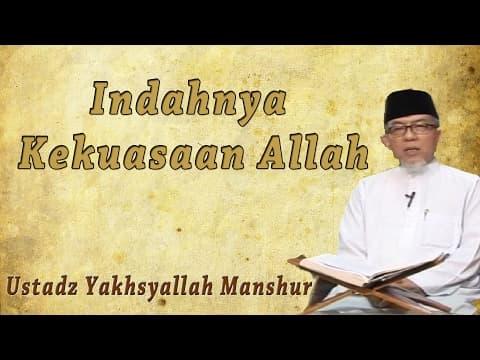
- again through our Thematic Tafsir study
- , where we will try to reflect on the
- word of Allah subhanahu wa ta'ala found
- in Surah Ali Imran, verse 26. Which
- speaks about the power of Allah
- subhanahu wa ta'ala, or a portion of
- the power of Allah subhanahu wa ta'ala.
- In this verse, Allah says, "I seek
- refuge in Allah from the accursed Satan
- .""Say, O Allah, Owner of Sovereignty,
- You give sovereignty to whom You will."
- "And You take sovereignty away from
- whom You will.""You honor whom You will
- .""And You humble whom You will. In
- Your hand is [all] good. Indeed, You
- are over all things competent." The
- meaning, more or less, is for the
- Prophet Muhammad sallallahu alaihi wa
- alihi wasallam to say: "O my Lord,""The
- One who possesses the kingdom or
- sovereignty.""You grant sovereignty or
- kingdom to those You desire,""and You
- remove sovereignty or kingdom from
- those You desire.""You exalt those You
- desire and You humble those You desire.
- ""In Your hands is all goodness.""
- Indeed, You are All-Powerful over all
- things." The word*mulk*or*al-mulku*,
- explained by Imam Al-Maraghi as*
- as-sultah*, or the authority to govern
- affairs. *Mulk*or power is mastery. Or
- the regulation of all things. Which in
- sociological terms, power is defined as
- the ability to influence other parties,
- so that they think and act in
- accordance with the will of the one
- directing or governing them. This is
- what is called power. Once again, the
- ability to direct or influence people
- to act and think in accordance with
- what is directed by the person in
- charge. If I am a family head, I am
- said to have power if I can direct all
- members of my family according to what
- I want, and my family follows it. If I
- am a school principal, I am capable of
- influencing all aspects within the
- school, especially, of course, the
- teachers, students, and other staff, in
- accordance with what I desire. That is
- what is called power. If I am a village
- head or a regional leader, I am capable
- of directing the people in that village
- or area in accordance with what I
- desire; that is what is called power.
- Brothers and sisters who are deeply
- loved by Allah subhanahu wa ta'ala.
- This verse, according to Imam Al-Wahidi
- , was revealed when the Messenger of
- Allah sallallahu alaihi wasallam
- successfully liberated the city of
- Makkah. In the tradition of Al-Wahidi,
- which is also cited by Imam Al-Baghawi
- from the companions Abdullah bin Abbas
- and Anas bin Malik, it is mentioned
- that when the Messenger of Allah
- sallallahu alaihi wasallam conquered
- Makkah, he promised his people the
- kingdoms of Persia and Rome. The
- hypocrites and the Jews said, "How
- impossible, how impossible! Where would
- Muhammad get the kingdoms of Persia and
- Rome?""They are mightier and more
- secure than that.""Is Makkah and Medina
- not enough for Muhammad, that he even
- aspires to the kingdoms of Persia and
- Rome?" Then Allah ta'ala revealed this
- verse. That is how Imam Wahidi in his
- book Asbabun Nuzul explains the reason
- for the revelation of this verse which
- roughly means that when the Prophet
- Muhammad, peace be upon him, succeeded
- in liberating the city of Makkah, I
- personally prefer to interpret 'fataha'
- as liberating rather than conquering.
- Because conquest is more political,
- while liberation is more sociological.
- This is according to my humble opinion.
- When the Prophet Muhammad, may Allah
- bless him and his family and grant them
- peace, succeeded in liberating Makkah,
- he promised the Muslims that the
- Persian and Roman empires would also be
- liberated. Then the hypocrites and the
- Jews said, "Hai hata, impossible,
- impossible for Muhammad to liberate, or
- in political terms, to conquer Persia
- and Rome. How could Muhammad liberate
- the Persian and Roman empires? What are
- his resources, so to speak? Who is he?
- And who are those Roman authorities?
- These two empires aazzu wa amna are
- stronger and more secure. If Makkah is
- small, so to speak, then it is natural
- that it could be conquered or liberated
- . But Persia and Rome were great
- empires, strong empires. This was at
- the time of the early development of
- Islam. Indeed, at that time there were
- two superpowers in the world,
- especially around the expansion of
- Islam, namely Persia and Rome. So when
- the Prophet Muhammad, peace be upon him
- , promised that we would be able to
- liberate Persia and Rome. The Jews and
- the hypocrites mocked it. Hai hata. Hai
- hata. Impossible. Impossible. Rome and
- Persia were strong and formidable
- empires. Then they stated," Are Makkah
- and Madinah not enough for Muhammad,
- peace be upon him, that he wants to
- control the Persian and Roman empires?
- "Then Allah revealed that verse which
- speaks about power. Where this verse is
- one of the verses that explains power.
- In this verse, Allah Subhanahu wa
- Ta'ala explains that it is Allah who is
- the true ruler. As mentioned in another
- verse in Surah Al-Mulk. Tabarokalladzi
- biyadhil mulku wahua ala kulliin qodir.
- The first verse of the 67th chapter
- which means blessed is He in whose hand
- is dominion, and He is over all things
- competent. Human power no matter how
- great, is only a loan. A loan from whom
- ? From Allah Subhanahu wa Ta'ala. And
- someone's ascent to become a ruler is
- only after recognition from others. So
- who is actually in power? The one who
- recognizes or the one recognized? Well,
- this is the relativity of human power.
- Like a king, he rules a kingdom.
- Because why? His people recognize him
- as king, or a president. He rules a
- country. Who is actually in power? The
- president or those who appointed him as
- president? Well, this is the relativity
- of human power. So the human power that
- exists on this earth is not real power.
- No matter how a king rules, no matter
- how a president rules, his power is
- merely a loan and recognition from
- those who gave him that power. The
- Dutch for example, and that power is
- not eternal. It is not eternal. I gave
- an example earlier of the Dutch, a
- small nation that was able to control
- Indonesia, or the archipelago, for 350
- years. And they felt that their power
- would be eternal, to the point of
- inscribing on their official currency a
- slogan that read" Je Maintiendrai. "
- What does it mean? This is ancient
- Roman or Greek, meaning" I will not let
- go. "Meaning the Dutch power over this
- archipelago would never be relinquished
- . Yet what happened when Japan arrived?
- The power that had lasted 350 years
- finally crumbled in just a week, 7 days
- . And after those 7 days, they tried to
- maintain that power. They were unable
- to. Then they surrendered, bowing down
- before Japan. This is human power. So
- human power, no matter how great, is
- merely borrowed and will not last.
- Whereas the power of Allah is almighty.
- Allah is powerful not because He was
- appointed. Allah is powerful not
- because there is an acknowledgment of
- power. Even if all creatures on the
- face of this earth rejected Allah's
- power, refused to acknowledge Allah's
- power, Allah remains powerful. Now,
- this is the difference from human power
- , and His nature is eternal,
- everlasting, infinite, not limited by
- space and time. Brothers and sisters, I
- hope we can realize this. Whatever
- power we possess is merely a loan from
- Allah. an acknowledgment from those we
- want to control, and it is not
- permanent. Therefore, in this verse,
- Allah teaches humans with expressions
- full of reverence about power. Judging
- from the words of this verse, this
- verse has the nuance of a prayer."
- Qulillahumma malikal mulki tutil mulka
- ... "until the end of the verse. In
- terms of meaning, it is a form of hope.
- In terms of content, it is a subtle
- touch to human feelings so as not to be
- ambitious towards power. Because that
- power belongs to Allah Subhanahu wa
- ta'ala. As the Prophet Muhammad SAW was
- reminded, in quotes, not to be overly
- ambitious to liberate Persia and Rome.
- Finally, he was commanded by Allah just
- to pray." Qulillahumma malikal mulki
- tutil mulka man tasya watanziul mulka
- mimman tasya. "Even when a companion,
- Abu Dharr, wanted to be given power by
- the Prophet, he said," Do not, Abu
- Dharr, power is heavy. "It is a regret
- later in the hereafter. Except for
- those who can use it as well as
- possible to seek the pleasure of Allah
- Subhanahu wa ta'ala. From the
- perspective of universal signs, this
- verse shows how great the power of
- Allah Subhanahu wa ta'ala is in
- managing this universe. Humans are only
- a small part of the vast universe that
- is controlled and regulated by Allah
- Subhanahu wa ta'ala. When interpreting
- this verse, Imam or Sheikh Ahmad
- Mustafa Al-Maraghi mentions that this
- verse is a consolation for the Prophet
- Muhammad SAW in facing those who oppose
- Islam, as well as a reminder for him of
- the power of Allah Subhanahu wa ta'ala,
- who is able to help His religion and
- exalt His word. And indeed, it was true
- that eventually, Persia and Rome were
- liberated. When was Persia liberated?
- During the time of Umar bin Khattab.
- Ultimately, Umar bin Khattab became a
- person who was greatly detested by
- people of Persian descent. Because it
- was during his caliphate that the
- massive Persian empire was finally
- shattered and destroyed. Then the Roman
- empire was razed several hundred years
- later during the time of Muhammad
- Al-Fatih, where in a narration by Imam
- Ahmad, the Messenger of Allah (peace be
- upon him) once gave a prophecy:"
- tuftahanna al-qustantiniyyah, fa ni'mal
- jayshu jayshuha, wa ni'mal amiru
- amiruha. "Truly, Constantinople, the
- capital of the Roman empire, will be
- liberated; and the best army is that
- which liberates it, and the best leader
- is the leader who liberates
- Constantinople. So this is it, brothers
- and sisters who are beloved by Allah
- Subhanahu wa ta'ala. Muhammad Ramadan
- Al-Bouti, who is, God willing, a martyr
- in this Syrian crisis. When he
- explained this verse, he stated that
- the Prophet Muhammad (peace and
- blessings be upon him and his family)
- did not struggle to achieve power. to
- reach the highest position as a ruler
- or king. And this is proven by famous
- and, God willing, strong narrations
- mentioned in history books, among
- others, Ibn Hisham narrated this
- account. Then Ibn Ishaq also narrated
- that Utbah bin Rabiah, one of the
- scholars of the Quraysh infidels, once
- came to the Prophet Muhammad (peace be
- upon him) to ask him to stop his
- preaching while saying to the Messenger
- of Allah (peace be upon him). O son of
- my brother, if your objective in
- preaching is to gain wealth, we will
- collect our wealth for you so that you
- become the richest among us. If you
- desire honor and glory, we will appoint
- you as our leader and we will not
- decide on any matter without your
- approval. If you wish to be a king, if
- you wish to be a ruler, we are willing
- to crown you as our king. If you are
- unable to ward off the jinn that have
- entered you—because they insulted the
- Messenger of Allah (peace be upon him),
- claiming his appointment as a prophet
- and messenger by Allah was due to being
- possessed by jinn. If you truly cannot
- ward off the jinn that have possessed
- you, we are willing to find a healer to
- cure you, regardless of the cost, until
- you are recovered. What? The Messenger
- of Allah (peace be upon him) replied.
- When he heard what was conveyed by
- Utbah bin Rabiah, he answered," In
- short, I do not need anything you are
- offering. "No. I do not preach out of a
- desire for wealth. Not out of a desire
- for honor, not out of a desire for
- power, but Allah sent me as a messenger
- . He revealed the Book to me and
- commanded me to be a bearer of glad
- tidings and a warner. It is clear here
- that the goal of the Prophet Muhammad's
- (peace be upon him) preaching was not
- to seek power. He did not want to use
- power to establish his message. He only
- carried out the commands of Allah
- Subhanahu wa ta'ala. He did not want to
- force people to enter the religion of
- Islam. He did not want to take power
- first. And after that, force people to
- enter Islam. No. Because coercion in
- religion is indeed not permitted. La
- ikraha fiddin qad tabayyanar rushdu
- minal ghay. Famay yakfur bit-taghuti wa
- yu'min billahi faqad istamsaka
- bil-urwatil wuthqa lan fisama laha.
- Wallahu sami'un 'alim. Which means
- there is no compulsion to enter the
- religion of Islam. Indeed, the right
- path has become clear from the path of
- error. Therefore, whoever rejects false
- idols and believes in Allah has grasped
- the most trustworthy handhold that will
- never break. So, this is the goal of
- his preaching, seeking the pleasure of
- Allah Subhanahu wa ta'ala. Now, what if
- that power is then granted to him? That
- was the prayer Qulillahumma malikal
- mulki tu'til mulka man tasya' until the
- end of the verse. Power is not the goal
- , but it is a gift from Allah Subhanahu
- wa ta'ala to be used. To seek the
- pleasure of Allah as well. Now, how can
- the Muslim community be granted power
- by Allah Subhanahu wa ta'ala? In Surah
- An-Nur verse 55. When Allah explains
- power, which is referred to there by
- the term Khilafah. Lastakhlifannahum
- fil ard. Although not every Khilafah
- can be precisely translated as power.
- Now, Allah Subhanahu wa ta'ala explains
- how we may be granted Khilafah by Allah
- Subhanahu wa ta'ala so we can govern
- humans according to Allah's commands.
- In verse 56, Allah explains:
- A'udzubillahi minasyaitanirrajim, wa
- aqimush-shalata wa atuz-zakata wa
- ati'ur-rasula la'allakum turhamun.
- Which means. Establish prayer, pay
- Zakat. Obey the Messenger, that is
- correct. So that you all may be shown
- mercy by Allah Subhanahu wa ta'ala. So.
- In order for us to be granted power by
- Allah Subhanahu wa ta'ala, the path we
- take includes three things. We perform
- prayer well, we pay Zakat, and we obey
- the Messenger of Allah, peace be upon
- him. Then, we will be shown mercy by
- Allah Subhanahu wa ta'ala and we will
- then be granted power by Allah
- Subhanahu wa ta'ala. Brothers and
- sisters, what happens when the Muslim
- community is granted power by Allah
- Subhanahu wa ta'ala? God willing, we
- will explain it after the following
- story.