Transkrip diambil dari YouTube. Klik timestamp biru untuk melompat ke posisi tersebut di pemutar.
- In the name of Allah, the Most Gracious
- , the Most Merciful. May the peace,
- mercy, and blessings of Allah be upon
- you. O Lord, increase me in knowledge;
- O Allah, benefit me with what You have
- taught me and grant me beneficial
- knowledge. Still broadcasting from
- Jalan Masjid Silaturahim number 36,
- Kalimanggis, Jatisampurna, Bekasi. This
- is Radio Silaturahim and Rasil TV for
- our brothers and sisters in Islam. I am
- Khalid Mustofa, very happy to accompany
- you in the "Sirah Sahabat"(Companions '
- Biographies) program. As usual, on this
- Monday, December 18, 2017, which
- coincides with the 30th of Rabiul Awal
- 1439 Hijriah. And as usual, the Sirah
- Sahabat program will be led by our
- teacher, Ustaz Komaruddin Basuni. And
- alhamdulillah, the Ustaz is already
- here with us. May the peace, mercy, and
- blessings of Allah be upon you, Ustaz.
- And may the peace, mercy, and blessings
- of Allah be upon you.
- How are you doing this morning, Ustaz?
- Alhamdulillah. Good.
- Alhamdulillah. Was the trip smooth,
- Ustaz?
- It was smooth. Alhamdulillah.
- Alright, brothers and sisters, let's
- listen together to the presentation
- that will be delivered by Ustaz
- Komaruddin Basuni in this edition of
- Sirah Sahabat, about the companion Abu
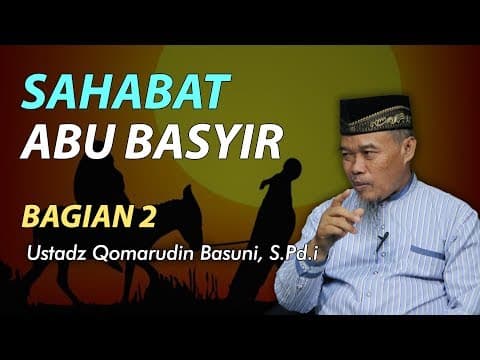
- Basir. Who is he? Let's listen. Please,
- Ustaz.
- In the name of Allah, the Most Gracious
- , the Most Merciful. May the peace,
- mercy, and blessings of Allah be upon
- you. All praise is due to Allah; we
- praise Him, seek His help, and ask for
- His forgiveness. Whomever Allah guides,
- none can misguide; and whomever He
- leaves astray, none can guide. I bear
- witness that there is no god but Allah
- alone, with no partner, and I bear
- witness that Muhammad is His servant
- and messenger. To proceed. Listeners of
- Radio Silaturahim and viewers of Rasil
- TV. Alhamdulillah, on this bright
- morning, we return to study the
- biography of a companion, and God
- willing, today we will share the life
- of a companion of the Prophet named Abu
- Basir. Abu Basir was a young figure
- from the Quraysh tribe whose Islam in
- the city of Mecca was obstructed by
- circumstances beyond his control.
- However, an event occurred that
- provided him with an opportunity to be
- with the Prophet, namely the event of
- Hudaibiyah. Because the event of
- Hudaibiyah was witnessed by many people
- , both from the Quraysh group and from
- the side of Prophet Muhammad, may the
- peace and blessings of Allah be upon
- him. After the treaty was signed, it
- was announced to all those present.
- Whoever wishes to join the Medina side,
- please join, and whoever wishes to join
- the Quraysh side, please join. So this
- opportunity gave the companions, who
- previously wanted to leave Mecca but
- were blocked and guarded, a chance. Now
- , it was as if there was an opportunity
- because the Treaty of Hudaibiyah had
- been agreed upon. And among other
- things, it was announced openly there
- because it was witnessed at a place we
- know as Saniatul Wada, which is also
- often referred to as the Treaty of
- Hudaibiyah. At that place, the Prophet,
- with his 1,400 companions, was present.
- From the Quraysh side, there were also
- many, represented by a figure named
- Suhail
- bin Amr. We previously spoke about the
- son of Suhail, namely Abu Jandal bin
- Suhail.
- Now, about Abu Jandal.
- Yes. Now, there is a name that sounds
- slightly similar. Not Abu Jandal, but
- Abu Basir. So, we will now tell the
- story of Abu Basir. Now, when we talk
- about Abu Basir, it's always synonymous
- with Abu Jandal. Why? Because these two
- characters are very similar. Two young
- men with strong desires, but they were
- hindered or constrained by things they
- faced within their own families, namely
- their parents. Abu Jandal couldn't be
- free because his parents were so strict
- . The same goes for Abu Basir. Abu
- Basir, well, his people were even
- stricter. Now, let's return to this Abu
- Basir. Now, as soon as the Prophet
- returned from the Treaty of Hudaybiyyah
- to Medina, Abu Basir happily he was
- determined to follow. However, when the
- Prophet left, perhaps something
- prevented him, so he couldn't go
- together. So he followed later. Now, as
- soon as he arrived in Medina, in short,
- he immediately said, "O Messenger of
- Allah, I am joining here." The Prophet
- said briefly, "It's a pity, but we have
- already made a treaty which states that
- we must fulfill the terms of the
- agreement. If anyone from Mecca comes
- to Medina, we must return them." It's
- just not possible. In our common
- language, there was already an
- announcement back there, right? Even
- back then, when it was announced,
- Sohail saw his son join and demanded he
- be returned. Meaning at that moment, at
- that very minute, whoever wanted to
- join was welcome to. Or his son who was
- recording the treaty administration
- joined the Prophet's side; he had to be
- pulled back according to the treaty.
- Now, we share this too. While they were
- talking, two envoys arrived from Mecca
- to convey, "O Messenger of Allah,
- according to the treaty, if anyone from
- Mecca comes to Medina, they must be
- returned." The Prophet said to Abu
- Basir, "See, those people have come to
- pick you up." Abu Basir said, "No, I
- don't want to. I don't want to." The
- Prophet said, "Yes, Abu Basir, I have
- made a treaty, so I will not betray the
- agreement." Abu Basir explained his
- reasons, "I will be tortured
- continuously." He was tortured every
- day, being forced to return to apostasy
- . I don't want that. The Prophet said,
- "Seek help from Allah." Yes, but now
- because they have come to fetch you,
- you must go. Reluctantly, Abu Basir was
- escorted by the two Quraysh men to
- return to Mecca. How would a person
- fleeing feel, right? In today's terms,
- it's like escaping from prison. But
- this prison was the Quraysh prison. He
- fled to Medina and was pursued; where
- else could he run? If not to the
- Prophet, surely nowhere else. In the
- end, the Prophet sincerely returned
- them. But the Prophet advised him to
- seek refuge in Allah and to be patient.
- But his heart remained troubled. If I
- go back now, I will definitely be
- tortured. Oh, abused and insulted. He
- could already imagine the days he would
- face back in Mecca like that. Now, he
- is being escorted by the young Quraysh
- leaders to return home. Well, at a
- place they deemed safe, they said, "Bro
- , let's take a break. I'm tired. We
- have some supplies here. Let's eat
- first. To relieve the exhaustion and
- fatigue. The three of them sat down.
- Now, while sitting and resting,
- enjoying the food and drink they
- brought as travel supplies. Abu Basir
- looked on and said, in simple terms,"
- Wow, that's an amazing sword. So sharp.
- "Oh, certainly. I've tried it many
- times. Maybe if we were saying it,
- don't mess with me. I've already tested
- this. Abu Basir said," Wow, it's really
- good. In that case, may I see it? "Yes,
- of course. So, there was no suspicion,
- nothing, because Abu Basir was now
- considered part of their group of three
- . Done. Now, as soon as the sword was
- handed to Abu Basir, he stared at it.
- It still looked good. Wow, this is my
- chance. I'll just finish him off, and
- he attacked. He immediately stabbed the
- one who gave him the sword. The other
- one was watching. Wow, as soon as he
- was struck, blood was spilled. Finally,
- he ran away while being chased. Now,
- where did he run to? Towards Medina.
- For what purpose was his friend running
- ? To ask for protection from the
- Prophet. I can imagine how someone in a
- state of fear is being chased while the
- chaser carries a sword. Wow, he looked
- more terrified than a chicken chased by
- its defeated companion." Putat petot, "
- as the Sundanese say. Running here and
- there.
- In a panic. Not long after, the Prophet
- was in the mosque. Entering the mosque,
- what happened?" Abu Basir killed my
- companion. He is even trying to kill me
- now, too. "Abu Basir said," I'll finish
- them both off at once. "" Hey, Abu
- Basir. The Prophet said, "You have
- caused another problem here. No
- mother's son who sparks the fire of
- conflict will avoid the consequences."
- What does that mean? He was subtly
- rebuked by the Prophet as the son of a
- mother. Meaning, he is fanning the
- flames of war. He already killed
- someone. Wow. "Come here, you. Be
- obedient, come here." Hey Basir,
- regardless, even if you want to stay, I
- will not allow you to stay here
- because of this.
- Yes. Basically, there is no place for
- you in Medina. It's up to you where you
- want to go. Then this person was
- secured, and he was told to leave.
- The one who was chased.
- The one who was chased returned home.
- Now Abu Basir, Abu Basir thought, there
- is no place in Medina.
- Where do I go? Going back to Mecca, he
- thought, is definitely out. If I'm not
- abused, I'll be tortured. Now, he
- observed the Prophet's attitude. He
- said, the Prophet...He said, "Go ahead,
- as long as it's not in Medina.""I don't
- want to go to Mecca.""Well, if I have
- to put it in my own words, I'll just
- wander about aimlessly.""The important
- thing is that I'm alive." As it turns
- out, he set off and said his goodbyes
- to the Prophet. "I'm taking my leave.""
- Yes, go ahead.""The main thing is, you
- cannot stay in Medina." After saying
- his goodbyes, where did he go? Toward
- the direction of the Red Sea coast.
- It’s west of Medina. So, he started
- walking. He was quite the wanderer,
- that man.
- It turns out he knew of a specific
- place where the Meccan caravans often
- passed. If they were trading toward the
- Levant, they had to pass through there.
- Wow.
- What is the name of that place, Ustadz?
- Finally, he found it; it was called the
- Valley of Al-Is.
- The Valley of Al-Is. He stayed in that
- place. The news of Abu Basir's presence
- and his disappearance from Medina
- reached Meccan intelligence. In our
- terms, it was getting serious. Isn't it
- dangerous? If this guy is wandering
- around like that, it's trouble.
- It turns out this information was
- intercepted by the Muslims who were
- imprisoned and oppressed by the Quraysh
- . They wanted to join up with those in
- Medina. But they couldn't, because of
- the Treaty of Hudaybiyyah. In the end,
- they gathered with Abu Basir, including
- Suhail's son, Abu Jandal.
- Ah.
- Abu Jandal joined them there. They were
- companions, weren't they?
- Separated for a while, then reunited.
- Then the news spread to other Muslims.
- Eventually, they joined up until they
- reached about 40 people. In one account
- , it was even nearly 80 people. So, the
- Meccans who were oppressed and
- humiliated, who wanted to move to
- Medina, had a roadblock. Finally, they
- converged in the Valley of Al-Is. In
- the Valley of Al-Is, they formed a
- strategy. What was the strategy? Anyone
- passing through that area, especially
- the Quraysh, hit them. If a group was
- returning from trade, they'd attack.
- They'd be terrified, leave their goods,
- and run for their lives. If others were
- heading out to trade, they'd be chased
- down. They’d run for it; it was
- non-stop. Sometimes, some of them would
- dare to fight back. Then a skirmish
- would break out. The Abu Basir group
- never gave up. He wanted to show the
- Quraysh leaders something. "I now have
- my own territory.""If you dare to pass,
- be ready to face me." It was as if Abu
- Basir was challenging them. "Tell the
- Quraysh leaders.""I am ready here,
- waiting for you." Oh my. Eventually,
- the Quraysh leaders, who thought the
- Treaty of Hudaybiyyah would bring them
- great profit...What actually happened?
- In reality, they suffered many losses
- because of this unexpected force, the
- troops of Abu Basir. After all that,
- the Quraysh leaders...had to rethink
- everything. How should I do it? They
- already wrote a letter to the Prophet.
- They wrote a letter to the Prophet
- asking for Abu Basir's group to be
- recalled. And not be in that place. It
- was presented to the Prophet. Aha. As
- soon as the Prophet read the letter, He
- sent someone with a reply. Abu Basir
- and his companions, you may now return
- to Medina. I welcome your arrival.
- Coming back.
- Yes. Finally, the messenger arrived.
- Upon arrival, it turned out Abu Basir
- was being swarmed by people—well, not
- swarmed, gathered around. Then the
- messenger said, "There is a letter from
- the Messenger of Allah for you and the
- others." As soon as Abu Basir heard
- that, he asked, "Is the Messenger of
- Allah pleased with me?" Meaning my
- position, my current state being here.
- I want to ask, is the Messenger pleased
- with me? The messenger said if the
- Messenger of Allah weren't pleased, it
- wouldn't be possible
- to be accepted. To return
- accepting you back to deliver this
- letter. The one asked remained silent
- as well. He asked again, "Is the
- Messenger of Allah pleased with me?"
- Yes, the Messenger is pleased with you.
- As soon as he answered, "The Messenger
- of Allah is pleased," he said, "Please
- convey my greetings to the Messenger."
- That was his final sentence. When he
- said, "Convey my greetings to the
- Messenger." Abu Basir passed away.
- So he didn't have a chance to return to
- Medina.
- He didn't make it to Medina. Just think
- , this is what is mentioned in history,
- there are people whose time in Islam is
- short, only a few moments, not even
- years. Then they are called by Allah in
- a state of husnul khatimah.
- Mashallah.
- Mashallah. That was Abu Basir.
- Now, while his other companions all
- moved to Medina, including Abu Jandal
- and others. They were then given a
- place by the Prophet as spacious as
- possible. And finally, these remnants
- of Abu Basir's group were able to lead
- great armies after the Prophet passed
- away, during the time of the Rightly
- Guided Caliphs.
- That is all, and praise be to Allah.
- Peace be upon you, and Allah's mercy
- and blessings.