Transkrip diambil dari YouTube. Klik timestamp biru untuk melompat ke posisi tersebut di pemutar.
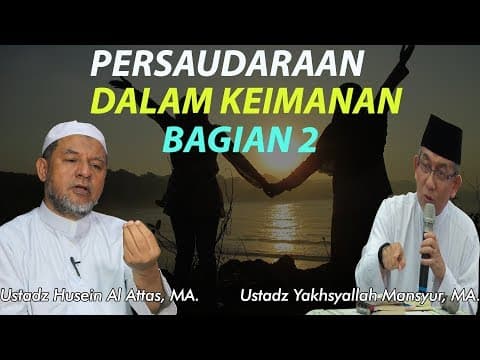
0:52 H In the name of Allah, the Most 1:06 Gracious, the Most Merciful. Peace be 1:07 upon you, and Allah's mercy and 1:09 blessings. Praise be to Allah, Lord of 1:11 the worlds. O Allah, send prayers and 1:13 blessings upon our master Muhammad and 1:15 upon his family. Brothers and sisters 1:18 who are blessed by Allah the Almighty. 1:20 How are you doing this afternoon? I 1:23 hope you are in good health and always 1:25 under the protection of Allah the 1:27 Almighty. This afternoon, brothers and 1:32 sisters, we meet again for the thematic 1:35 Tafsir study with Imam Yaksullah Mansur 1:38 , edition of 23 Safar 1444 Hijriah, 17 1:41 September 2022, with the theme: the 1:44 urgency of Islamic brotherhood. Praise 1:49 be to Allah, he is here with us now. 1:52 Peace be upon you, and Allah's mercy 1:53 and blessings, Imam. 1:54 And unto you be peace, and Allah's 1:55 mercy and blessings. 1:56 Are you well, Imam? I am well. I hope 2:00 all Silaturahim TV viewers and 2:03 Silaturahim radio listeners are in good 2:06 health, just as we feel this afternoon. 2:10 Very well, Imam. Thank you. Let us 2:12 begin, Imam, with our discussion this 2:14 afternoon. Please, Imam. 2:16 Peace be upon you, and Allah's mercy 2:19 and blessings. Indeed, all praise is 2:25 due to Allah, we praise Him, we seek 2:27 His help, we seek His forgiveness, and 2:30 we take refuge in Allah from the evils 2:32 of our souls and the consequences of 2:35 our deeds; whoever Allah guides, none 2:37 can misguide, and whoever He leads 2:40 astray, none can guide. I bear witness 2:46 that there is no god but Allah alone, 2:48 with no partner. And I bear witness 2:52 that Muhammad is His servant and 2:54 messenger. What Allah wills happens, 2:59 and what He does not will, does not 3:01 happen; there is no power nor strength 3:04 except by Allah, the Almighty, the 3:07 Great. To proceed. Brothers and sisters 3:12 , who are deeply loved by Allah the 3:15 Almighty. Praise be to Allah, this 3:20 afternoon we can meet heart-to-heart 3:25 again at this Radio and TV Silaturahim 3:31 that we cherish so much. Today, let us 3:39 reflect on the word of Allah the 3:42 Almighty, which I hope you have 3:45 memorized, or at least have often heard 3:49 this verse. It is the 10th verse found 3:58 in Surah Al-Hujurat, which we titled " 4:04 The Urgency of Islamic Brotherhood." In 4:12 this verse, Allah the Almighty says, 4:14 seeking refuge in Allah from the 4:16 accursed Satan. In the name of Allah, 4:19 the Most Gracious, the Most Merciful. " 4:22 The believers are but brothers, so make 4:25 settlement between your brothers and 4:28 fear Allah that you may receive mercy." 4:35 Which means, indeed, the believers are 4:39 nothing but brothers. Therefore, make 4:46 peace between your two brothers and 4:53 fear Allah so that you may receive 5:00 mercy. The content of this verse is so 5:05 beautiful and profound, with such 5:09 beautiful words as well. So it feels 5:16 impossible for us to understand it 5:19 integrally or completely. Therefore, 5:26 the humble servant can only explain it 5:30 to myself in particular, and hopefully 5:34 for the brothers and sisters, the 5:37 listeners and viewers of Radio and TV 5:41 Silaturahim, in a simple way. The verse 5:48 contained in Surah Al-Hujurat explains 5:50 that when faith has grown in people's 5:59 hearts, there will be no hostility 6:05 between them. Because, in essence, 6:13 believers are brothers. "Brother" in 6:22 Arabic is "akh," which originally means 6:30 equality and harmony in many aspects. 6:40 That is the original meaning of "akh," 6:43 which then became the meaning of 6:46 brother. Therefore, equality in lineage 6:54 , equality in character, and equality 7:01 in belief will result in brotherhood, 7:06 or "ukhuwah" in Arabic. The word "akh" 7:16 in the Quran has two plural forms. The 7:24 first is "ikhwan," mentioned 7:27 approximately 22 times in the Quran. It 7:34 is usually used for brotherhood in the 7:38 sense of being non-biological. For 7:44 example in Surah at-Taubah, the 9th 7:51 surah, verse 11, Allah states I seek 7:57 refuge in Allah from the accursed Satan 7:59 . Fain tabu wa aqomus shalah wa 8:04 atuzzakata fa ikhwanukum fiddin which 8:16 means if they repent and perform prayer 8:26 and pay zakat, then they are your 8:31 brothers in religion. And we explain 8:39 our signs for a people who know. Pay 8:47 attention to the reading of "atawu". 8:51 Because in the Quran, there are two 8:54 forms of writing like this. The first 9:00 is "atu", which appears frequently. 9:04 Then the second is "atawu", which is 9:06 rare, including the one in Surah 9:08 at-Taubah we are reading. So it is "wa 9:13 atawuzzakata" not "wa atuz zakata". 9:19 What is the difference? "Atu" is a 9:22 command verb (fi'il amr). "Atawu" is a 9:27 past tense verb (fi'il madhi). So, this 9:34 is the plural form of the word "akh" in 9:38 the Quran. The first is "ikhwan". This 9:45 one appears frequently. Then the second 9:48 is "ikhwah". So the plurals of "akh" 9:52 are, first "ikhwan", and second is " 9:58 ikhwah". Now, "ikhwah" is used to mean 10:05 biological siblings. Like the word of 10:11 Allah in matters of inheritance, the 10:16 word "ikhwah" is usually used. Likewise 10:21 , we see in Surah Yusuf, verse 7. Surah 10:28 Yusuf is the 12th surah. Allah states, 10:32 I seek refuge in Allah from the 10:34 accursed Satan. Laqod kana fi yusufa wa 10:39 ikhwatihi ayatul lis-sailin. Which 10:47 means, indeed, there are signs of 10:52 Allah's power in the story of Yusuf and 10:57 his brothers for those who ask. 11 11:04 brothers of Prophet Yusuf, 12 with him. 11:10 From whose lineage? From Prophet Yaqub 11:14 (Jacob), peace be upon him. From at 11:17 least two wives. Yaqub. This is the 11:22 other name for Israel. So the 12 sons 11:27 of Yaqub, one of whom is Yusuf, peace 11:30 be upon him, are called the Children of 11:33 Israel (Bani Israel). The word "ikhwah" 11:40 , the plural of "akh" mentioned earlier 11:44 , is used seven times in the Quran. All 11:51 of them are used to mean biological 11:56 siblings except for one verse, namely 12:02 in Surah Al-Hujurat which we are 12:06 contemplating right now. Verse 10, the 12:10 one above it that we already read. Now, 12:15 in this verse, the word "ikhwah" which 12:19 is always used for non-biological 12:23 brotherhood is used. Even though 12:32 everywhere else, other than in this 12:35 sentence, the word "ikhwah" is always 12:38 used for biological ones. Because the 12:42 believers are indeed not biologically 12:45 related. Even if they are distantly 12:50 related back to Prophet Adam, usually " 12:53 lineage" refers to immediate parents. 12:57 Now, the reality is that these 12:59 believers are not just from one father 13:04 in the immediate sense, but from 13:06 several fathers. Yet Allah Subhanahu wa 13:12 ta'ala uses the word "ikhwah" in 13:15 describing the brotherhood of believers 13:18 . Innamal mu'minuna ikhwah. Indeed, the 13:25 believers are brothers. It should be 13:29 that way because the reality is that 13:32 believers don't share one father. One 13:34 immediate father, I mean, not tracing 13:36 back to Prophet Adam. It should have 13:40 used the word "ikhwan" as before, but 13:43 Allah used the word "ikhwah". This 13:49 becomes a sign for the believers that 13:54 their bond, the bond among believing 13:59 Muslims, is forged by two things. The 14:06 first is forged by faith as indicated 14:10 by "innamal mu'minuna ikhwah." And the 14:16 second is as if forged by kinship, as 14:21 indicated by the word "ikhwah." So 14:27 there is no reason that causes the bond 14:34 or brotherhood among Muslims or among 14:39 believers to crack or even lead to 14:44 hostility. Why? Because their creed is 14:52 one, namely faith; they all believe in 14:56 Allah Subhanahu wa Ta'ala, and they are 15:00 as if one lineage, described by the 15:04 word "ikhwah." So, maasya Allah, 15:10 believers should never have any 15:14 hostility among them. What should exist 15:20 is brotherhood and commonality. Now, 15:24 brothers and sisters who are very much 15:28 loved by Allah Subhanahu wa Ta'ala, in 15:31 order to strengthen the brotherhood 15:34 among Muslims, the Islamic religion is 15:40 built upon factors that unify or 15:45 factors of commonality. What are some 15:50 of them? Said Hawa in his book, 15:56 Al-Islam, mentions there are seven 16:00 commonalities in Islam. The first is 16:05 the commonality of creed. So every 16:10 Muslim has a common creed based on the 16:15 shahada. Ashadu alla ilaha illallah wa 16:21 ashadu anna Muhammadar Rasulullah. 16:26 Everyone's shahada in Islam is the same 16:29 . There is no difference. Once again, 16:35 the shahada of Muslims everywhere is 16:39 the same, namely ashadu alla ilaha 16:43 illallah wa ashadu anna Muhammadar 16:48 Rasulullah. That is one, the 16:51 commonality of creed. The second is the 16:56 commonality of worship. The acts of 17:02 worship of Muslims are built with the 17:08 same procedures. Prayer five times a 17:16 day is the same for all Muslims. Zakat 17:22 is the same in its measurements. Then 17:28 Hajj is the same, all heading to one 17:32 place, one point, namely Makkah 17:35 al-Mukarramah. Fasting in Ramadan. It 17:41 is also the same. When? During the 17:45 month of Ramadan. Even if there are 17:50 differences, those differences are 17:53 called "furu '" which will not affect 17:56 the validity of our worship. For 18:02 example, prayer indeed there are some 18:07 differences, but the principles and 18:09 foundations are the same. For example, 18:13 the Takbir is all the same. Allahu 18:17 Akbar. The greeting is the same, 18:21 Assalamu'alaikum. Some add " 18:25 warahmatullah," some complete it with " 18:28 wabarakatuh." Even if there is a 18:32 difference, it happens in the second 18:34 greeting. Scholars state that the first 18:39 greeting is mandatory, the second is 18:42 sunnah. Ruku is the same for everyone. 18:49 The position, the procedure. Perhaps 18:54 only the dhikr used might differ. 18:59 I'tidal is the same, only the method 19:02 might possibly differ. Some return to 19:06 folding hands, some release them, both 19:09 are valid. Some recite "Sami'allahu 19:14 liman hamidah" or other dhikr, it is 19:16 the same. Now, this is it, brothers. 19:22 Likewise with Hajj, everyone is at one 19:25 point, the Kaaba, even if the prayers 19:28 might differ and so on. Likewise with 19:34 the month of Ramadan, although the 19:36 method of determining it sometimes 19:39 differs, because the determination is 19:41 different, the timing eventually 19:44 differs, but it is still within the 19:46 month of Ramadan. So this is the second 19:50 one. The commonality of worship. 19:56 Therefore, if there are minor 19:58 differences in worship, we do not need 20:01 to escalate them. For example, Subh 20:06 prayer is everywhere two raka'at. As 20:10 for whether one recites Qunut or not, 20:13 well, all are valid. Reciting Fatihah 20:19 everyone recites it. Only some recite 20:24 the Basmalah aloud. Some recite the 20:30 basmalah softly. Some even do not 20:34 recite the basmalah at all. Because 20:38 scholars indeed differ on whether the 20:40 basmalah is part of Surah al-Fatihah or 20:43 just a marker. A separator between 20:48 surahs, starting from alhamdulillah 20:51 until the final waladolin amin and so 20:54 on. This is the second commonality. The 21:00 third commonality, the commonality of 21:02 the role model. Every Muslim everywhere 21:08 has only one role model, who is the 21:13 uswah? The Prophet Muhammad sallallahu 21:18 alaihi wa alihi wasallam, as Allah 21:21 states: "laqad kana lakum fi 21:23 rasulillahi uswatun hasanah" to the end 21:26 of the verse. So, the one we take as a 21:32 role model is only one, who is it? The 21:35 Prophet Muhammad sallallahu alaihi 21:36 wasallam. This makes it easier for us 21:40 to carry out the sharia because why? 21:43 The role model is one. Now, because the 21:47 one we emulate is one, whatever comes 21:49 from the Prophet Muhammad sallallahu 21:52 alaihi wasallam must be true. Even if 21:56 perhaps in one matter, there are two 22:01 things he did, as long as it comes from 22:04 the Prophet. It is true. And we follow 22:08 it, except for matters that were 22:11 specific to him. For example, marrying 22:16 more than four, and so on. Then the 22:20 fourth, the commonality of history. The 22:26 Muslim ummah is formed by, the same 22:32 historical roots. Not formed by ties of 22:39 homeland, national ties, or language 22:46 ties, but by the commonality of the 22:49 Prophet’s and the prophets' da'wah. 22:55 Every Muslim has a historical bond with 22:57 Prophet Adam, with Prophet Nuh, with 23:03 Prophet Musa, with Prophet Isa, with 23:06 Prophet Muhammad sallallahu alaihi 23:09 wasallam, and those who believe and 23:12 follow them. Even though Prophet 23:17 Muhammad, not just because he was an 23:19 Arab, but those who follow are Arabs 23:22 and non-Arabs. As long as he is a 23:26 Muslim, that includes Prophet Isa Alaih 23:28 Salam. Even though he was from the 23:32 nation of Israel, as long as his sharia 23:36 was not abrogated, Muslims today follow 23:42 him and everyone knows who Prophet Isa 23:45 Alaih Salam is, who Prophet Musa Alaih 23:48 Salam is. Even though he is not from 23:52 one nation. For example, we as the 23:56 Indonesian nation, but we know who 23:58 Prophet Musa is. And so on. So this 24:03 commonality in history is what unites 24:07 us, the Muslim ummah. Then the fifth, 24:11 the commonality of guidance. The entire 24:15 Muslim ummah has the same guidance. 24:17 What is it? The Quran and the Sunnah. 24:23 So wherever Muslims are, as long as it 24:28 comes from the Quran and the Sunnah, 24:33 they follow it. Thus, the rules are the 24:39 same because the Quran is one, and the 24:42 sunnah is one, which comes from the 24:44 Prophet Muhammad sallallahu alaihi 24:46 wasallam. If there were any differences 24:52 , they are only differences in 24:54 perspective or ijtihad, but the verse 24:58 is one, and as mentioned before, the 25:02 uswah is one. Both come from one verse, 25:08 for example, regarding touching the 25:11 Quran. Must one be pure or not? The 25:17 verse is the same. La yamassuhu illal 25:20 mutahaharun. Those who mandate 25:25 purification use that verse from Surah 25:28 Al-Waqi'ah, and those who do not, use 25:31 the same verse; it is just a matter of 25:35 perspective. At the very least, in the 25:41 sentence "la yamassuhu illal 25:43 mutahaharun", there are two things that 25:46 differentiate. First, the pronoun "hu"" 25:51 does not touch it," the Quran, right? 25:55 Is this the Quran in the Lauhil Mahfuz 25:57 or the Quran in the form of a mushaf? 26:01 Then "mutahaharun". Who is meant by " 26:03 mutahaharun" here? Are the angels 26:07 purified from sin, or are Muslims 26:10 purified from major and minor 26:13 impurities, guided by the same 26:16 principle? La yamassuhu illal 26:20 mutahaharun. Well, that is also the 26:25 case in the hadith. If there happen to 26:29 be different understandings, that is a 26:31 matter of perspective or ijtihad. Then 26:35 the sixth, the similarity of manhaj, 26:39 which is the path. All Muslims are 26:44 asked for only one thing, namely 26:46 siratal mustaqim. The straight path, 26:52 the path of the prophets, the path of 26:55 the righteous people who follow them. 26:59 This is what all Muslims ask for in 27:02 their prayers. Ihdinasiratal mustaqim. 27:07 So, even if a Muslim prays alone, it is 27:12 forbidden for them to change the 27:17 pronoun "ihdina" to "ihdini." It must 27:22 remain "ihdina." O Allah, guide us. 27:27 Even if they are praying alone, it is 27:29 as if they are praying for others. Well 27:32 , it's not just praying for oneself. 27:35 And that is indeed how it should be. We 27:38 can imagine that whoever prays, what 27:42 they pray for is not just for 27:45 themselves. Ihdina. O Allah, guide us 27:52 Muslims who are in Indonesia. For 27:57 example, we are Indonesians, and people 27:59 in England are the same. O Allah, guide 28:02 us people in England and also in 28:05 Indonesia. If I were in Africa, I would 28:10 pray "ihdina," O Allah, guide us 28:13 Africans and non-Africans; it is all 28:16 the same, let alone organizations or 28:20 parties, those do not influence it at 28:24 all. So this is the manhaj of Muslims. 28:30 Only one thing is asked for, which is " 28:33 ihdina." Guide us, not "ihdini." 28:40 Ihdinasiratal mustaqim. Even though if 28:45 we count our prayers, between the 28:48 obligatory and the sunnah, there are 28:50 more sunnah prayers in our daily life. 28:55 Brothers, let's count; tahajud prayer 28:58 alone is 12 rak'ahs. 11 rak'ahs, we 29:01 mean, that is just tahajud prayer. 29:04 Meanwhile, the obligatory prayer is 29:07 only 17 rak'ahs, just five times a day. 29:10 That's not even counting the sunnah 29:13 prayers, the qobliyah or the ba'diyah. 29:16 Not to mention the duha prayer and so 29:20 on. Now, when praying, we pray, even if 29:26 alone. Ihdinasiratal mustaqim. Then the 29:35 seventh, the similarity of language. 29:39 Alhamdulillah, we are bound by what 29:41 language? Arabic. So it is easier for 29:46 Muslims to get along as it has become 29:49 the international language of Muslims. 29:52 What is it? Arabic. So sometimes we 29:57 assume that if a non-Muslim speaks 30:01 Arabic, we consider them a Muslim. 30:07 Alhamdulillah, we are grateful to Allah 30:09 Subhanahu wa ta'ala for having a 30:12 religion that is so powerful in its 30:14 efforts to unite uniting its followers 30:19 from the aspect of language. Therefore, 30:24 Imam Shafi'i even said something about 30:26 this Arabic language. He said, roughly 30:31 translated, that implicitly, Allah 30:37 requires humans or Muslims to learn 30:42 Arabic. Because the dialogue between 30:47 Allah and humans is through the Quran, 30:50 which is in Arabic. So, when we read 30:56 the Quran, we are dialoguing with Allah 30:58 in what? In Arabic. So if we read a 31:04 translation of the Quran, it does not 31:07 count as reading the Quran. Although 31:12 one gets a reward, the reward is not 31:15 the same as reading the Quran. Reading 31:20 the Qur'an clearly brings rewards; one 31:22 letter equals 10 rewards, and so on. 31:27 Imam Shafi'i stated that Allah 31:30 indirectly obligates all humans, 31:33 meaning Muslims, to learn Arabic. Why? 31:39 Because the dialogue between Allah and 31:42 humans is through the Arabic Qur'an. 31:47 And Allah established reciting the 31:51 Arabic Qur'an as a means of worship. So 31:57 , this is what unites and makes us 32:00 equal. Lastly, having the same 32:03 leadership. After the Prophet Muhammad 32:08 peace be upon him passed away, the 32:10 companions then consulted to choose who 32:17 would lead them. Then Abu Bakr was 32:21 chosen as the imam, the leader of 32:24 Muslims, the caliph of the Prophet. And 32:29 that continued on. We should also think 32:34 about how Muslims everywhere can have 32:39 one leader. Even though, politically, 32:43 it's allowed; for example, Indonesians 32:49 have a leader, Mr. Jokowi, for instance 32:55 . Americans are free to have their 32:58 president, Joe Biden, if I recall his 33:02 name correctly. And the British, as a 33:07 nation, have their new king, Charles. 33:12 But they should ideally have one leader 33:15 called the Imam of the Muslims. Those 33:19 are the eight similarities that should 33:24 make the brotherhood of Muslims strong. 33:32 Brothers and sisters, to strengthen and 33:36 maintain this Islamic brotherhood, 33:39 Allah provides guidance in the 33:42 following verses, the 11th and 12th. We 33:48 will continue after these messages. 33:50 Very well, Imam. Thank you very much 33:53 for the explanation. Brothers and 33:56 sisters, it was promised that there 33:58 would be further discussion by the Imam 34:01 after the break. So stay with us in the 34:05 "Thematic Tafsir" program with the 34:08 theme: the urgency of Islamic 34:10 brotherhood. Ah. Hmm. Radio Silaturahim 38:50 for a united Islam. Brothers and 38:53 sisters who are blessed by Allah 38:54 subhanahu wa taala. Thank you for 38:57 staying with us in our study of the 39:00 thematic tafsir with Imam Yaaksallah 39:02 Mansur on the urgency of Islamic 39:05 brotherhood. It was mentioned earlier 39:09 that there would be more discussion 39:11 after the break. We will listen again. 39:14 Please, go ahead. 39:15 In the name of Allah, the Most Gracious 39:16 , the Most Merciful. Brothers and 39:18 sisters who are very dear to Allah 39:20 Subhanahu wa taala, to keep this 39:26 Islamic brotherhood strong, and to 39:34 realize and strengthen this Islamic 39:37 brotherhood, Allah provides guidance in 39:41 the following verses. Two rather long 39:46 verses. I will read the verses, then I 39:50 will explain their meaning directly. I 39:54 seek refuge in Allah from the accursed 39:56 Satan. O you who have believed, let not 40:02 a people ridicule [another] people; 40:06 perhaps they may be perhaps they may be 40:15 better. than them perhaps they are 40:28 better than them. And do not insult one 40:35 another. And do not call each other by 40:40 [offensive] nicknames. Wretched is the 40:45 name of disobedience after [one's] 40:54 faith. And whoever does not repent-then 40:57 it is those who are the wrongdoers. O 41:02 you who have believed, avoid much [ 41:07 negative] assumption. Indeed, some 41:13 assumption is sin. And do not spy And 41:21 do not spy or backbite each other. 41:26 would one of you like to eat the flesh 41:32 of his brother when dead? You would 41:36 detest it. And fear Allah; Indeed, 41:44 Allah is Accepting of repentance and 41:47 Merciful. Through these verses, Allah 41:54 gives us guidance on what we must avoid 42:01 so that Islamic brotherhood is 42:03 maintained. The first is "la yaskhar." 42:14 We must not mock one another. Mocking, 42:20 ridiculing, insulting, belittling, and 42:25 the like must not happen among Muslims, 42:30 especially among the believers. Because 42:38 by avoiding mocking, ridiculing, 42:41 insulting, belittling, and the like, 42:44 brotherhood will be preserved. Second, 42:51 insulting one another. Allah states, " 42:57 wala talmizu anfusakum." The language 43:02 is so beautiful. Do not insult your own 43:06 selves. Even though it feels impossible 43:10 to insult oneself. But Allah states, " 43:14 Do not insult your own selves." Meaning 43:19 , insulting another Muslim is the same 43:23 as insulting yourself. "Iltimas" is 43:31 assuming that others 'actions are 43:34 always wrong, with no good in them. So, 43:40 among Muslims, such things must not 43:41 happen. So everything others do is 43:46 wrong, everything is bad. Now, in this 43:51 verse, Allah uses the prohibition of 43:55 not insulting yourself. So it means 43:59 insulting others. But Allah uses the 44:03 words "do not insult your own selves." 44:06 What does that mean? Insulting others 44:10 means insulting yourself. So if we 44:16 consider others' actions always wrong, 44:19 we are actually saying our own actions 44:21 are always wrong. If we consider others 44:28 to have no good, we are actually saying 44:32 that what we do has no good. It is so 44:38 beautiful, brothers and sisters beloved 44:40 by Allah Subhanahu wa Ta'ala. Why? 44:44 Because essentially, Muslims are "kal 44:48 jasadil wahid." Like one body that 44:53 cannot be separated. This is the second 44:59 point. So if we want this Islamic 45:03 brotherhood to be maintained and remain 45:07 strong, let us not insult others, which 45:11 is essentially insulting ourselves. 45:16 Third, "wala tanabazu bil alqob." Do 45:21 not call others with bad nicknames or 45:24 bad titles. Calling someone by such 45:28 names will have a psychological effect 45:30 on the person being called. Therefore, 45:35 we are encouraged to name our children 45:38 with good names because it will bring 45:41 psychological effects. Now, because of 45:46 that, Islam forbids calling fellow 45:52 believers, fellow Muslims, with bad 45:56 calls or titles. For example, "O you 46:02 wicked one." Now, "O you ignorant fool, 46:07 " we must avoid that. "O you heretic," 46:13 we avoid that. "O you innovator," we 46:17 avoid that. Do not easily accuse fellow 46:22 Muslims of innovation in matters of 46:24 ijtihad. Now, that is part of 46:29 maintaining brotherhood. So, do not 46:34 give nicknames or call others by bad 46:38 titles. That is the third one. The 46:45 fourth one, Allah states, "Ya 46:51 ayyuhalladzina amanutannibu katsiron 46:54 minaz-zon." The fourth is to guard 47:00 against bad prejudices, we mean. 47:08 Prejudice is an accusation without a 47:12 strong basis. That is called "zon." 47:16 Accusing others without a strong reason 47:20 . Now, prejudice is one of the actions 47:26 that destroys brotherhood. Even the 47:31 Messenger of Allah considered it a 47:33 trait that brings crisis. In a hadith 47:38 narrated by At-Tabrani, the Messenger 47:40 of Allah, peace be upon him, said, " 47:42 Three traits are dangerous for my ummah 47:44 : ill omens, envy, and prejudice." 47:53 Which means three things that result in 47:57 a crisis. Among my people, what are 48:01 they? Believing in bad omens, or*tiarah 48:05 *. So, considering this day, this year, 48:10 this road, or this time to be unlucky 48:12 —no, there is no such thing as*tiarah 48:15 *. A bird appears, an animal appears, 48:20 or the wind blows—there is no such 48:23 thing as*tiarah*; it should be cast 48:25 aside. Then, the second thing causing a 48:30 crisis for the Muslim community is envy 48:34 , *hasad*, yes, not being happy when 48:39 their friend receives a blessing. That 48:42 is*hasad*. Yes. Then, the last one 48:45 mentioned earlier is*su'u zhan*, which 48:47 is having negative prejudice. That is 48:51 the fourth one. We should avoid 48:54 negative prejudice toward fellow 48:56 Muslims. The fifth is nitpicking or 49:00 searching for faults. Fellow Muslims 49:04 are forbidden from searching for faults 49:07 , in the language of the Quran, *wala 49:09 tajassasu*. So, fellow Muslims must not 49:17 look for the faults of their brothers. 49:23 Usually, people look for faults to 49:26 bring down an individual and their 49:29 honor in public. Sometimes it is 49:34 heartbreaking to see shows that do not 49:37 align with Islamic teachings. Tearing 49:41 each other down, mocking, and searching 49:44 for each other's faults. Now, *tajassus 49:48 *is actually a behavior of communists. 49:53 They even had an office called the 49:55 disinformation bureau. To bring down an 49:59 opponent, they would look for their 50:02 faults. Convey those faults to the 50:06 public. Communists are used to that. 50:12 Those who are 60 or 70 years old or 50:15 older felt the impact of the Indonesian 50:19 Communist Party, which in its daily 50:23 life always looked for the faults of 50:27 political opponents to destroy them and 50:31 seize state power. They searched for 50:35 their political opponents 'faults so 50:38 that power would remain in their hands. 50:42 But it turned out not to be so. Allah 50:44 does not approve of communists in 50:46 Indonesia. For believers, this is 50:51 clearly not appropriate to do. In fact, 50:57 what a believer should do is search for 51:00 their own faults. And that is what was 51:05 once conveyed by the Messenger of Allah 51:07 , peace be upon him. *Tuba liman 51:10 shaghalahu ‘aybuhu ‘an ‘uyubi 51:13 an-nas. *Fortunate and happy is the 51:18 person who is busy finding their own 51:21 faults rather than being busy finding 51:25 the faults of others. And the last one 51:31 is backbiting. What is backbiting, 51:35 brothers and sisters? The Messenger of 51:38 Allah, peace be upon him, has provided 51:40 guidance. He offered a definition when 51:44 he asked his companions, "Do you know 51:46 what*ghibah*is?" The word*ghibah*comes 51:51 from the root*ghaba-yaghibu-ghibatan*. 51:55 *Ghaba*means something that is not 51:56 visible. Linguistically, we are talking 52:01 about someone who is not present. The 52:05 Prophet provided the definition when he 52:08 asked his companions, "Do you know what 52:10 *ghibah*is?" The companions, of course, 52:13 usually replied, "Allah and His 52:14 Messenger know best." He stated, " 52:16 Mentioning your brother with something 52:19 he dislikes." What does that mean? 52:23 Mentioning the fault of your brother 52:28 which he dislikes. Meaning if he heard 52:32 what you mentioned, he would dislike it 52:35 or feel unhappy. Truly a definition 52:39 that is comprehensive and exclusive in 52:42 the terms of logic. What was conveyed 52:45 by the Messenger of Allah, peace be 52:47 upon him, regarding the definition of* 52:49 ghibah*. *Zikruka akhaka bima yakrah. * 52:54 You mention the flaws of your brother 52:59 that he would dislike. In this verse, 53:06 Allah explains that*ghibah*or 53:10 backbiting a fellow Muslim is a major 53:14 sin. Even Allah describes it as eating 53:22 the carcass of one's own brother. Allah 53:27 states, Ayuhibbu ahadukum ayyakula 53:32 lahma akhihi maitan? Would any of you 53:40 like to eat the flesh of your dead 53:45 brother? Allah continues the verse. 53:51 Certainly, you would feel disgusted. 53:53 Well, this is it, brothers and sisters. 53:55 So, backbiting our brother is like 54:01 eating their carcass. Therefore, if 54:09 hostility occurs among Muslims, they 54:12 should be reconciled. So, it must not 54:18 be left unchecked. Allah states in the 54:24 previous verse, "Wa in ta'ifatani minal 54:28 mu'mininaqtatalu fa-aslihu bainahuma." 54:34 So, do not leave it; in this effort to 54:37 reconcile, there is no other purpose 54:40 but to seek the pleasure of Allah 54:42 Subhanahu wa ta'ala and love among 54:47 fellow believers. There are no personal 54:51 interests that must be defended either. 54:54 There is no other interest except 54:56 seeking the pleasure of Allah Subhanahu 54:59 wa ta'ala. Also, there is no interest 55:02 for one of those groups. No matter how 55:06 intense the hostility among Muslims, 55:10 Allah still regards them as believers. 55:17 Wa ta'ifatani minal mu'mininaqtatalu. 55:24 So, there are two groups of Muslims, 55:26 fellow Muslims, who are fighting. Allah 55:30 still considers them as believers. Now, 55:35 in this verse, Allah commands believers 55:40 to have a sense of responsibility to 55:43 reconcile two groups who are both 55:47 believers and involved in hostility. 55:54 From this verse, we learn not to easily 55:59 consider a believer an infidel. 56:05 Na'udzubillahi min dzalik (We seek 56:06 refuge in Allah from that). Do not 56:09 easily judge a believer just for 56:11 certain mistakes. As long as they do 56:16 not declare themselves infidels or 56:18 invalidate their Shahada. Do not view 56:21 them as infidels. Remember the words of 56:26 the Messenger of Allah, peace be upon 56:29 him, narrated by Imam Al-Bukhari, which 56:32 means no one accuses another of being 56:35 immoral or an infidel except that the 56:38 accusation returns to the accuser if 56:40 the accused is not as described. As 56:44 accused. Therefore, brothers and 56:49 sisters, the example of the righteous 56:50 predecessors (salafus salih) is very 56:52 beautiful. One of them is what was 56:57 conveyed by Abdullah bin Abbas, when 57:00 asked why a war occurred between the 57:03 companion Ali bin Abi Thalib, may Allah 57:06 be pleased with him, and the companion 57:10 Muawiyah bin Abi Sufyan, may Allah be 57:13 pleased with him? He answered with a 57:17 beautiful reply. The reason is that 57:21 among our side, meaning Ali's side 57:24 because he supported Ali, there was no 57:27 one like Muawiyah. And on Muawiyah's 57:32 side, there was no one like Ali. This 57:36 is the beauty of his answer. This was 57:40 also conveyed by Caliph Umar bin Abdul 57:43 Aziz when asked about his stance on the 57:46 conflict between Ali, may Allah be 57:49 pleased with him, and Muawiyah, may 57:52 Allah be pleased with him, at the 57:54 Battle of Siffin. He also answered very 57:58 beautifully. He said, "My hands have 58:02 been cleansed by Allah, so they were 58:08 not involved in the splatters of blood 58:12 spilled at that time." So I hope, "Do 58:16 not ask me again what my opinion is on 58:21 this matter, so that my tongue does not 58:26 also become stained with the blood of 58:30 an event that happened long ago." How 58:35 beautiful is the answer of the 58:37 righteous predecessor Umar bin Abdul 58:40 Aziz regarding the conflict between 58:42 these two great companions. Well, 58:47 hopefully, our brotherhood will 58:49 continue to be preserved so that we may 58:52 obtain the mercy of Allah Subhanahu wa 58:54 ta'ala. Wattaqullah la'allakum turhamun 59:00 . Wallahu a'lam bish-shawab. Very well, 59:04 Imam. Thank you. Wallahu a'lam 59:06 bish-shawab. Brothers and sisters who 59:08 are blessed by Allah subhanahu wa 59:09 ta'ala. It truly felt as if his 59:12 explanation was so clear and detailed. 59:17 And now we move on to the questions 59:20 that you have sent to us at 0811 999720 59:28 . The first question comes from Mr. 59:34 Hadi in Sukabumi. Imam, assalamualaikum 59:37 warahmatullahi wabarakatuh. 59:38 Waalaikumsalam warahmatullah 59:40 wabarakatuh. 59:42 Imam, if a devout Muslim, surely Allah 59:44 makes his worldly affairs easy and 59:47 blessed. What if someone who is blind 59:50 to Islamic Sharia, or even allergic to 59:54 Islamic teachings, refuses to prostrate 59:57 , yet is given abundant blessings? 1:00:00 While those who are obedient seem 1:00:02 monotonous and... 1:00:03 yes 1:00:05 is there a Mushaf? yes Brothers and 1:00:12 sisters, especially Mr. Hadi who asked 1:00:16 about the matter of sustenance between 1:00:21 a believer and a non-believer. Why is 1:00:27 it like that? Sometimes, believers are 1:00:31 given somewhat restricted sustenance. 1:00:38 While non-Muslims, those who do not 1:00:42 believe, are given sustenance that is 1:00:46 ...well, easier or even abundant. Now, 1:00:52 we can see this in the word of Allah 1:00:56 Subhanahu wa ta'ala in Surah Saba'. Let 1:01:03 us look at verse 20...er, we mean 36. 1:01:13 In Surah Saba ', in the 22nd Juz. Allah 1:01:19 states as follows. Qul inna Rabbi 1:01:22 yab-sutu......er-rizqa liman yasha'u wa 1:01:27 yaqdir......walakinna...wa ma amwalukum 1:01:35 wa la awladukum billati tuqarribukum' 1:01:37 indana zulfa. Man amana wa 'amila...... 1:01:47 shalihan......fa...bima' amilu. This is 1:01:56 a continuation of the assumptions made 1:02:00 by the disbelievers where they equate 1:02:06 happiness, success, or Allah’s 1:02:10 pleasure with two elements. First, 1:02:17 wealth; second, children. In verse 35, 1:02:20 if Mr. Hadi is looking at the Quran, 1:02:23 try opening Surah Saba '. Allah states: 1:02:29 Wa qalu nahnu aktharu amwalan wa 1:02:33 awladan wa ma nahnu bi-mu'adhabin. 1:02:39 Meaning, more or less, the proof is 1:02:41 that we are loved by Allah and will not 1:02:43 be punished by Him. Because we have 1:02:47 much wealth and many children. Allah 1:02:51 replies, "No, that is not the measure." 1:02:56 In verse 36, as we just read, 1:02:58 concerning sustenance, Allah will 1:03:01 expand it for whomever He wills. And 1:03:06 Allah restricts it for whomever He 1:03:09 wills. But most people do not know. 1:03:14 People assume that if a person is loved 1:03:17 by Allah, their sustenance will be easy 1:03:20 . Whereas that is not necessarily true. 1:03:26 Now, regarding sustenance, Allah gives 1:03:29 it to whomever He wills. Even 1:03:32 disbelievers are given sustenance by 1:03:34 Allah Subhanahu wa ta'ala. And if asked 1:03:37 why it feels that when a non-believer 1:03:39 has it, their sustenance is easy, while 1:03:41 for Muslims it is difficult? It is not 1:03:44 like that. Are there poor non-believers 1:03:48 , Mas Agus? There are many. There are 1:03:53 also many poor Muslims... 1:03:56 many. Are there many rich non-believers 1:03:59 ? 1:04:00 many. 1:04:01 many. Are there rich Muslims? 1:04:03 many. 1:04:04 So, regarding sustenance, Mr. Hadi, it 1:04:07 is not a barometer. A non-believer can 1:04:12 be rich, a Muslim can be rich. As they 1:04:16 say in Malaysia, "boleh." That is why 1:04:19 many friends are wealthy, but many are 1:04:22 also poor, because provision is not a 1:04:25 barometer. So, what is the barometer? 1:04:29 In verse 37. Wa amwalukum wa auladukum 1:04:34 billati tuqarribukum' indana zulfa. 1:04:38 Illa man amana wa 'amila shalihan. So 1:04:43 it is not your wealth or your children 1:04:47 that can bring you closer to us, to 1:04:51 Allah, no. But the barometer of 1:04:55 closeness to Allah is faith and 1:04:58 righteous deeds. So this is it, 1:05:03 gentlemen and ladies, brothers and 1:05:05 sisters beloved by Allah, listeners of 1:05:07 Radio Silaturahim and viewers of Rasil. 1:05:10 The matter of provision is not the 1:05:12 measurement. Once again, this sequence 1:05:17 of verses shows that what determines 1:05:20 whether one is good or not before Allah 1:05:24 is faith and righteous deeds. There are 1:05:29 many wealthy Muslims, and many who are 1:05:33 not wealthy. 1:05:34 There are many wealthy disbelievers, 1:05:37 and the poor ones are what? Many. So, 1:05:41 what becomes the measure is faith and 1:05:43 righteous deeds. Yes, that is how it is 1:05:46 . Wallahu a'lam bish-shawab. 1:05:48 Alright, Mr. Hadi in Sukabumi, I hope 1:05:50 that answers it. Then there is Mrs. 1:05:53 Aminah in Citra Indah. Assalamu'alaikum 1:05:56 warahmatullahi wabarakatuh. 1:05:58 Wa'alaikumussalam warahmatullahi 1:05:59 wabarakatuh. 1:05:59 Imam, I would like to ask. For example, 1:06:02 if I get knowledge from Rasil, then I 1:06:05 share it again with family groups, 1:06:07 study groups, and others. Do I also 1:06:10 receive rewards? Please enlighten me. 1:06:14 Thank you. 1:06:14 Yes. This is included in righteous 1:06:19 deeds, specifically continuous charity, 1:06:22 meaning beneficial knowledge. The 1:06:26 Messenger of Allah (peace be upon him) 1:06:27 said, in a hadith narrated by Muslim. 1:06:31 Idza mata ibnu adama inqatha'a' amaluhu 1:06:33 illa min tsalatsin. Ilmin yuntafa'u 1:06:39 bihi, wa waladin shalihin yad'u lahu, 1:06:42 wa sadaqatin jariatin. When a person 1:06:48 dies, their deeds are cut off except 1:06:51 for three things. Beneficial knowledge. 1:06:57 Then a righteous child who prays for 1:07:00 their parents and continuous charity. 1:07:04 What are the characteristics of 1:07:06 beneficial knowledge? A scholar stated 1:07:11 that the characteristics of beneficial 1:07:14 knowledge are first, the knowledge is 1:07:17 useful for oneself. One. Second, the 1:07:24 knowledge is useful for others. And 1:07:30 third, the knowledge can improve the 1:07:33 condition of society. So if you gain 1:07:38 knowledge and it improves yourself, 1:07:41 then it is conveyed to others and has a 1:07:45 positive impact, that is what is called 1:07:49 beneficial knowledge. And you will 1:07:55 continue to receive rewards even after 1:07:58 you have passed away. Therefore, please 1:08:03 share what you have obtained from Rasil 1:08:06 . 1:08:07 That is it. For example, the rewards 1:08:09 for doing so are strengthened by 1:08:11 another hadith. Man dalla 'ala khairin 1:08:13 falahu mitslu ajri fa'ilihi. Whoever 1:08:17 points to goodness is like the one who 1:08:20 does it. Therefore, let us spread 1:08:24 knowledge as widely as possible so that 1:08:28 we receive the rewards. And those 1:08:32 rewards will continue to flow when we 1:08:35 meet Allah Subhanahu wa ta'ala. So, 1:08:39 there is charity that flows, and there 1:08:43 is charity that stops. Now, charity 1:08:46 where the reward continues to flow is 1:08:48 called continuous charity (sadaqah 1:08:50 jariyah). Are there deeds whose rewards 1:08:56 are cut off? Prayer. When a person 1:09:03 passes away, it is finished; they no 1:09:05 longer get rewards for prayer or 1:09:07 reading the Quran, it is done. When 1:09:11 they pass away, they no longer receive 1:09:13 rewards for reading the Quran. 1:09:15 The Quran. 1:09:16 Fasting is over. When they pass away, 1:09:19 they no longer receive rewards for 1:09:21 fasting. But for the three things 1:09:22 mentioned earlier: 1:09:24 namely beneficial knowledge, a 1:09:26 righteous child, and ongoing charity, 1:09:28 even after the person has died, they 1:09:30 will continue to receive the rewards. 1:09:35 Someone who has a righteous child, even 1:09:38 when they pass away, gets a reward when 1:09:40 their child prays. When their child 1:09:44 reads the Quran, they receive a reward. 1:09:47 When their child gives charity, even 1:09:49 without intending it for their parents, 1:09:51 the parents receive a reward. When the 1:09:55 child gives a lecture, if the lecture 1:09:58 brings benefit, their deceased parents 1:10:01 will receive the reward. This is the 1:10:05 beauty of life, having a righteous 1:10:07 child. Yes, even if you don't have 1:10:10 children, there are still two things 1:10:12 that will keep the rewards flowing. 1:10:14 What were they? Beneficial knowledge. 1:10:17 And of course, ongoing charity. Jaro 1:10:21 yajri means to flow. Meaning charity 1:10:24 whose benefits can be enjoyed 1:10:26 continuously. For example, if we build 1:10:32 a road, as long as people use it for 1:10:36 good, we receive the rewards. We create 1:10:42 a shelter. As long as that shelter is 1:10:46 used by people, we receive the reward. 1:10:49 Especially places of worship. So, keep 1:10:52 spreading, ladies, whatever you get 1:10:55 from Rasil or anywhere else, yes. As 1:10:59 long as it's good, spread it. Hopefully 1:11:02 , it will become your ongoing charity 1:11:05 after you meet Allah Subhana wa Ta'ala. 1:11:09 Wallahu a'lam. Biswab. Imam, thank you 1:11:12 very much. There is Mrs. Tini. Peace be 1:11:16 upon you and Allah's mercy and 1:11:17 blessings. 1:11:18 And peace be upon you, and Allah's 1:11:19 mercy. 1:11:19 Thank you, Imam, for the enlightenment. 1:11:22 I would like to ask a question. Um, I 1:11:25 once heard a study on a religious radio 1:11:28 station that issues currently occurring 1:11:31 and being faced by Muslims in Indonesia 1:11:35 and around the world include the peak 1:11:38 of feelings regarding the differences 1:11:41 among Muslims, which is indeed a 1:11:44 Zionist project already outlined in the 1:11:47 Protocols of Zionism, one of which is 1:11:50 Protocol of Zionism number 7, a 1:11:54 decision to incite conflict among 1:11:56 Muslims. Then protocol number 15, we 1:12:00 are obliged to launch political coups, 1:12:03 and indeed Muslims are intentionally 1:12:05 pitted against heresies, infidelity, 1:12:08 and misguided beliefs. With that, Imam, 1:12:10 please provide some insight. Yes. So, 1:12:14 hopefully, my book will be published 1:12:16 soon as it is in process. 1:12:18 Amen. 1:12:19 It is my next book. The latest one is 1:12:22 reading the Protocols of Zionism. 1:12:27 So I have dissected the contents of the 1:12:29 protocols from the perspective of the 1:12:31 Quran and Sunnah. This is currently in 1:12:35 the publishing process. 1:12:36 Yes. 1:12:37 And maybe later we can 1:12:38 dissect it. 1:12:39 Dissect it here at Rasil, yes. 1:12:41 God willing. Imam. So indeed, Ma'am, in 1:12:44 particular, and the brothers in general 1:12:47 , those non-Muslims will not be happy 1:12:55 to see Muslims receive goodness. So if 1:13:02 we look generally, the division of the 1:13:05 Ummah or the disruption of brotherhood 1:13:08 is because of two things. 1:13:12 Yes. 1:13:13 One is external, from the enemies of 1:13:16 Islam who are not happy that Muslims 1:13:20 are brothers. Yes. The second is 1:13:24 internal, within the Muslims themselves 1:13:26 . I have already conveyed the issue 1:13:30 several times. Now, this external 1:13:32 factor is exactly what the Prophet 1:13:35 Muhammad, peace be upon him, 1:13:37 experienced. Since the time of the 1:13:41 Prophet, the reason for the revelation 1:13:46 (asbab al-nuzul) of the verses in Surah 1:13:51 Ali Imran, from verse 100 to 110, was a 1:13:56 result of those who were displeased to 1:14:01 see the unity and harmony among Muslims 1:14:06 . In the books of Asbab al-Nuzul, it is 1:14:12 recounted that before Islam, the Aus 1:14:14 and Khazraj tribes had been enemies for 1:14:17 hundreds of years. Once Islam arrived, 1:14:23 they became united. One day, when 1:14:29 members of the Ansar, consisting of the 1:14:34 Aus and Khazraj, were chatting warmly, 1:14:38 a Jewish priest passed by. He was 1:14:45 unhappy to see the harmony between the 1:14:47 Aus and Khazraj, who used to always be 1:14:50 at war. He then returned to his school. 1:14:58 The Jews in Medina had their own 1:15:00 educational institutions. 1:15:02 H 1:15:03 He shared what he had seen with his 1:15:06 students. Then he asked, "Is there any 1:15:10 among you who can divide the Aus and 1:15:13 Khazraj again?" One of his students 1:15:17 replied, "I can do it." In short, the 1:15:21 student infiltrated the Aus and Khazraj 1:15:25 group, bringing up past events. 1:15:31 Especially the Bu'ath war. The Bu'ath 1:15:35 war was a battle that occurred 100 1:15:37 years earlier between the Aus and 1:15:39 Khazraj tribes before they embraced 1:15:41 Islam. 1:15:42 The Bu'ath war. The Bu'ath war. 1:15:44 Yes. It was where both groups suffered 1:15:47 heavy casualties. He said, "Your father 1:15:50 died back then.""Your father was killed 1:15:53 by this person.""Your father died here 1:15:56 because of this," and so on. What 1:15:58 happened in the end? It was true. The 1:16:02 Muslims, consisting of the Aus and 1:16:04 Khazraj, who were once so harmonious. 1:16:07 They were chatting so intimately. 1:16:10 Finally, they drifted apart. Each 1:16:15 gathered with their own group. The Aus 1:16:19 gathered with the Aus. The Khazraj 1:16:22 gathered with the Khazraj. Even though 1:16:25 they were both Muslims. Then, the Jew 1:16:28 continued to plant seeds of hostility 1:16:31 among them. Finally, they declared that 1:16:36 nothing could resolve the matter except 1:16:39 for a war of swords. They then said, " 1:16:44 If we are to fight, let us not do it 1:16:47 here.""We must find a wide-open space." 1:16:50 Exactly. They then searched for a 1:16:53 wide-open space. On the way to find a 1:16:56 battlefield, thank God, someone took 1:16:59 the initiative to report the situation 1:17:03 to the Prophet Muhammad, peace be upon 1:17:06 him. The Prophet was indeed informed. 1:17:11 He rushed to their location, where they 1:17:14 were already preparing for battle. 1:17:16 H 1:17:17 He and his noble companions approached 1:17:20 them and brought them to their senses. 1:17:24 He basically said, "Will you return to 1:17:27 the calls of Jahiliyyah (ignorance)?"" 1:17:33 While Allah has erased it and gathered 1:17:37 you into one religion, uniting your 1:17:40 hearts?""While I am still among you." 1:17:45 Allah. Remember Allah. Remember Allah. 1:17:49 Remember Allah. That short but profound 1:17:53 speech turned out to be very impactful, 1:17:56 touching the hearts of the Aus and 1:17:59 Khazraj people. So their weapons, which 1:18:04 consisted of various palm fronds and so 1:18:07 on, were released and discarded. Then 1:18:12 they embraced each other, weeping, 1:18:15 realizing their mistakes. To illustrate 1:18:20 a very dramatic event, which was 1:18:23 initially very dangerous, but ended 1:18:27 happily. Allah's revelation descended 1:18:31 in Surah Ali Imran, verses 100 to 110. 1:18:36 That is according to some exegetes, 1:18:38 which begins with... "Ya ayyuhalladzina 1:18:40 amanu..."(Reciting Quranic verse)( 1:18:58 Reciting Quranic verse)(Reciting 1:19:02 Quranic verse)(Reciting Quranic verse) 1:19:08 And this verse explains the external 1:19:12 factors causing the breakdown of 1:19:15 Islamic brotherhood. Now, the internal 1:19:19 factors are generally caused by 1:19:21 secondary issues (furu'iyyah), not 1:19:24 fundamental ones (usuliyyah). Why are 1:19:28 Muslims sometimes hostile towards one 1:19:31 another? There are four main causes. 1:19:36 First, because of politics. Second, 1:19:39 because of nationalistic tribalism ( 1:19:41 asabiyyah). Third, because of schools 1:19:44 of thought (madhhab). And fourth, 1:19:46 people being proud of their own 1:19:49 opinions. These are the things that 1:19:52 sometimes cause Islamic brotherhood to 1:19:55 break down. Therefore, do not let any 1:19:59 political affiliation chosen by Muslims 1:20:02 cause their brotherhood to be ruined. 1:20:06 Whatever school of thought Muslims 1:20:09 choose, as long as it is based on the 1:20:12 Quran and Sunnah, it should not divide 1:20:16 them. Regardless of race, tribe, or 1:20:20 background, do not let the issue of 1:20:23 tribalism ruin our brotherhood. And 1:20:27 fourth, do not blame other people's 1:20:30 opinions simply because of your own. As 1:20:35 long as other people's opinions are 1:20:37 based on the Quran and Sunnah, they 1:20:39 remain correct. Remember what Imam 1:20:41 Shafi'i reminded us of. My opinion 1:20:44 might be correct, but it may contain 1:20:49 errors. Others' opinions might be wrong 1:20:52 , but they may contain some truth. That 1:20:56 is some of what was said by Imam 1:20:58 Shafi'i, may Allah be pleased with him. 1:21:01 Hopefully, we all... 1:21:03 are kept by Allah from the breakdown of 1:21:07 Islamic brotherhood and we unite in 1:21:11 communal life. United under the Quran 1:21:16 and Sunnah, led by an Imam. Wallahu 1:21:20 a'lam bish-shawab. 1:21:21 Very well, Imam. Thank you very much. 1:21:23 That was the answer and explanation 1:21:26 from Imam Yaksallah Mansur for Ibu Tini 1:21:29 . This was the final question, Imam. 1:21:31 Yes. 1:21:32 This afternoon, that was the question 1:21:34 from Ibu Tini, and we will close with a 1:21:36 conclusion that the Imam will provide. 1:21:39 So...Indeed, based on the Quran and 1:21:46 Sunnah, Muslims are brothers. And 1:21:54 brotherhood will be maintained as long 1:21:58 as Muslims make the Quran and Sunnah 1:22:02 their guide. Then remember, the 1:22:07 disbelievers are not happy when Muslims 1:22:12 are brothers. Therefore, let us 1:22:16 strengthen our brotherhood. Do not let 1:22:20 small issues cause the brotherhood or 1:22:23 ukhuwah among Muslims to become 1:22:26 strained. Because the disbelievers will 1:22:30 be happy when the brotherhood among 1:22:32 Muslims is broken. Let us maintain it 1:22:37 so that what we receive is the mercy of 1:22:39 Allah Subhanahu wa Ta'ala. "Al-jama'atu 1:22:44 rahmah, wal-furqatu 'adhab." Being in a 1:22:47 community brings mercy, while being 1:22:50 divided only brings torment. Hadith 1:22:52 narrated by Ahmad. Hopefully, we can 1:22:54 understand this. Wallahu a'lam 1:22:56 bish-shawab. Alright, brothers and 1:22:59 sisters who are blessed by Allah 1:23:00 Subhanahu wa Ta'ala. And so we conclude 1:23:04 our program this afternoon, the 1:23:06 thematic tafsir study with Imam 1:23:09 Yaksullah Mansur on the urgency of 1:23:12 Islamic brotherhood. We must now take 1:23:16 our leave. Subhanakallahumma 1:23:18 wabihamdika, ashadu alla ilaha illa 1:23:20 anta, astaghfiruka wa atubu ilaik. 1:23:23 Wabillahi taufiq wal hidayah, wassalamu 1:23:25 alaikum. Warahmatullahi wabarakatuh.