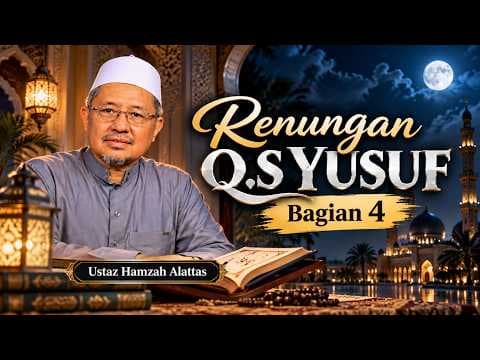
Transkrip diambil dari YouTube. Klik timestamp biru untuk melompat ke posisi tersebut di pemutar.
- wasatu wasalam ala rasulillah waa alihi
- asalamualaikum warahmatullahi
- wabarakatuh ikhwan akhwat welcome good
- morning with alfqir is alkaf back to
- accompany us in reflections under the
- auspices of the Qur'an live Q&A edition
- with Ustaz Husin bin Hamid Alattos who,
- thank God, has accompanied us in the
- studio. Asalamualaikum, Ustaz.
- Waalaikumsalam warahmatullah.
- May you always be healthy, Ustaz. Yes.
- We have entered the beginning of the
- month of Rajab, Ustaz.
- Soon eh Syakban. Allahu Akbar. Yes.
- Syakban will soon be Ramadan, Ustaz.
- Masyaallah.
- How is this? We have to prepare
- ourselves to face Ramadan, Ustaz.
- Hopefully
- Allah will extend our lifespan in the
- month of Ramadan. Amen, O Lord of the
- Worlds. Ikhwan akhwat who are blessed
- by Allah subhanahu wa taala. As I
- mentioned earlier, this morning, God
- willing, we will have a live Q&A
- session answering questions from all
- brothers and sisters sent via WhatsApp
- messages. If you want to ask questions,
- please send a WhatsApp message to
- 0811999 720. Once again, the WhatsApp
- number is 08 111999 720 or you can call
- us at 0218451512. We are waiting for
- your questions, we will open it first
- by reading the ummul Quran surah
- al-Fatihah. Tafadul Ustaz
- Auzubillahiminasyaitanirrajim.
- Bismillahirrahmanirrahim.
- Alhamdulillahirabbil alamin
- arrahmanirrahim. Maiki yaumiddin iyaka
- na'budu wa iyyaka nasta 'ihdinasirathal
- mustaqim shathalladzina an'amta alaihim
- ghairil maghdubi alaihim walad in. Amen
- .
- Amen. Amen ya rabbal alamin.
- Allahumarhamna bilquran. May from the
- recitation of the Qur'an, Allah opens
- the door of guidance, the door of His
- mercy for all of us. Amen, O Lord of
- the Worlds. Brothers and sisters, let's
- get to the first question, Ustaz. From
- a servant of Allah in Bekasi. Ustaz,
- what do you think if a man is unable to
- work in the midst of the economic
- onslaught? How does Islam actually view
- productivity? Thank you, Ustaz.
- Bismillahirrahmanirrahim.
- Alhamdulillahi rabbil alamin. Allahumma
- sholli ala Muhammadin wa alihi Muhammad
- . Subhanaka la ilma lana. illa ma
- alamtana innaka antal alimul hakim wala
- haula wala quwwata illa billahil
- aliyilim. Rbana zidna ilman walhiknain.
- Peace be upon you, O Messenger of Allah
- . Peace be upon you, O Messenger of
- Allah. Peace be upon you, brothers and
- sisters, and may Allah bless you and
- grant you peace. And peace be
- upon you. Allah Subhanahu wa taala in
- His holy book emphasizes to us all that
- the obligation to provide for the
- family is the responsibility of men. As
- His word says, arrijalu qawamuna
- alanisa. Bima fadallahu ba'bahum ala
- ba'din wabima anfaqu
- min amwalihim. Indeed, Allah Subhanahu
- wa taala entrusted men with the
- responsibility to take care of, protect
- , and provide for them. Likewise, to
- continue. Because the word qawwam is a
- word that is chosen very beautifully,
- very precisely, containing a very deep
- meaning. not just providing food,
- drink, and clothing. Likewise, a place
- to live. Because we are different from
- animals. But the task of humans here is
- specifically for men, their task is in
- addition to protecting, taking care of,
- protecting, and also straightening.
- That is the responsibility of men.
- Therefore, they must know the
- responsibilities that rest on their
- shoulders before they settle down. Bima
- fadalallahu ba'dahum ala ba'din with
- the priority that Allah has given to
- each. Men are given priority, women are
- also given priority and tasks that
- Allah mandates in accordance with the
- priority that Allah gives to each of
- them. Wabima anfaqu min amwalihi.
- Likewise with what? With what they earn
- from their wealth. Likewise the word of
- Allah in Suratul Baqarah wa al mauludi
- lahu wa al mauludi
- lahu bil bil
- maruf
- Almaulud lahu here like it or not, what
- are husbands, what are their
- obligations, to provide for their food,
- clothing, including a place to live.
- Well, women are naturally also assigned
- by Allah Subhanahu wa Taala to be
- obedient and devoted to Allah, to obey
- their husbands, to carry out their
- obligations to take care of their home.
- The same goes for their children, so
- that they can live complementary lives
- with each other with the virtues that
- God has given to each of them. But
- sometimes there are situations where a
- good man is responsible. Suddenly, due
- to economic circumstances, he is laid
- off. Previously, he was fully
- responsible for his wife, children, and
- family. Does this mean a wife should
- ask her husband for advice because he
- is weak and unable to fulfill his
- obligations to provide for her? If the
- husband was irresponsible before, then
- when he is able, he is less responsible
- . When he is strong, he neglects his
- wife when he is weak. At that time, the
- wife says she wants to separate, which
- is reasonable, considering his previous
- track record. But if the husband is
- responsible and caring, then he will be
- when he is able. So, when he is laid
- off, what would a pious woman choose?
- She will naturally wait and hope for
- God's mercy. This is a test that Allah
- (Subhanahu wa Ta'ala) has placed upon
- them to test their patience. Being laid
- off does not mean that her husband's
- hopes are dashed; rather, he can rely
- on Allah (Subhanahu wa Ta'ala) for
- alternative avenues. As we witnessed
- how Hajar was left by her husband in a
- desert with her healthy child. Because
- they believed that this was a test from
- Allah Subhanahu wa ta'ala. They
- surrendered to Him. Hajar carried out
- her obligation to strive, which is
- expressed in the expression sa'i.
- Because the word sai in Arabic means to
- strive.
- Saa yas'a ana as'ah which means I
- strive. However, because ain is
- difficult to pronounce in Indonesian
- because there is no letter ain, it
- changed from as'a to strive. She
- strived, then the rest, she surrendered
- herself to Allah Subhanahu wa ta'ala.
- Allah gave and bestowed upon them their
- sustenance. So when we face trials in
- our lives, a husband who was previously
- healthy and strong at work becomes sick
- , someone who previously worked with a
- sufficient income, even beyond his
- needs, is laid off. These are the tests
- that Allah Subhanahu wa ta'ala inflicts
- on His servants to test their gratitude
- when given blessings and their patience
- when facing trials. And Allah has
- emphasized this in Surah Al-Ankabut. At
- the beginning of this surah Allah says,
- "Ahasibanasuqu amanna wahumun." Do
- people think that it is enough for them
- to say we believe when they have not
- faced the trials like those before them
- ? Walaqad fatanadzina minqoblihim fala
- yalamannallahuladzina shodqu w yamanal
- kadibin. Indeed, we have tested people
- before them. So with this test Allah
- will see and reveal which of them is
- honest in their faith. Even though they
- face storms, face trials, face various
- kinds of attractions and tempting
- offers, they remain honest, upright and
- steadfast in the truth. Fala
- yalamanallahulladina shqu wamalibin.
- Through new tests it will be seen who
- is sincere and who is lying. He was
- tested by Allah with enormous
- opportunities. He can carry out God's
- mandate, can betray to enrich himself,
- to build splendor for his family. But a
- believer, even when faced with allure
- and opportunity, remains steadfast in
- the truth. Likewise, when faced with
- temptation from a beautiful woman who
- offers herself to him. But in a
- relationship that Allah has forbidden,
- he says, "This is the Lord of the
- Worlds." So, trials like these prove
- who we are, and our standing with Allah
- . So, suppose a woman whose husband,
- who previously had a good income, is
- unable to provide for her due to
- circumstances such as being laid off or
- , say, being sick and unable to earn a
- living, is devout. A pious woman will
- remember her husband's kindness,
- loyalty, and responsibility. She will
- faithfully serve him. There's an
- interesting story, a true story from
- someone we know. This man happened to
- be prosperous and had a fairly nice
- home. He happened to be married to
- several wives, not just one. One day,
- Allah tested him with a setback in his
- business.
- Ultimately, he was unable to fulfill
- his obligation to provide for his wives
- . Ultimately, he chose to neglect his
- obligations to his family. He came to
- each of his wives one by one. He said,
- "I can no longer provide a decent
- living for you as you know my condition
- ." So, what if we separate? The wife
- said, "No way. You are still my husband
- . You don't need to think about
- providing a living. The important thing
- is that you carry out your obligations
- as a husband. When you came to us. The
- woman refused to
- divorce. Why? Because she met her
- husband who had truly honored her. She
- felt like an ordinary person. But in
- front of her husband because he treated
- her so noble, what did she feel?
- She felt like a truly noble woman by
- her husband's side. came again to his
- other wife, he said the same thing. The
- woman was reluctant to separate. In
- fact, the woman said," You don't need
- to provide a living. Thank God I have
- enough business. Even when you take
- turns, if you don't have money, I give
- you transportation. "Why? Because this
- man honors his woman. He not only sees
- her husband from his responsibility to
- provide for his obligations, but he
- sees that she beside him feels noble
- even though her life is simple. So,
- what is important is not because of the
- husband's laziness to try, not because
- he is irresponsible, but the difficult
- conditions faced beyond his control. He
- continues to try to find work and the
- grace of Allah Subhanahu wa ta'ala is
- not only limited to the place of work
- he works. There was a man who was laid
- off from his job, he was patient, his
- wife was also patient. They asked Allah
- to get a better job and business field,
- a bigger income. Because of why?
- Because of their gratitude to Allah and
- their patience. So when it comes to
- productivity, Allah Subhanahu wa ta'ala
- commands us believers to try, to work.
- Allah Subhanahu wa ta'ala will help
- those who try but do not achieve what
- they want. But Allah will not help
- those who do not try and are lazy. In
- the Arabic proverb, innallaha yajbur
- alqusur h
- w yajbur takir.
- Allah will patch up, help people Those
- who have tried but failed.
- Hm.
- Allah will come to him with His mercy.
- Yes.
- But it will not help at all those who
- neglect their obligations. Okay. So if
- he says he is trying but his efforts
- are unable to achieve what he wants,
- the grace of Allah's help will come
- with the condition that in his efforts,
- what is he hoping for? Hoping in
- Allah.
- Therefore, saying
- bismillahirrahmanirrahim is not just a
- ritual, but what is this really?
- Opening the door of Allah's mercy that
- will open the embers of help that come
- from Allah. Because if we only depend
- on our efforts, it is impossible to
- depend on our knowledge as well. Witu
- minal ilmi illa qila. Therefore, after
- we work, Allah commands us to put our
- trust in Allah.
- After we try, waallahi fatawakalu
- inuntumin.
- Likewise, the closing faidza farag
- waika. If you finish one job, then
- start again with a new effort. But
- remember, all your hopes are directed
- only to Allah. Iyaka na'budu wa iyaka
- nastain. So trying, doing good deeds,
- and striving are what will open the
- door of Allah's mercy. Walladina jahadu
- fina
- fina lanahdiannahum
- sub
- subbulan. This verse was revealed in
- the period of Mecca before the jihad
- war. It means that these jaha yujahis
- are those who fight in our way, we will
- show them our many ways.
- Wa inallahasi
- muhsin. Allah is always with those who
- do good. This is a picture of a true
- Muslim believer who strives in the way
- of Allah, hoping for His pleasure and
- not neglecting his obligations. And
- Allah knows best.
- Masyaallah. Eh, very good answer, Ustaz
- . Ustaz, this is from Fani. Ustaz,
- peace be upon you, Ustaz. Inin asked,"
- What about someone who has been
- delaying doing good? For example, Ustaz
- wants to give charity but later. But in
- the end the funds used for charity are
- used for other needs. Others read the
- Qur'an but later end up reading social
- media. Please advise, Ustaz. Is this a
- heart disease, Ustaz? Namely, sadness
- is delaying, likes to procrastinate
- doing good deeds. Syukran, Ustaz.
- Bismillahirrahmanirrahim. There is a
- saying that says khairul birri ajilu.
- What is the best kindness? We'll make
- it quick. We'll make it quick. Because
- once we delay, even if only for a few
- moments, what will this devil try to do
- ? Prevents us from doing good.
- Encourages us to do cruel things.
- Asyaitan yuruhum bil fahsya. E e Satan
- ymmurukum bil fahsya wal munkar. What
- is this devil? Always encouraging you
- to do cruel and evil things. Asyaitan
- yauhumu. Yes. What? Oh my God.
- What letter Ustaz?
- Albaqarah. What?
- Albaqarah.
- E wala tayammamul khit minhu
- tunfiquunaastum biakhirihi illa anmidu
- f.
- Walastum biahhi illa anmidu f. Wallahu
- wallahu ghaniyun. Wallahu ghaniyun
- pregnant. And Allah knows best, and He
- is the only one who is a learned man.
- We see in Surat al-Baqarah that Allah
- reminds us that Satan is the only one
- who is a good person and the only one
- who is a learned man. When we want to
- do good, to give charity in the way of
- Allah, Satan scares us with what? With
- the threat of poverty. If we help a lot
- by giving charity, we start to be
- frightened by the shadow of poverty.
- Subhanallah. Wurukum bil fahsya. But he
- pushes and encourages you to do evil.
- Even if the cost is high, Satan will
- not what? He will scare you with great
- expense. Allah will give promises of
- pleasure, enjoyment, profit, and
- happiness. While Allah knows best, He
- is the only one who is a
- learned man. While Allah subhanahu wa
- ta'ala, with what He recommends from
- these good and noble deeds, promises
- you forgiveness. Besides, Allah
- promises to multiply the rewards of
- those who give charity in the way of
- Allah. One is rewarded 700 times over.
- Allah also promises you, in addition to
- the multiple rewards in this worldly
- life, Allah promises forgiveness from
- it. Wallahu wasiun pious. Indeed, Allah
- is all-encompassing in His grace and
- all-knowing of everything. So those who
- give infaq receive an infinite promise
- from Allah
- in addition to multiple rewards in this
- world of forgiveness from Allah and in
- the hereafter they will not experience
- fear or sadness. Alladina yunfiquuna
- amwalahum fibilillah tumma la yutbiuna
- ma faqu manan wala lahum ajruhumbihim
- wala khaufun alaihim wum yahsanun.
- People who spend their wealth in the
- way of Allah. In the way of Allah, this
- is not just limited to fighting in the
- way of Allah, no. But it includes all
- donations in places that Allah is
- pleased with. They spend their wealth
- in the way of Allah. Then they don't
- accompany the infaq they spend by
- bringing up what we gave or hurting the
- feelings of the person we gave it to.
- What has God provided for them? Their
- reward. Then Allah freed them from fear
- , sadness when humans experience fear.
- That is the benefit that Allah promises
- for people who donate. And every time,
- every morning, the angel prays, "
- Allahumma a munfiqan khalafa wa ati
- mumsikan talafa." O Allah, replace
- those who give infaq. Meanwhile, on the
- contrary, destroy the wealth of those
- who hold back their wealth and hoard it
- . Because once they hoard it, what does
- it mean? They monopolize God's favor.
- So many people will live in suffering
- and hardship because of them. In fact,
- Allah made us human beings, especially
- those who believe in ba'bukum min ba
- wal mukminun wal mukminat ba'dukum
- auliya, believers, both men and women,
- some of them become guardians of others
- . So what does that have to do with
- that question or why are you
- procrastinating? Well, delaying doing
- good is precisely what Satan wants.
- There is a story, attaswif syi'usit
- yulqihi fi qulubil mukminin.
- H.
- Taswif is taken from the word saufa.
- Sawafa yusawifu taswifan.
- Delaying it until later, soon, tomorrow
- . That is the motto of Satan that is
- inserted into the hearts of believers.
- Ai before he does good or before he
- repents, death comes to take him.
- Before he has the chance to do good,
- the opportunity that Allah has given
- him is lost. Whether it is sufficiency,
- excess, yes
- ability, health, so let us never
- postpone the good that we will do. For
- example, I once experienced that.
- Someone asked for help, he explained
- his condition. What is our heart? We
- want to give him everything he wants.
- From the front we go to the back to get
- the money. Ah, if we give him
- everything, in the end he will not have
- the spirit to try.
- Heeh.
- Right? We start by saying only half so
- that the other half can be worked on
- and he does not rely too much. As soon
- as we enter the room, start from what
- half?
- Satan whispers to us again, what is the
- purpose?
- There is another purpose for this. We
- can help others. We reduce it from half
- to a quarter. When we take money, we
- turn back in the middle of the road,
- Satan tries to whisper to us to reduce
- what we donate even more.
- Yes. Yes. Yes.
- We can feel how Satan will not waste
- the opportunity to make us what? Not
- just delay, but also reduce what we
- will spend. Even though the distance is
- so close, right?
- Right. Minal if it doesn't happen, it
- will be reduced by the same amount.
- Yes.
- Absolutely.
- So we see how Satan tries to prevent us
- from doing good but for sinful deeds.
- For example, let's say someone is going
- to have a birthday.
- Heeh.
- He has already spent, say, Rp100
- million. Later, someone says that if
- there is this, it would be better if we
- call a magician and add more funds.
- That is subhanallah without being
- calculated. But if it is for good,
- Satan tries to hinder. So all the
- efforts that we hear in our hearts to
- prevent us from doing good immediately
- or reduce the good we will spend are
- wasawis asyaitan. Wali iyadubillah.
- Masyaallah. Next is Ustaz from Maulana
- Yusuf.
- Heeh.
- Oh, this is quite an interesting
- question, Ustaz. But is it okay to have
- a different topic, Ustaz? Yes.
- Peace be upon you, Ustaz. Sorry for the
- off-topic. May I ask a question? Sil.
- I'm Ali Basah on Jalan Parjajaran,
- Sukabumi. If, Ustaz, there is an
- official who abuses his position, how
- should he repent? Especially regarding
- human relations and what happens when
- he is tried or his assets are
- confiscated but still has the proceeds
- of his abuse of office attached to him.
- Please give me some direction and
- guidance, Ustaz. Thank you. Masyaallah.
- I remember an incident involving a
- regent. I happened to be giving a
- sermon at the National Police
- Headquarters.
- Yes.
- In the midst of prisoners from among
- high-ranking officials or former
- officials. There were former regents,
- there were also governors, all kinds of
- people who were previously entrusted
- with positions. He was detained. Then
- after the lecture was over, one of them
- , a regent, asked me, though not
- directly, "How am I doing? All of this
- wealth I've accumulated comes from
- illegitimate business income. That's
- abuse of office. What should I do to
- repent? I told him, if you could return
- it to the state, receive it from honest
- officials, distribute it for your
- benefit, and then return it to the
- people, then you hand it over to the
- state. But if you hand it over to the
- state and it's eaten by corrupt
- officials, it won't be returned to the
- state, which belongs to the people. You
- should establish institutions whose
- benefits are returned to humanity.
- Whether it's a health institution that
- serves public health or an educational
- institution, or you build houses for
- those who don't have a place to live,
- return it to the people. Because in
- fact, the wealth of the state belongs
- to the people, who are empowered by the
- state. So if state officials are not
- responsible for their obligations, you
- return it to the people from whom you
- took it. At most, what is rightfully
- yours is from your lawful income, the
- rest you return to the people while you
- repent and ask for forgiveness from
- Allah. If he sincerely wants to repent,
- it won't be difficult to return what
- isn't his. But when he's touched, he
- might want to repent, and then what
- happens? He'll return to his original
- state. He'll think a thousand times
- about giving away what belongs to the
- people, but isn't his. But some of them
- are truly willing to return what isn't
- theirs, and they repent sincerely. So,
- if you feel that what's in your hands
- isn't yours, try establishing an
- institution that can benefit the people
- with intention. Not with the intention
- of charity. If the charity comes from
- your personal money, but with the
- intention of returning the people's
- rights. Because if we return it to the
- state, it's unclear who will receive it
- or where it will be distributed. You
- know better than our officials what
- their situation is. Even when the
- people are hungry, some of them still
- want to eat the people's money. This is
- what we see before our eyes. Now, if
- his wealth is confiscated, he's
- punished, and he's left with nothing,
- then what's the point? I pray to Allah
- to make the incident he's facing
- punishable. Shamed, he then repents to
- Allah Subhanahu wa ta'ala for his
- actions. He amends himself, and the
- door of repentance is wide open. But as
- long as he continues to commit
- corruption, even if he donates most of
- the wealth he obtained from corruption
- and he does not repent, his prayers are
- left in limbo. Likewise, his fasting,
- and his worship, until he repents to
- Allah Ta'ala. Because Allah only
- accepts those who are pious. As Allah
- tells us, the son of Adam said to his
- brother who was angry because his deeds
- were rejected. While his brother was
- rejected, he said," Innama
- yataqabbalullahu minal muttaqin. ""
- Don't blame me. Because Allah only
- accepts from those who are pious. So
- those who commit acts of corruption,
- abuse their position, if they want
- their prayers accepted, their siam
- accepted, their worship, their alms and
- donations accepted, repent. Repent.
- Stop doing wrong things. Then from that
- moment on, their good deeds, God
- willing, will be accepted by Allah
- Taala and what is not theirs will be
- returned to the people in a wise way
- that truly guarantees what? This return
- will be fully returned to the people
- who deserve it. Well, hopefully Allah
- will accept your repentance. Because
- the open reckoning in the hereafter is
- far greater than what someone faces
- before the Corruption Eradication
- Commission (KPK) or the police. If the
- KPK can be negotiated with,
- the police can too.
- In fact, bargaining is more profitable.
- He.
- I know one person who collaborated with
- an official. He ended up being pursued
- by the KPK, about 10 years ago. In the
- end, he gathered orphans in his house.
- I was one of the people present. I
- don't know what his original goal was.
- It turned out he was asking for...
- prayed to be freed from the Corruption
- Eradication Commission, from what? The
- legal trap. I said, "If you want to be
- freed, repent to Allah. Because even
- though you call these orphans, you ask
- Allah to free you from what? From the
- trap of the Corruption Eradication
- Commission, who will you face when you
- are released from the Corruption
- Eradication Commission? Face Allah
- Subhanahu wa ta'ala on the Day of
- Judgment. There you cannot bargain. So
- it is better for us to be honest with
- Allah, honest with ourselves. We
- improve our attitudes to be in
- accordance with Allah's pleasure. This
- is the path to salvation for us. So
- those who have ever abused their
- position for their own benefit or who
- are currently doing so before it is too
- late, let us repent to Allah together.
- God knows best. Masyaallah. Masyaallah.
- Ustaz. But if for example, he is caught
- , he is caught and then he goes through
- the legal process. He.
- Ee all the legal processes he went
- through and the decision of his
- dependence he went through. Does that
- count as repentance, Ustaz? Even though
- his assets may not have been returned.
- Look, if in his heart he truly repents
- and returns to Allah completely, then
- what? He still has money in his hands
- from what proceeds? From corruption,
- abuse of office, then his repentance
- will not be complete until he returns
- what is not his right. Because the
- requirements for a repentant person are
- ...
- Heeh.
- If it's related to a person, besides
- stopping the wrongdoing, he regrets his
- actions, returns the person's rights,
- or asks for their sincerity. Right.
- Now, if it's related to the people's
- rights,
- naturally what must be returned to the
- people,
- and the best way is to establish
- institutions that can bring continuous
- benefits back to the people. So if I
- build a hospital, yes, but the hospital
- is not a profit-making hospital.
- Yes.
- But a profit-making hospital that truly
- expects what? Service is entirely for
- the benefit of the community. And today
- it is beneficial.
- Yes, Ustaz.
- And what to say? For those who cannot
- afford it, it is fully covered by the
- hospital that can pay,
- but not what, the benefits return to
- those who built the hospital, which
- belongs entirely to Allah.
- And this, God willing, will also
- educate the doctors to do their work
- sincerely. They shouldn't pay attention
- to the higher classes. They shouldn't
- pay attention to the wards. If
- necessary, all classes should be the
- same. There's no such thing as VIP.
- Everyone is equal. The attention of
- doctors and others is the same. And
- doctors will also receive their
- happiness with full justice. But for
- the weak, the hospital and the doctors
- will be sincere in their deeds. That is
- their jihad. God knows best. Well, this
- Ustaz, there's one person we know who
- went to prison. Then he told me about
- some of his friends who, according to
- his belief, were in prison for
- embezzlement. While in prison, okay,
- the sentence was 2-3 years. He.
- When he was charged with embezzlement,
- he had already saved billions of rupiah
- .
- Heeh.
- He had already put up a tough front,
- the legal process was over. When he got
- out, he still had the money, Ustaz. So,
- what's the law on this, Ustaz?
- Money obtained through illegitimate
- means must be returned.
- Yes.
- Mandatory. No bargaining. He.
- Why? Because it wasn't earned from his
- legitimate business.
- Yes.
- So, let's say his salary is Rp. 50
- million, and his legitimate business is
- growing, then what he receives comes
- from his salary and his legitimate
- business.
- The rest is returned. Yes.
- Let's say he's having difficulties.
- Yes.
- What are his difficulties? What about
- what he earned from his legitimate
- business?
- Uh, what exactly is it? Insufficient.
- His legitimate assets are mixed with
- those that are not his.
- He can return them slowly, because of
- his condition, return them, say, half
- first or a quarter first, and
- gradually return them. He
- until he is completely free of what?
- From assets that are not his. So, la
- yukallifulahu nafsan illa, in the form
- of assets, there is his money there.
- There is also haram money mixed
- together.
- He can wait until the house is sold.
- Take what is his right, return what is
- not his right. And this is not one
- person's right, it is the people's
- right.
- A right. But this official is not aware
- . He thinks that when he commits
- corruption, he is committing corruption
- , betraying his office.
- He doesn't realize that this leads to
- what? The losses suffered by the people
- . How will he be in the hereafter when
- the people sue him? He doesn't feel
- that now. But in the hereafter, Allah
- Subhanahu wa Ta'ala will represent the
- oppressors in demanding their rights.
- Well, in this case, clerics are also
- not allowed to pray for him to continue
- his rise in office,
- and he also shouldn't
- sin. If he prays for an oppressor, he
- is responsible. He is contributing to
- the oppression.
- Oh.
- And then he is also not allowed to
- accept money from that person for his
- own benefit.
- Ah.
- But if a repentant official says,"
- Please, Ustaz Isa, these are the funds
- I obtained from corruption. "Try to
- wisely return them to the people who
- deserve it. But if the cleric accepts
- red envelopes from corruptors, he is
- contributing to the act.
- Yes.
- I remember a story.
- Heeh.
- A businessman who used to lend out
- horses.
- Yes.
- His business was like a rental. Horse
- rental.
- Stable. It's called stable.
- Yes Incidentally he collaborated with
- the Abbasid government. At that time it
- was controlled by Harun Rasyid. He
- rented out his horses for work related
- to what? Government interests. This
- came to a fairly well-known cleric,
- namely Abu Abdullah Assadiq. He said,"
- Yes, Aba Abdillah, what do you think I
- am doing in my business by lending what
- ? By lending
- my horse rentals to the authorities. "
- Abu Abdillah Asadiq answered," Anta
- syarikuhu, you are his ally in
- injustice. "
- He said," Walimika, Abu Abdillah, how
- can I be included? "He said," You'd
- hope he'd finish what he
- was paid. "Okay.
- You pray for his long life.
- In order for his life to be extended,
- things must be carried out
- so that he is able to fulfill his
- obligations to you. So, anta shariku
- you are his allies in injustice.
- Imagine this is a problem that we
- consider normal, right? I work by
- providing what's called a horse and I
- receive a profit from it. But what is
- this actually related to? The vested
- interest in that person that drives him
- to pray for that person to remain, what
- ? To remain able to pay his obligations
- . So, when we work with an oppressive
- person, we hope he will pay his
- obligations. What if he dies or is
- unable to pay and fulfill our
- obligations? We feel disadvantaged. So
- we pray for his sustenance to be made
- easier, for his life to be prolonged.
- Even though his business is an unjust
- business.
- Yes.
- So it's better not to be close to
- oppressive rulers, unjust ones, or
- corrupt officials. Eventually, we
- consider corruption to be what it is?
- Right.
- Right. He.
- Especially if we accept you for our
- needs, there are events he provides
- assistance, when there is a need he
- provides assistance. We ask and hope
- from people like this, and inevitably
- we will see them in a negative light
- even if they do wrong.
- Yes.
- This is the positive side.
- So it's better than the positive side.
- Surely he will look at it from the
- positive side because it provides
- benefits for him, right? Because people
- have a tendency to judge a good person
- depending on whether he is good to
- himself,
- even if he does injustice to society,
- yes, he abuses his position, but if he
- is good to him, when asked how you view
- so and so, wow, he is a good person, a
- person who is full of concern because
- it relates to himself,
- yes, yes,
- people are rarely objective in this
- matter. But if a person is truly fair,
- when he sees that someone is saying
- something to himself that is not good,
- it may be due to certain problems, but
- towards the people, towards society, he
- is truly acting fairly.
- Yes
- He should have said," So and so, I see
- from his work, his charity, his honesty
- he is a just person. "Masha Allah. Even
- though there are things between me and
- him that I don't like, objectively I
- can say that he is good. H.
- Well, this is what is dangerous for
- ustaz, for certain groups who are close
- to corrupt officials, who do not really
- benefit from them. Finally his eyes
- became blind, his ears became deaf, his
- tongue became numb. In the end he did
- not rate it with a positive assessment.
- He's not speaking fairly and
- objectively,
- but speaking with the logic of God,
- which benefits him. Well, Ustaz, you
- said earlier that if we were entrusted
- with funds to return to the community,
- that's okay.
- Although he didn't say where the funds
- came from,
- we know he holds a position where there
- are many doubts and so on. We were
- entrusted with it, and you donated it,
- there's no problem, Ustaz. No. We'll
- return it to those who deserve it.
- I once had an event,
- okay,
- during the Soeharto era. He was
- invited to an event, uh, congregational
- tarawih prayers.
- Okay.
- It happened that those in attendance
- were essays from the Cendana family at
- the time, from high-ranking officials.
- I had hopes that maybe I could provide
- some benefit, give advice because my
- goal wasn't to please them. After the
- event, what did they give me? I refused
- to accept it, but they forced me to. We
- don't feel comfortable when we're being
- pulled over in public, right? I
- accepted the money. But throughout the
- journey, my heart was incredibly
- restless. Restless for no reason. This
- anxiety is because of money. This is
- what I know comes from officials who
- abuse their position. They have fun,
- gather together, pray tarawih and
- invite the ulama to do what? Their
- hearts are at peace and they hope that
- what they are enjoying will last a long
- time.
- Meanwhile, businesses only receive a
- little, like a cat sitting under its
- master's table to get scraps of food.
- I had a restless heart throughout the
- trip. Finally, before I got home, I
- stopped at the edge of the river in the
- midst of people who were in trouble. I
- took everything out for them, then
- Subhanallah, my heart was calm and at
- peace at that time. So, Allah
- subhanallah, the bad things cause
- anxiety, while the good ones give a
- sense of peace in our hearts. So we
- should never get close to corrupt
- officials except to provide advice.
- Okay.
- Allah says in Surah Hud. Wala
- tarkanuinaamuakumunar wumunillahi min
- auliya. Don't get along. In Indonesian,
- rukun describes harmony, right?
- Hey.
- Don't get along well with oppressive
- people. In the end, you will be
- punished by the fires of hell, even
- though you are not the perpetrators,
- but because you gathered with them when
- the punishment descended, you were
- affected. In the end, you will not find
- a protector who will help you and you
- will truly be in a very sad situation.
- Now, this is the most difficult thing
- for us ustaz, preachers, when dealing
- with people like them. Especially with
- their sweet talk, with their gifts. Who
- doesn't like gifts? Right?
- Especially with the many needs of today
- . Therefore, for those who can't stand
- it, it's better not to be close to them
- , not to gather with them.
- Tat. Yes. Yes.
- Even though the ustaz said earlier,
- it's like a cat that is only given its
- bones.
- Right. Right. He waits, he is happy to
- be given fish bones to eat.
- Oh God.
- Meat is eaten by the elderly. But in
- the hereafter, who will have the
- greatest reckoning?
- The one who eats the bones.
- The one who eats this bone. The ustaz
- who eats the bones will have the
- greatest reckoning. Because he should
- be enjoining what is good and
- forbidding what is evil. But what?
- Yes. Yes. But instead, he gathers with
- oppressors, giving them blessings and
- support. And on average, what I've
- encountered over the past 30 years or
- so, conglomerate officials invite
- clerics not because they want to hear
- good advice,
- not because they want to improve, but
- simply for what?
- Just for an
- event that perfects what?
- Perfecting their goals with prayers
- from clerics, readings of the Quran.
- The Quran is read, not to be absorbed.
- Yes. The
- clerics also lecture, starting with
- praise, elevating, elevating,
- flattering, that's what I heard with my
- ears, I felt directly.
- He he.
- He gives praise, flattery without
- reminding himself
- that he will soon be called by Allah
- and accountable for his deeds. Whereas
- if we gather together in an atmosphere
- of mutual reminders, our hearts are at
- peace. That's right, Ustaz,
- because we, like it or not, often
- experience moments of forgetfulness, of
- being unaware, of being careless.
- Yes.
- As soon as we were reminded," Oh so and
- so, what you did is truly bringing you
- down, making you look bad. "We realized
- at that moment. Because a believer is a
- mirror for his brother. What can he see
- himself through? His brother. So, why
- does Allah command us to observe the
- law of obedience after faith and
- righteous deeds? Why? Because humans
- sometimes forget and are unaware of
- their actions. And God knows best.
- Masyaallah, Ustaz. So, Ustaz, when we
- return the money to the people
- and then we publish it. And the
- publication is a sin, Ustaz, publishing
- that this money is from this politician
- . Alhamdulillah. So this is the problem
- , officials when they donate something
- to mosques, to certain businesses,
- usually they are said to be
- true
- in order to improve their name among
- the people. Pious officials, good ones,
- who care about the people are used as
- propaganda or campaign tools. So, we
- should not do this at all.
- I am right. I once had a time when the
- pork fat issue was developing
- during the Sudomo era, yes, starting
- with companies, yes, those producing
- food, yes, Indofood and so on, tried to
- invite clerics to, what, hold events,
- say, mass religious gatherings, then
- put ABC chili sauce, the products that
- caused a commotion, on the podium.
- Their chili sauce products so that the
- impression was, what? These are all
- halal products. Most of the clerics
- never checked, never checked in the
- laboratory whether the products were
- halal or not. But because of the
- donations given by these producers.
- Hehe.
- Then with what is it called? With uh,
- yes, let's say with a billboard. A
- billboard with production goods placed
- on what? On the podium. So indirectly
- the clerics approved. Some were even
- invited to the Indomie factory, if I'm
- not mistaken, at that time they were
- invited, yes, they ate Indomie in
- droves. They said," We didn't see any
- pigs, we didn't see any pig heads or
- any pork there. "This is the wrong
- attitude. He didn't come as someone
- responsible for researching whether
- Indomie or similar products contain
- pork, but what? He was invited to eat
- among them and show the community that
- what he did proves that all of this is
- halal. I'm not accusing Indomie of
- containing pork, but the ulama's
- attitude is wrong.
- Yes.
- Unless they are thorough, they check it
- in a laboratory and make sure it's
- clean, then he will honestly say that
- there are no findings indicating the
- presence of pork in what? In the food.
- That's a good way. But we are just
- becoming tools, propaganda tools,
- campaign tools during elections,
- or tools to legitimize something
- unclear.
- But because the money is large, we are
- in trouble, Ustaz, we need
- our children to go to school, want to
- pay for this, pay for that, we accept
- it, we surrender to Allah Taala. He
- said this is a trial from Allah
- Subhanahu wa taala.
- Masyaallah, Ustaz. Hey, this next one
- is from Muhammad in Bekasi.
- Assalamualaikum warahmatullahi
- wabarakatuh, Ustaz. How do we act if we
- are lent money by someone else and that
- person is not able to answer? On the
- other hand, we need it, but on the
- other hand, we also feel sorry for the
- people we lend to. It's due, Ustaz.
- Thank You. Allah Subhanahu wa Taala in
- Suratul Baqarah says, wainana
- usratiniratun waquirakum intumamun.
- If the person who borrows is in a tight
- situation, what is the faamiru? If the
- person borrowing is in a tight
- situation and has not been able to
- fulfill his obligations and not
- intentionally, then defer him until
- such time as he finds it easier.
- Hm.
- If you give alms, yes if you give alms
- it will be even better. Seeing that his
- abilities are really weak, his
- condition is, especially since he has
- children who need it. If we think about
- it, with his income, it is impossible
- to pay the debt. So if we let it go it
- will be better. And the reward from
- Allah is not one to one. H
- is not an installment, yes,
- but Allah repays one in 700.
- Allah. That's
- why I often say people need loans,
- we'll give them loans. Let's see if he
- doesn't have the ability to pay, it's
- normal when someone is able. We've also
- been in situations like this.
- I said," I've forgiven him. You don't
- need to pay for yourself. "He felt
- embarrassed. We'll try not to have to.
- What Allah replaced me with is better.
- The important thing is that you don't
- be burdened by feelings of debt. Once
- he is free from feelings of debt, the
- door of Allah's mercy will open for all
- of us.
- Rather than hoping for someone who
- can't afford it, it's better to hope
- for Allah, the All-Rich, the
- All-Powerful.
- If his lifestyle is like that of a dead
- person,
- sometimes what does he look after? He
- looks after himself. Yes. Oh, that's
- right.
- It doesn't mean he's someone with
- excess,
- Ben.
- But if he has the ability but doesn't
- pay, then he's considered al-mumatil.
- Mumatil is Arabic for delaying debt
- repayment. Matul ghani dulmun. If
- someone delays paying a debt when he is
- able
- or hides his ability, then he's
- committing extraordinary injustice.
- Unjust. Unjust to the person who helped
- him, Ustaz. Yes, it is
- true. Meanwhile, those who help will
- not be wasted by Allah. Allah will
- replace it with something better. If
- you have done good, you will be wronged
- and get two things.
- Allah is
- the first yes He helps people with a
- good purpose.
- Whether people deserve goodness or not.
- What is clear about what we have done?
- Help.
- Then, for his cruelty, he received a
- reply without reckoning.
- Innama Yasir Ajab.
- Instead of hoping to be annoyed with
- the person we are giving kindness to,
- it is better for us to hope for someone
- who is most gracious.
- That's right. more good fortune comes.
- God will definitely replace it.
- Last question, this Ustaz is from
- Philutfiah. Just keep it short, Ustaz.
- If we donate to a mosque or assembly
- and ask for the Fatihah to be read in
- the name of the donor with the
- intention of wanting the Fatihah to
- flow to those who donate, what is the
- law, Ustaz? A cashier? If he donates
- from good money, which is halal, yes.
- Then we pray.
- Hey.
- What do we pray for him? so he gets
- what? Allah makes things easy, make
- them more spacious and say what? Make
- your heart healthy, keep it away from
- disease. This is part of what Allah
- commanded, yes. People who bring out
- something in goodness ya kh min
- amwalihim shodqatanirhum tuzakihim.
- After that wasolli alai. Salawat from
- the Apostle means prayer from the
- Apostle for people who give out their
- zakat or donations. So, we pray if we
- read Al-Fatihah as an opening, what is
- this Al-Fatihah? The pennant of the
- Koran and its contents are truly the
- manners of communication between a
- servant and his God. He read Al-Fatihah
- . After that, pray for those who donate
- in the way of Allah Subhanahu wa Taala.
- If necessary, without mentioning names,
- let's just pray that those who spend
- their wealth in the way of Allah will
- receive forgiveness, find space, gain
- breadth, be kept away from disease, and
- Allah will make it a provision for them
- in the last day. So without having to
- mention names. Because mentioning names
- is feared that it will cause ripples in
- their hearts, right? We pray unless we
- want to invite other people to donate.
- There is one person who donated to the
- struggle. Then we remind people," So
- and so gave so much in the way of Allah
- Taala. "Hopefully Allah will accept it,
- Allah will accept whatever they spend.
- So
- what are you going to spend as a
- contribution to the struggle?
- But the best thing is to hide what we
- give. But even if we show it, it is
- good. If you look as close as possible,
- it means that your actions are as long
- as you intend them for Allah. But if
- you hide the tukfu watul fuqar wine you
- give to the poor, it will be better.
- The reply is that yukirum sayatikum
- Allah will forgive you, cleanse the
- ugliness of your sins ukirumikum saatum
- Suratul Baqarah Hubqati wafaha
- fuqahuairakumukiru wallahu bimaalun
- bimaalunir. So if you give to the
- fuqara by hiding your gift, that will
- be a better reward that Allah will give
- you. Then Allah promises that besides
- giving a better reward, Allah Subhanahu
- wa Taala will cover our bad things and
- erase them. Because we sometimes step
- towards hard goodness because of what?
- Because of our sins. What does our sin
- cause? There is a heavy burden on our
- shoulders to do good and to stay away
- from evil. But with these kindnesses,
- Allah forgives our sins, cleanses our
- mistakes, lightens our burden. our
- steps on the path of goodness.
- Hopefully, God willing, Allah will give
- you the benefits of
- our dialogue this morning and
- what we convey, hopefully solely by
- hoping for Allah Subhanahu wa Taala's
- pleasure because this will
- open the door to acceptance for us. If
- not, iyadubillah,
- we are in vain doing good deeds if we
- don't hope for Allah's approval.
- Subhanakallahumma
- wabihamdikallahum wabihamdik asadu
- antagfiruka wauubuai. OK, thanks Ustaz
- for the explanation. Thank you, Ondi
- and Mas Algi at the Ikhwan Akwat
- operator desk. Thank you for listening
- so far. Alfagqir Isa Alkaf and all of
- his staff ask to resign. Asalamualaikum
- warahmatullahi wabarakatuh.
- Waalaikumsalam warahmatullah.