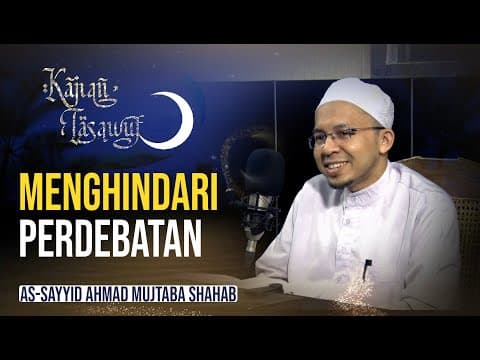
Transkrip diambil dari YouTube. Klik timestamp biru untuk melompat ke posisi tersebut di pemutar.
0:17 In the name of Allah, all praise is due 0:18 to Allah, may peace and blessings be 0:20 upon the Messenger of Allah, his family 0:22 , and his companions. Peace be upon you 0:25 and the mercy of Allah and His 0:26 blessings. Brothers and sisters, may 0:29 you be blessed by Allah the Almighty. 0:31 How are you? Welcome to our program, a 0:34 Sufism study with the humble servant, 0:36 Isa Alkaf. We have Kang Neja on camera 0:38 and Mas Edo at the control desk. Praise 0:40 be to Allah, brothers and sisters, this 0:43 morning we have the opportunity to meet 0:45 again with our teacher, Habib Ahmad 0:47 Mustaba bin Abhab. Peace be upon you, 0:49 Habib. 0:50 And peace be upon you and the mercy of 0:51 Allah. 0:52 Are you healthy? Praise be to Allah. 0:53 Praise be to Allah, oh God, it has been 0:55 a long time since we last met. Masha 0:56 Allah. Two weeks. 0:58 Two weeks. 0:59 God willing, thank God we can meet 1:01 again. We will 1:03 as usual, brothers and sisters, we will 1:06 read the book Bidayatul Hidayah. 1:08 This time we are still discussing the 1:11 introduction, covering the intentions 1:14 in seeking knowledge so that we are 1:17 truly sincere, brothers and sisters, 1:20 wherever we may be. Even you brothers 1:23 and sisters who are studying via radio 1:26 at home must also guard your hearts. 1:29 Now, what is the full explanation? We 1:30 will hear the explanation from Habib 1:33 Ahmad Mustaba later. But before that, 1:35 it would be good if we open by reciting 1:37 the Ummul Quran, Surah Al-Fatihah. Let 1:40 us recite it in order. Amen. Amen. Amen 1:43 . Amen. All praise is due to Allah, the 2:01 Lord of the worlds...Guide us to the 2:02 straight path, the path of those upon 2:04 whom You have bestowed favor, not of 2:06 those who have evoked [Your] anger or 2:08 of those who are astray. Amen. Amen. 2:13 Amen, O Lord of the worlds. Hopefully, 2:16 from the recitation of Surah Al-Fatihah 2:18 earlier, Allah will open the door of 2:20 guidance, grant the door of mercy, and 2:22 instill success in our hearts, brothers 2:24 and sisters, so that we remain on the 2:25 straight path of Allah the Almighty. 2:29 Not the path of those who are angered 2:31 or those who are led astray by Allah 2:32 the Almighty. Brothers and sisters, may 2:34 you be blessed by Allah the Almighty. 2:37 Yes, please open the book again, the 2:40 Bidayatul Hidayah PDF. Now, this is... 2:46 God willing, we want to hold an offline 2:49 event again, right, Habib? Hopefully. 2:52 Meet again. 2:53 A Sufism study with all the brothers 2:55 and sisters. If you brothers and 2:56 sisters want it, we will schedule it 2:58 later. Please send your attendance via 3:01 WhatsApp message to 0811999720. Please 3:08 open the Bidayatul Hidayah book, the 3:11 PDF. If you want the book, I will send 3:14 it via WhatsApp, on page 60. "And your 3:21 saying...""...by Allah...""...Bidayatul 3:28 Hidayah is merely a narrative, so 3:30 rejoice." Imam Ghazali said: "The 3:34 angels will surround you with their 3:36 wings as long as you seek knowledge, 3:39 and the fish in the sea will pray for 3:41 your forgiveness as long as you 3:43 continue, but you must understand 3:46 before...""...the end, only after 4:00 realizing its beginning...""...only 4:07 after fulfilling its requirements, and 4:10 I insist that you study Bidayatul 4:13 Hidayah to test yourself before others. 4:16 " Please, Habib, perhaps you can 4:19 explain. Alright. In the name of Allah, 4:22 the Most Gracious, the Most Merciful. 4:23 All praise is due to Allah, the Lord of 4:24 the worlds. O Allah, send peace and 4:25 blessings upon our master Muhammad and 4:27 upon his family and all his companions. 4:29 Glory be to You, we have no knowledge 4:30 except what You have taught us. Indeed, 4:31 You are the Knowing, the Wise. Turn 4:32 towards us, for You are the Accepter of 4:34 Repentance, the Merciful. O Allah, O 4:36 Opener, O All-Knowing, O Opener, O 4:37 All-Knowing, O Opener, O All-Knowing. 4:39 Grant us a near opening, O Most 4:40 Merciful of the merciful. O Allah, 4:44 there is no ease except what You make 4:45 easy, and You make the difficult easy. 4:48 O Allah, make knowledge easy for us and 4:50 grant us true understanding by the 4:51 virtue of the protected Prophet, may 4:53 Allah bless him and grant him peace. O 4:55 Allah, we ask You for beneficial 4:57 knowledge and...From a heart that is 5:01 not callous, a tongue that is not 5:02 silent, and an eye that does not shed 5:04 tears. We seek refuge in Allah. And His 5:24 companions. Glorified and Exalted is He 5:27 . We praise Allah the Almighty for His 5:31 goodness. Alhamdulillah, all praise be 5:34 to Allah the Almighty for His abundant 5:37 favors, and praise be to Allah that we 5:40 can meet again on this blessed morning 5:43 for the study of the Bidayatul Hidayah 5:45 book. And this is our third meeting 5:48 discussing this book. Previously, we 5:52 discussed the biography of Imam Ghazali 5:53 and a brief overview of the book 5:55 Bidayatul Hidayah. In the last two 6:00 meetings, we discussed the introduction 6:03 of the book, where Imam Ghazali talks 6:06 about the intention in seeking 6:09 knowledge. He uses the concept of " 6:13 takhliyah" then "tahliyah." He begins 6:16 by cleansing the heart from vile 6:20 intentions. We mentioned yesterday the 6:23 intentions that are not appropriate for 6:25 us to use as targets in seeking 6:27 knowledge. Competition, showing off, 6:31 being ahead of peers, and seeking fame. 6:35 After our hearts are cleansed of those 6:38 vile intentions, now he will adorn our 6:41 hearts with praiseworthy intentions. Ah 6:44 , this is what is meant by the first 6:47 intention and your objectives. If your 6:50 intention and your goal, between you 6:55 and Allah the Almighty, is in seeking 7:00 knowledge. If you seek knowledge for 7:04 the sake of Allah, what is your purpose 7:07 ? It is guidance. Now, this is it. This 7:10 is the main target, brothers, in 7:11 seeking knowledge. Guidance. What is 7:14 the meaning of guidance? Guidance means 7:16 direction, brothers. And this is the 7:20 core of the most important intention in 7:24 seeking knowledge. Why do you seek 7:27 knowledge? To...obtain guidance. What 7:31 kind of guidance is meant? Guidance to 7:33 be closer to Allah. Yes, that is the 7:36 meaning of guidance. So, the measure of 7:38 beneficial knowledge is that. Does the 7:41 knowledge bring you closer to Allah, or 7:44 does it distance you from Him? Any 7:48 knowledge that brings you closer to 7:50 Allah, whatever it may be, is 7:52 beneficial knowledge and the best 7:55 intention. Seeking the face of Allah 7:57 and His pleasure. We make knowledge a 8:01 means to reach Allah's pleasure, to be 8:04 near to Allah, to gain many rewards 8:07 from Allah the Almighty, and to attain 8:11 Allah's love through knowledge. That is 8:15 why knowledge is extraordinary, 8:16 brothers. You can make knowledge a 8:19 means to gain Allah's love and His 8:22 eternal pleasure. Paradise is knowledge 8:25 . You can get all of that through 8:27 knowledge. That is why it is a shame if 8:30 you use knowledge as a means to gain 8:32 this fleeting world. As we discussed in 8:35 the last meeting, right? You should 8:38 have traded this for Paradise, but 8:40 instead, you traded it for the fleeting 8:43 world. It is a great pity. That is why 8:48 he says, if your intention in seeking 8:50 knowledge is to get guidance from Allah 8:53 , not just for the sake of narration. 8:56 Not just to narrate, not just to quote, 9:01 to transfer. We hear knowledge from our 9:05 teachers, we memorize it, then we 9:06 transfer it to our students. It is not 9:11 just that, not just spreading it, not 9:13 just channeling it, but what is that 9:15 knowledge for? It should be practiced 9:19 personally, not just conveyed. Well, if 9:21 it is only conveyed, that is a pity, 9:24 brothers. And it is true, it is good, 9:26 the matter of conveying knowledge is 9:28 important, the matter of da'wah is 9:29 important. But what is more important 9:32 than all of that is how you improve 9:34 yourself with this knowledge, 9:36 practicing this knowledge upon yourself 9:38 . Only then, after that, you convey it. 9:42 So, the process is: learn the knowledge 9:46 , then practice it, and only then teach 9:50 it. Do not just learn knowledge and 9:54 immediately teach it; where is the 9:56 practice? This is what he meant; the 9:59 intention must be to gain guidance, not 10:02 just to narrate, not just to learn and 10:05 then teach—where is the action? 10:09 That is the core of it, brothers. And 10:11 in fact, when you practice that 10:13 knowledge, that is the most effective 10:16 method of delivery. It is said: spread 10:21 goodness with your behavior before you 10:23 spread goodness with your words. Right? 10:28 If spreading goodness through words, it 10:30 is easy; we hear from our teachers and 10:32 spread it to others. Yes, people might 10:36 be obsessed or carried away by your 10:38 beautiful words. But actually, even if 10:41 you do not speak of that goodness, if 10:44 you practice it, people are more 10:46 inclined to follow. 10:47 Hm. More motivated to practice goodness 10:50 because they see the goodness 10:53 which is clearly manifested 10:55 in your daily life. That is more 10:57 effective in terms of da'wah, Habib. 10:59 More impressive. 11:00 More impressive, B. 11:01 Yes. The tongue of state (behavior) is 11:03 more eloquent than the tongue of speech 11:05 . Right. Here, the 'tongue of state' 11:08 means behavior; it is more eloquent, 11:12 clearer, and easier to understand 11:16 than the tongue of speech. 11:19 The tongue of speech is just talk. What 11:21 does the tongue of state mean? Action. 11:23 Yes. 11:24 So, the language of action is easier to 11:26 understand than oral language, 11:28 words, 11:29 verbal language. 11:30 What is it called? 11:31 Verbal. Verbal. 11:32 Verbal. MasyaAllah. MasyaAllah. Yes. 11:37 Because the Prophet also 11:39 became an example, right. Yes. He 11:41 became an example first, right, before 11:42 carrying it out. MasyaAllah. Allahumma 11:45 shalli. Sometimes that is why we apply 11:50 the words of Allah Ta'ala, right. Now, 12:01 this is what is meant by Imam Ghazali: 12:03 guidance, not just narration. So, what 12:05 you make your target in your knowledge 12:09 is to gain guidance from Allah. Not 12:12 just transferring knowledge alone. When 12:14 your intention in seeking knowledge is 12:17 guidance, then receive the good news. 12:20 So accept the good tidings. 12:22 What? Wow, this is masyaAllah. This is 12:24 truly about the noble knowledge, there 12:27 are many hadiths, what is it called? 12:29 Hadiths or verses that discuss the 12:31 virtue of knowledge for those whose 12:33 intentions are correct. 12:35 Among them are the narrations that 12:37 discuss the virtue of knowledge, that 12:39 the angels... 12:43 Indeed, the angels spread their wings 12:46 for those who seek knowledge. 12:49 MasyaAllah. When you walk upon, when 12:51 you walk upon it. And surely, when you 12:55 walk, the angels spread their wings. 12:58 The angels do not accept it if you just 13:00 walk alone. The angels understand the 13:02 value and virtue of a student of 13:04 knowledge. If, for instance, officials 13:07 are given a red carpet, oh, stepping 13:10 off the plane onto a red carpet. Why? 13:13 Oh, the honorable official, right? The 13:16 angels feel-wait, why feel hurt? 13:20 Worldly officials are given a carpet. 13:23 What are the officials of the afterlife 13:24 given? 13:25 They spread 13:26 their wings. 13:27 That is it. 13:29 Now, this means there is a narration, 13:30 even with a chain that is considered 13:31 authentic. Truly amazing. Indeed, the 13:38 angels spread their wings for the 13:40 seekers of knowledge because the angels 13:42 are pleased with what the seekers of 13:44 knowledge do. 13:45 Mashallah. 13:45 Now, that is one. The second, and the 13:47 fish in the sea seek forgiveness for 13:49 you. Hitan means fish. And the fish in 13:52 the sea, not just fish, all sea 13:54 creatures. And actually, this matter of 13:57 the sea is just an example, brothers. 13:58 Sea creatures and even the trees on 14:02 land, they all seek forgiveness for you 14:06 . They ask for forgiveness from Allah 14:09 for you when you walk. So the entire 14:12 universe interacts with you, supporting 14:15 you in this goodness. What goodness? 14:17 The goodness of seeking knowledge. The 14:19 angels support by spreading their wings 14:21 . Even animals support the students of 14:23 knowledge with what? With their prayers 14:26 . And Allah Ta'ala guarantees the 14:28 provision of those who study with good 14:31 intentions with a special guarantee. Oh 14:34 yes. Allah Ta'ala has guaranteed the 14:37 provision of all His servants. Now, all 14:43 that walks upon this earth, Allah bears 14:45 their provision. That is a general 14:47 guarantee. But for students of 14:49 knowledge, Allah Ta'ala gives a more 14:52 special guarantee for them. Ah, that is 14:55 why when studying, do not think about 14:57 worldly matters. Just be at ease. It is 15:00 guaranteed by Allah Ta'ala as long as 15:02 the intention is correct, seeking that 15:04 guidance. And many more things, 15:06 brothers, will be discussed here 15:08 regarding the virtues of knowledge with 15:10 good intentions. Now, here, this is 15:15 important, brothers, he says, "Walakin, 15:18 " however, starting the qualification, 15:21 "yagbuka an ta'lam" you ought to know 15:24 before everything else, "annal hidayah" 15:27 that guidance, "allati hiya thamratul 15:30 ilm" which is the fruit of knowledge, 15:33 which is the target of our seeking 15:36 knowledge to attain. Now, know that the 15:40 guidance you seek has a beginning and 15:43 an end. There is a beginning, there is 15:46 an end. An outward and an inward. And 15:50 guidance also has its outer, physical 15:52 aspects, and also inner, spiritual 15:54 aspects. Now, 15:56 what does that mean? 15:58 Well, here it is, Bib. He explains, " 16:00 And it is impossible for you to reach 16:03 the end of guidance without first 16:09 mastering its beginning." And it is 16:16 impossible for you to attain what is in 16:19 its depths (in its inner reality, in 16:21 its core) illa ba wukuf (except after 16:23 you have first passed through) alairha 16:25 (its outward manifestation). "Okay, 16:28 what does that mean? Like this, 16:32 guidance, the direction to be close to 16:35 Allah, to reach the love of Allah, 16:38 which is the target of knowledge, and 16:40 we want to make this knowledge a means 16:43 for us to obtain that guidance. Imam 16:46 Ghazali says," Now, know that guidance 16:48 is grand. "Oh, guidance has an outward 16:50 side, and an inner side. Guidance has 16:55 its beginning, its start, and it has 16:57 its end. We cannot just jump straight 17:02 to the end or to the inner part, to the 17:04 deep core. We must pass through the 17:08 outward first. We must have mastered 17:09 the outward aspects first. We must be 17:12 diligent in the beginnings first. What 17:16 does that mean? We often hear 17:20 discussions from the Habib regarding a 17:22 servant's closeness to Allah. Gnosis ( 17:25 Ma'rifat). H. Wow. Gnosis. Mashallah. 17:29 Becoming a saint (wali), for example. 17:32 Becoming a saint who knows Allah or 17:33 entering into spiritual unveiling ( 17:35 mukasyafat) or something like that. 17:39 Those high levels regarding a servant's 17:41 closeness to Allah, when we hear about 17:43 them, we are truly tempted. Wow. Great. 17:47 It would be wonderful if it were like 17:49 that. Now, that is what is meant by the 17:53 inner aspect of guidance, or the end, 17:55 the culmination of guidance; being 17:58 close to Allah Ta'ala, obtaining 18:00 special gnosis, special understanding, 18:03 being granted divine knowledge (ilmu 18:05 ladunni)—all of those are matters of 18:08 the end, all of those are matters of 18:10 the inner realm. Now, there are people 18:14 who only seek that. They only look for 18:17 the science of unveiling, the science 18:19 of gnosis, the science of truth ( 18:21 haqiqah). If we use that term, reality. 18:24 Yes. 18:24 That is what they seek, the reality of 18:27 everything. But they forget that those 18:32 ends, that inner realm, you cannot 18:34 attain it unless you have diligently 18:36 pursued the outward first. What is the 18:39 outward? What is the outward of the 18:41 beginning of guidance? The outward or 18:45 the beginning of guidance is to 18:47 diligently practice the sharia, like 18:49 performing prayer correctly, the right 18:52 way to perform ablution, practicing all 18:55 the sunnahs—all of this is what will 18:58 lead you to that special gnosis. Which 19:02 will lead you to that incredibly 19:03 beautiful state of love (mahabbah). It 19:06 is impossible for someone to claim to 19:09 have attained gnosis, mashallah, or to 19:12 have attained the love of Allah Ta'ala, 19:15 to be annihilated from the universe, 19:18 right? But their prayer is not correct. 19:21 That is impossible. Or usually, people 19:24 who often hear high-level lectures, 19:26 when they are offered a jurisprudence ( 19:29 fiqh) study—for example, how to 19:31 perform ablution or ritual cleansing— 19:34 they say things like this. Ah, that is 19:37 for laypeople. This is a special study, 19:41 what is it? Gnosis. 19:44 That is usually how it goes, right? 19:46 Yes. 19:46 Wow, this book is advanced, Risalah 19:48 Qushayri, for example, or whatever 19:51 high-level books, then they are offered 19:53 ," Let's study jurisprudence. "That is 19:56 for laypeople. Even though in the books 19:59 , one also knows everything regarding, 20:01 for example, matters of fiqh or 20:03 auxiliary sciences like understanding 20:05 nahwu or sharf. To put it crudely, 20:09 that’s still superficial, they say. 20:12 Not deep yet. 20:13 Now, this is what is addressed by Imam 20:15 Ghazali. H. 20:17 It is impossible, he says, it is 20:19 impossible for you to attain the peak 20:22 of guidance, which is the special 20:24 gnosis, or the core and the deepest 20:27 essence of that guidance; you cannot 20:30 possibly reach it unless you have first 20:33 passed through and penetrated these 20:35 external matters. That is why it is 20:38 impossible to have matters of reality ( 20:40 haqiqah) without first diligently 20:41 practicing the sharia, Habib. So there 20:44 is sharia, tariqah, haqiqah—sharia, 20:47 tariqah, reality, in their terms. And 20:51 all of this is always connected; a 20:53 sharia that does not lead you to the 20:55 tariqah or the haqiqah is a great loss. 21:00 It is a great loss, but people who jump 21:02 to the haqiqah without the sharia or 21:05 tariqah are lost. It is impossible to 21:07 reach the true haqiqah. They, well, 21:09 sometimes there are people," Bib, I 21:11 don't know if in this area it is rare. 21:13 In some remote areas, usually... " 21:16 Yeah." They don't pray anymore; why 21:18 don't you pray? "" Wow, I’m already 21:20 mindful (eling), they say. "" What do 21:22 you mean mindful, are you already at 21:23 the level of gnosis (makrifat)? "" So 21:24 what if I'm at the level of gnosis? "" 21:25 Eh, no need to pray anymore. "How can 21:27 that be? Doesn't Allah say, what is it 21:30 called? What is it called? Aqimata 21:33 lidik. Establish prayer for......for My 21:36 remembrance." I am already remembering 21:37 Allah, so I don't go [to pray]. "" The 21:38 essence of prayer is already obtained 21:40 now. "" So there is no need to pray. " 21:41 Oh my God." Prayer is just the shell, " 21:43 they say. Now, this kind of thing is 21:44 dangerous. Right? This will be strongly 21:47 reprimanded by Imam Ghazali. People 21:50 like that, right? H, how strange. 21:52 Impossible. Impossible, O my brother. 21:55 It is impossible to attain the ultimate 21:56 end (nihayah) unless you diligently 21:57 practice the beginning (bidayah). 21:58 The beginning. 21:59 There is no such thing as true gnosis 22:00 unless one’s prayer is correct first. 22:03 Meaning the external (zahir) is 22:05 something that we can see like that. 22:07 That is, okay, external and internal by 22:10 their definition. External is that 22:13 which is visible, internal is that 22:14 which is invisible. 22:15 H. 22:16 That is by linguistic definition; what 22:18 is meant here by external is matters 22:20 for beginners. Oh, fundamental. 22:23 Those basics, whether internal or 22:25 external, visible or invisible, are the 22:27 fundamentals. 22:29 The internal is for high-level people. 22:34 We cannot possibly attain what is 22:36 attained by the friends of Allah (aulia 22:38 Allah) regarding gnosis, 22:40 or reality, unless you first diligently 22:43 practice the basics. That is why in 22:46 this book, what is discussed, Bib? That 22:49 is why it discusses the etiquette of 22:50 prayer, the etiquette of ablution, the 22:52 etiquette of istinja, 22:53 the etiquette of waking up from sleep. 22:55 How does this happen? Imam Ghazali 22:56 teaches us things like this, even 22:58 though he is supposed to be teaching us 23:00 gnosis. Is this really the way to 23:01 attain gnosis, is this the way? Amazing 23:07 . Okay. It is often said that if a 23:10 person does not fortify themselves with 23:13 Sharia or with outward guidance, they 23:17 are easily deceived by the devil. Even 23:21 if that person is a devout worshipper, 23:23 what do you call it? Someone who 23:24 worships a lot. As long as they do not 23:26 fortify themselves with outward 23:28 knowledge, that is dangerous. This is 23:30 like Sayyidina Abdul Qadir Al-Jailani, 23:33 may God be pleased with him, the great 23:35 Imam, when he was in seclusion. 23:38 In the midst of deep devotion, a light 23:40 appeared before him, a great light, and 23:43 that light said," O my servant, Abdul 23:46 Qadir. "" Verily, I have become pleased 23:51 with you, and I have absolved you from 23:53 the obligation of prayer. "Said that 23:57 light. He was confused. Sayyid Sheikh 24:01 Abdul Qadir Al-Jailani thought," What 24:03 is this? "Because he fortified himself 24:05 with Sharia. He was not easily deceived 24:08 by that. He said," Begone, O enemy of 24:10 God. "" Shrink away, O devil. "" If 24:15 God's pleasure could absolve a servant 24:18 from prayer, it would have been 24:20 absolved for Prophet Muhammad, peace be 24:23 upon him. " 24:25 That is true, isn't it? Indeed. 24:27 And the Prophet never missed a prayer. 24:29 Not only did he never miss a prayer, he 24:30 never prayed alone. He always prayed in 24:31 congregation; he would never abandon 24:33 prayer. Then the light shrank and 24:36 vanished into darkness. That was a 24:39 devil's deception. See, this is how the 24:42 devil easily toys with people who lack 24:45 outward knowledge and only think that 24:47 the inner aspect is what matters. This 24:50 is just the wrapper. Huh. 24:52 Ah, that is it, Bib. What matters is 24:54 what is inside the gift. But you cannot 24:56 get to the contents of the gift without 24:59 first understanding how the wrapper is 25:02 patterned, how to open it. Now, this is 25:06 what he means here. 25:07 Hmm. Meaning, if someone says," Wow, 25:10 this is a saint, "but they do not pray, 25:11 like that. 25:12 Oh, that is not possible, Bib. 25:13 It cannot be. It cannot be. Oh, I see. 25:16 The point is, for us, having a good 25:17 opinion is good. 25:18 Yes. 25:19 In fact, it is good if we believe that 25:22 all Muslims are saints of God. It is 25:24 good. But to use them as a role model, 25:27 oh, that is not possible. 25:28 Okay. That is why Imam Sha'rani said," 25:32 If you hear someone claiming to be a 25:34 saint, go ahead. "But if you really 25:39 want to believe it, weigh them." He 25:43 even said, "If someone claims to be a 25:44 saint, and not only that, you see them 25:46 flying," 25:48 h 25:48 in the air, what do you call it? Diving 25:52 into the sea and not dying. Wow, 25:54 pulling money from under a prayer mat, 25:56 for example. Those are types of 25:58 miracles, right? What then? Imam 26:01 Sha'rani said, "Do not believe them 26:03 until you have weighed them against the 26:05 scale of Sharia." Weigh them with the 26:09 scale of Sharia, then you may believe. 26:12 Look at how they pray. Not just that, 26:15 no. Look at their Duha prayer, their 26:18 Witr prayer. Look at that first. Ah, 26:20 weigh them calmly. Look at their speech 26:23 . Do they lie or not? Are there any 26:27 inappropriate words coming out? Look at 26:29 how they behave. Now, the way to judge 26:31 people is not by their, uh, mystical 26:33 insight or lack thereof. No. But by 26:35 their sharia, their outward conduct. 26:37 That is how to judge people 26:41 so that we don't wrongly make someone 26:43 an idol or a, what is it? As a role 26:47 model. Correct, Habib. Correct. Also 26:50 correct. Hey, Bib, aren't there many 26:53 saints who are like that? It could be. 26:55 But that's it. If you want to emulate 26:58 someone, emulate them. What is the 27:02 story of how they reached that rank? 27:04 Like this. 27:06 Right? There are people with high 27:08 status. 27:09 Yes. 27:09 Extraordinary. Wow, I want to be like 27:11 them. We copy their current state now. 27:14 Wow, we end up going astray. 27:16 True. True. 27:17 That won't work. If you want to be like 27:19 them, emulate them. How they walked 27:22 from the beginning to that point. 27:24 Copy their steps, okay? Don't 27:25 true. 27:26 Don't just copy their 27:27 style. True. Copy their steps. Don't 27:29 copy their style. 27:30 Their style, 27:31 don't copy it. Oh yes, true, true, true 27:33 , true. Yeah, sometimes we are in a 27:35 hurry to copy their clothes and 27:37 everything. 27:38 Yeah. 27:39 Without copying the behavior that 27:40 allowed them to reach 27:43 that place, right? 27:44 May I provide an analogy, Habib? Like a 27:46 person, heh, 27:47 lifting weights. 27:48 Wow, how? Oh yes. 27:49 There is a person lifting weights, able 27:51 to lift 100 kilos. 27:52 Allahu Akbar. Same, same. 27:54 Then there is a newcomer, 27:56 he, 27:56 new to fitness, for example, just 27:58 started training, 27:59 haven't tested, 28:00 immediately wants to lift 100. 28:01 Like that, 28:03 it's impossible, right? 28:04 Faint. 28:05 How to get them to 100 kilos? They must 28:08 train just like the person who can lift 28:09 100 kilos, 28:11 slowly first until they can lift 100. 28:13 True. Yes. 28:15 More or less like that. Correct, Habib. 28:17 Correct. Correct. In this discussion, 28:20 it is addressed: whoever emulates a 28:23 saint of Allah, 28:24 Hm. 28:25 After they become a saint of Allah—no 28:27 , not becoming a saint, they might end 28:29 up as a heretic instead, 28:30 becoming wicked. 28:32 But those who emulate a saint of Allah 28:35 in their early steps can do it. Now, 28:37 these are the ones who will become 28:38 saints of Allah later. 28:39 Oh. Lessons from how they were when 28:43 they were students of knowledge.. 28:46 Now, this is Ghazali, right? You won't 28:49 be able to reach that peak unless you 28:51 have mastered the basics. So, guidance, 28:55 guidance is what again? There is a 28:57 beginning, there is an end. 28:59 It is impossible to reach the end 29:00 unless we have mastered this beginning. 29:02 Now, try to combine these two words. 29:04 Ready. And this is the book called 29:07 Bidayatul 29:08 Hidayah. The beginning of guidance is 29:11 you making guidance your target for 29:13 seeking knowledge. Good. If you want to 29:16 reach the end of the beginning, of that 29:18 guidance, that is good. Don't forget, 29:20 just as guidance has an end, the end of 29:23 this guidance also has its beginning. 29:26 And this is the book named Bidayatul 29:28 Hidayah. Now, try to present this book 29:32 to yourself. How is it? Test whether 29:35 the core of your intention in seeking 29:38 knowledge is truly to attain guidance 29:40 or is it just a mere deception? Well, 29:42 if you find yourself eager to practice 29:44 the teachings of this book, then your 29:46 intention to attain guidance is indeed 29:49 sincere. Because this is the first step 29:51 in reaching that guidance. That is why 29:54 he said, "Waha ana musyirun alaika 29:56 bibidayatil hidayah.""Waha, and here am 29:59 I." He says musyirun alaika, meaning 30:02 giving you a sign with bidayatil 30:04 hidayah, the beginning of guidance. 30:08 Litujar fiha nafsak. So that you may 30:13 test yourself with this book of 30:16 beginnings. And also, you try—waha— 30:20 to test your heart as well, meaning 30:21 with this bidayah. And if you find 30:25 yourself in harmony with this, then 30:27 your intention to seek guidance in that 30:30 knowledge is correct. But if you say, " 30:33 Ah, why like this? Why are we asked to 30:36 study about wudu, about istinja? We 30:38 already understand this.""Well, that 30:40 means there is something wrong with the 30:41 intention." I. 30:43 So, that is what he said. 30:44 This sheikh. This is already the story. 30:48 Waha ana musyirun. 30:49 Yes. 30:51 Waha ana, and the 'ha'...what is it 30:54 called? In, the 'ha' is called harfut 30:57 tanbih (a particle of attention). Even 30:59 in the study of nahwu (Arabic grammar), 31:00 it is discussed at great length. And 31:02 here am I, giving you a sign with 31:05 bidayatul hidayah. What is the story? 31:08 Well, Imam Umar bin Abdurrahman 31:09 Al-Attas, the author of the Ratib. He 31:13 is a figure who is masyaAllah 31:15 extraordinary, one of the great saints, 31:17 Al-Habib Umar bin Abdurrahman Al-Attas, 31:19 Sahib al-Anfas, isn't he? He was very 31:24 humble, truly and incredibly humble. To 31:29 the point that Imam Haddad said, 31:30 subhanAllah, the earth complained 31:32 because of his humility, Al-Habib Umar 31:34 bin Abdurrahman Al-Attas, his humility 31:36 was extraordinary. 31:37 Why did it complain? 31:38 So very humble. 31:39 It felt burdened. 31:40 Yes, that is correct. Sibun. O Allah. 31:44 Don't be like that, Habib. Meaning he 31:45 was truly humble. 31:47 Extraordinary. Imam Haddad, when he 31:49 visited him—for he was the teacher of 31:52 Haddad—when Imam Haddad visited him, 31:54 he was asked, "How did you find Umar 31:56 bin Abdurrahman?""I found him filled 31:59 with the Lord." What was in his heart 32:01 was only Allah Ta'ala, nothing else. 32:03 His heart was purely for Allah Ta'ala 32:04 alone. Now, Habib Umar bin Abdurrahman 32:08 Al-Attas had a student named Sheikh Ali 32:10 Baros. Isn't that right? This is a 32:13 special student. A very special student 32:15 . This Sheikh Ali Baros. Always with 32:19 him, and there are many long stories 32:21 between this teacher and student. To 32:25 the point that he said, "If a person 32:26 prays for me but does not pray for my 32:28 student, then their prayer for me is 32:30 not valid.""If we read this." 32:34 He loved him so much. 32:35 Extraordinary. Extraordinary. That is 32:38 why when we read Fatihah to Sahib Ratib 32:40 Umar, we immediately say, oh, Sheikh 32:42 Ali bin Abdullah Baros, right? 32:45 If we don't mention his student, he 32:46 doesn't want it, he won't accept the 32:47 prayer. MasyaAllah, Najib. So it is 32:50 extraordinary. 32:51 Even though Sheikh Ali Baros was just 32:52 an ordinary person, Habib. Well, Sheikh 32:55 Ali Baros was an extraordinary scholar, 32:59 Habib. He authored many books. Among 33:02 what he authored was a two-volume 33:04 commentary on the Hikam by Ibn 33:05 Ata'illah as-Sakandari. That commentary 33:08 is extraordinary. Now, how did Sheikh 33:10 Ali Baros gain such high and incredible 33:13 knowledge and gnosis? It was through 33:15 his service to his teacher. So, Sheikh 33:19 Ali Baros was originally serving his 33:22 teacher while his friends studied under 33:25 Habib Umar bin Abdurrahman al-Attas. 33:30 For years, his friends had finished 33:31 this book and that book, and were 33:33 already teaching, while he kept on 33:34 serving. 33:36 He was never given the opportunity to 33:37 study with his teacher. 33:38 Finally, one day, his friends said, " 33:41 You, Ali," they called him Ali Baros, " 33:43 how many years have you been here?" For 33:45 years. "What books have you finished?" 33:48 He just stayed silent, he wasn't like 33:51 that. How many books have you completed 33:53 ? You haven't even read anything. What 33:56 are you doing here then? Serving the 33:58 teacher, but when will you study? He 34:02 felt discouraged, so finally, he 34:06 brought a book, not serving anymore. 34:11 Habib Umar bin Abdurrahman al-Attas 34:12 noticed. "Now, what is the meaning of 34:14 this?""Ali, why are you bringing a book 34:17 , Habib?""I want to study, Habib.""His 34:19 friends have all become scholars.""I'm 34:21 still the same, I want to study." He 34:24 knew the book was in the room. But he 34:27 was obedient, Habib. Obedient to his 34:29 teacher. He said, "Yes, marhaba," if 34:30 the Habib said serve, he served. He 34:32 kept on serving. Then, one day, Sheikh 34:36 Ali Baros was called, "Ali, come here." 34:42 He was confused about what to do. " 34:43 Marhaba, Habib.""Take the book 34:45 Bidayatul Hidayah.""Take the book 34:47 Bidayatul Hidayah." 34:48 He was so happy, Habib. "Oh, I'm going 34:50 to study now, let's read.""In the name 34:52 of Allah, read.""Read from the 34:53 beginning of the book."" 34:54 Bismillahirrahmanirrahim."" 34:55 Alhamdulillah, the first paragraph." 34:57 The second, until he reached: "Wa..."" 35:02 Ana musirun alaika," stop. That is 35:05 enough, just right up to this phrase. " 35:07 Waha ana musirun alaika.""Now, stop 35:10 here, that is enough.""Allah Ta'ala 35:13 will open up for you the knowledge of 35:14 the zahir and the batin.""The knowledge 35:17 of Sharia, Tarekat, and Haqiqat.""That 35:19 is enough, you may close the book." He 35:21 closed it. "Marhaba, ahlan wa sahlan." 35:23 What did he become? He became a great 35:24 scholar. And all those colleagues who 35:28 had finished dozens of books ended up 35:30 studying under him. And he authored 35:34 many profound books, Habib. It was 35:36 extraordinary. The commentary on Hikam 35:37 Ibn Ata'illah as-Sakandari, as well as 35:39 works on jurisprudence, and his 35:40 children also became scholars, all of 35:41 them, until now. 35:42 Masha Allah. 35:43 Even until now, the scholars in Do'an, 35:45 in Kharibah, his grave—his children, 35:48 Masha Allah, there are many scholars, 35:50 Habib, many, they still exist today. 35:53 Then where did he learn from? 35:54 Huh? 35:55 Where did he learn from? 35:57 That was the one, Sheikh Baros. 35:59 That was the only thing he learned from 36:01 his teacher. 36:02 He read Bidayatul Hidayah up to "waha 36:04 ana musirun alaika," stop, enough. That 36:07 prayer was the essence of the teacher's 36:08 prayer earlier. 36:10 An extraordinary and powerful prayer 36:11 from a teacher. 36:12 A teacher's prayer is so important, 36:14 subhanallah. 36:15 The teacher's prayer and the student's 36:17 sincerity. Subhanallah, because of that 36:21 , to the point where the teacher said, 36:22 "The one who prays for me, I'm not 36:24 praying for my student? That's wrong, 36:25 the prayer is for me," it was that 36:27 profound. There are many stories, and 36:30 that is truly extraordinary, Baros. 36:32 Once, when he was serving his teacher, 36:34 he said, "O Ali, if Prophet Khidr were 36:37 to knock on the door, would you open it 36:39 ?""No, no.""Why?""I'm with you, I don't 36:43 want to miss your powerful prayer." 36:45 This is someone who once sought Prophet 36:47 Khidr. He sought the powerful prayer. 36:49 No, 36:50 no, no. Because Prophet Khidr carries 36:52 the lineage of Prophet Muhammad peace 36:53 be upon him. 36:54 Masyaallah. An amazing test. And he was 36:58 tested a lot, Bib. But he was sincere 36:59 and extraordinary. There are many such 37:03 stories. Now, here is the lesson from 37:06 this story. He is guiding you to all 37:11 aspects, outward and inward, of the 37:15 reality. Masyaallah. Masyaallah. 37:19 Masyaallah. The importance of serving 37:21 the teacher. Yes. Indeed. The 37:23 importance of service. There it is. 37:25 What matters is the teacher's guidance. 37:26 But when our teacher gives guidance, 37:28 which teacher are we talking about? But 37:30 this... 37:32 If the teacher is like Musabah, 37:34 insyaallah. 37:34 Ah, don't, astagfirullahalazim, Bib. We 37:37 are just ordinary people, Bib. A 37:40 teacher who is a true mentor. 37:41 Masyaallah. 37:42 What do you call it? Essentially, we 37:44 follow the teacher's guidance. 37:46 If our teacher tells us to study, we 37:48 study. 37:49 If our teacher tells us to serve, we 37:50 serve. Don't be stubborn, like wanting 37:52 to be like Syari Baros but refusing to 37:54 study when told. It's not like that, 37:56 Syari Baros was obedient. Yes. 37:59 It’s actually the other way around. 38:02 He was obedient, told to serve, he 38:05 served, told to study, he studied. If 38:07 our teacher tells us to study, we study 38:09 as diligently as possible. Rid Syekh 38:13 Subhanallah said this. That is why, if 38:24 a teacher is not pleased with their 38:26 student, the student is in a pitiful 38:28 and dangerous state. Dangerous. Even if 38:31 other saints pray for them or help them 38:34 , it remains the same. If the teacher 38:36 cuts them off, the student's knowledge 38:38 will not be blessed. May we be 38:40 protected from that. Perhaps, brothers, 38:43 we should frequently ask for prayers 38:45 from our teachers. Visit them, maintain 38:49 good relations with them, especially 38:51 the teachers who taught us the basics 38:53 at the beginning, who taught us to read 38:56 and pray; their contribution is immense 38:59 , Bib. Extraordinary. Never think that 39:02 we are more learned than them. Ah, 39:04 that's impossible. Impossible. There is 39:06 a story about that. Yes. If it weren't 39:09 for those who taught us the alphabet, 39:11 we wouldn't be able to read any books. 39:14 Exactly, so they have the greatest 39:16 contribution to us. Their contribution 39:19 is even greater than those who teach 39:20 advanced texts. The services of 39:23 kindergarten teachers are 39:24 extraordinarily great. Please pray for 39:27 them. Please ask for prayers from our 39:28 teachers, okay. Habib. God willing, 39:30 this is enough. God willing. 39:31 What God has willed. May God reward you 39:33 for the explanation. Hopefully, it will 39:35 be useful for us all. Brothers and 39:37 sisters. Don't go anywhere. We will 39:39 return in a moment. blessed by Allah 40:50 Subhanahu wa ta'ala. Back again with us 40:52 on this Sufism study program. There is 40:55 Mrs. Arfah, there is Mrs. Tini. What 40:57 God has willed, may God reward the 40:58 brothers and sisters who have listened 41:00 so far. Hopefully, it will be useful 41:01 for all the brothers and sisters. Thank 41:04 you for the attention of Mr. Sutrisno, 41:07 there is Mr. Bahroni Anwar, Mrs. Nini, 41:10 Mr. Supri, there is Mr. Hairudin, Mrs. 41:14 Rina, and so on. There is one question 41:16 here, Habib, from a servant of Allah 41:18 Subhanahu wa ta'ala. Habib, regarding 41:20 the three Habaib who practiced the book 41:23 Bidayatul Hidayah, who were they 41:26 yesterday? Yesterday it was H 41:30 Abdurrahman, right. Hab Abdurahman, Hab 41:33 Syekh bin Muhammad 41:36 and Habib Abu Bakar bin Husin Al-Faqih. 41:38 The question is, what era did they live 41:41 in, Habib? 41:42 at that time? Gratitude, Habib. What 41:44 God has willed. Asking that 41:46 them. Okay, ready. Well, those are the 41:49 trio, the trio of Habaib, Habib 41:52 Abdurrahman bin Mustafa, Habib Syekh 41:54 bin Muhammad Al-Jufri, and also Habib 41:57 Abu Bakar Balfaqih, they lived after 42:00 the era of Imam Haddad. Like that. 42:03 After the era of Imam Haddad, including 42:05 the students of Imam Haddad's students. 42:07 These figures. So it is the generation 42:09 after Habib Ahmad bin Zain al-Habsyi. 42:11 If we calculate it now, maybe their 42:14 passing was 42:15 200 years ago. 42:16 200 years ago. Correct. Yes, 200 years 42:18 ago. 42:19 students of the students of Imam Haddad 42:20 . Yes, direct students of Imam Haddad. 42:23 They didn't, they didn't, they didn't 42:24 reach the time of Imam Haddad. 42:26 They reached the times of the students 42:28 of Imam Haddad. Oh. 42:29 Wow. Approximately, if now it's 200 42:31 years ago, roughly. Correct. 42:33 Habib Ahmad bin Zain, like that. 42:35 Well, that is among their teachers, 42:37 Al-Habsyi. Habib Muhammad bin Zain bin 42:40 Sumaith, Amar bin Zain bin Sumaith. Wow 42:42 . 42:43 All from Hadhramaut, right? All from 42:46 Hadhramaut. If Al-Habib Abdurrahman bin 42:50 Mustafa Al-Idrus is from Tarim, Abu 42:54 Bakar Al-Faqih is also from Tarim. As 42:57 for Habib Syekh bin Muhammad Al-Jufri, 42:59 I forget if he is from Tarim or if he 43:01 is from Taris. 43:03 What God has willed. What God has 43:04 willed. 43:05 What God has willed. May God reward you 43:06 . There is Ina, there is Abu Muaz, 43:09 there is Hesti, there is Fatma Dewi. 43:12 What God has willed, there are also 43:14 those who did not mention their numbers 43:16 . What God has willed. Suharti, Maya, 43:19 Tangsal. May God reward you with the 43:22 best reward. Now, this, Habib, you have 43:25 been mentioning 'wali'(saint) from 43:27 earlier. What is the definition of a 43:28 wali? 43:29 Oh, yes. 43:30 And how does one become a wali? 43:32 What God has willed. 43:33 Beautiful. Beautiful. Okay. Habib 43:37 it is easy for us to understand because 43:39 , thank God, our language has terms 43:41 that are somewhat similar. 43:44 We might understand the term 'wali 43:45 murid'(student's guardian). Ah, 43:47 A student's guardian, right? 43:48 A student's guardian or homeroom 43:50 teacher, for example. Yeah. 43:54 There's a homeroom teacher, right? Is 43:55 that correct? Homeroom teacher, correct 43:56 . 43:56 There is a homeroom teacher. 43:58 A student's guardian is the easiest 44:00 example. I have a child here. I have a 44:02 child. My child goes to school, so I am 44:04 the guardian. The guardian of this 44:06 child. The guardian of this student. 44:07 Yes. 44:08 What are my obligations to my child? 44:12 They are at school, so the school will 44:14 contact me if anything happens to my 44:16 child. 44:16 Right? 44:17 Correct. 44:17 Paying tuition fees. 44:19 Uh-huh. 44:20 If the child misbehaves, I am the one 44:22 called because I am the guardian of 44:24 that student. 44:25 Yeah. 44:26 So, a guardian is a protector. 44:28 A... 44:28 A person in charge, like that. Likewise 44:32 , a servant, all of Allah's creatures 44:35 are servants of Allah Ta'ala. However, 44:38 there are some servants of Allah whom 44:39 Allah has appointed. Saying, "This one, 44:41 I am their guardian." 44:42 H... 44:43 Hmm. Just as I am the guardian of my 44:46 child who is a student at that school, 44:49 Allah Ta'ala appoints Himself as the 44:51 guardian of this one servant. It's just 44:55 like I said, if something happens to 44:57 this servant, then Allah will 44:59 immediately step in. Exactly. If 45:03 someone bothers them, Allah will defend 45:06 that servant. If that servant wants 45:09 anything, Allah Ta'ala immediately 45:11 grants it. Exactly. So, "wali"(saint/ 45:14 guardian) is a metaphor for a servant's 45:16 closeness to Allah Ta'ala. To the point 45:18 that Allah Himself appoints Himself as 45:20 the guardian. 45:21 For this servant. And this is very 45:25 clear, brothers, regarding the "Auliya 45:27 Allah"(friends of Allah), their 45:29 definition, and how to become one is 45:31 all in one hadith. In Bukhari and 45:32 Muslim. "Taqarrub ilayya 'abdi...""... 45:39 bima aftaradhtu' alaihi." Now, that's 45:45 the point. "No servant can draw near to 45:48 Me..." So, sainthood (wilayah) is a 45:50 level of closeness. Yeah. "...except by 45:52 fulfilling the obligations that I have 45:55 made mandatory for them." That's the 45:58 starting step of closeness. "Wala yazal 46:01 ," and he continues to draw closer to 46:02 Me by what? By performing the voluntary 46:05 (sunnah) acts. Now, this is the key to 46:07 perfect sainthood, brothers, in 46:08 practicing both the mandatory and the 46:10 voluntary. When he continues to 46:14 habituate himself to perform the 46:16 mandatory and the sunnah, never missing 46:19 an obligation or a recommended act. 46:23 Then, "Hatta uhibbah," until I love him 46:25 , says Allah Ta'ala. So when Allah 46:28 loves this servant, Allah appoints 46:30 Himself as the guardian for this 46:32 servant. What happens then? Ah. What is 46:37 it? "Hatta uhibbah, faidza ahbabtuhu." 46:40 Allah says in that hadith qudsi, "When 46:43 I love him, I become his hearing..."" 46:46 ...I become his sight, I become the 46:49 feet he walks with, I become the hand 46:52 he uses to do things." What does that 46:55 mean? Ah, I bestow My power upon this 46:58 servant through his hearing, so he can 47:01 hear what others cannot hear. 47:03 Because I bestow My power upon his 47:05 hearing, I bestow My power upon his 47:08 eyes. So he can see what others cannot 47:10 see. 47:11 I bestow My power upon his feet. So he 47:14 can step to places that others cannot 47:16 reach. 47:17 Or to his hands. Now, this is what we 47:19 often refer to as karamah, yes. 47:21 Karamatul auliya means the power of 47:23 Allah Taala that Allah grants to this 47:25 servant. Well, why? Because Allah loves 47:27 that servant. Hm. When a parent loves 47:30 their child, whatever the child asks 47:32 for, the parent grants because of that 47:34 love, right? Likewise, when Allah 47:39 already loves His servant, then 47:41 whatever that servant asks, walaani 47:46 whatever he asks, I will grant, says 47:48 Allah Taala. And whatever he seeks 47:50 protection for, I will protect him from 47:52 that. Now that is it, brothers. So the 47:59 auliya of Allah Taala are servants who 48:01 are close [to Him]. Their closeness to 48:04 Allah is called wilayah, so it is Allah 48:07 who shelters them. Inna 48:10 waliallahulladhi nazzala al-kitab, what 48:12 ? Wa huwa yatawalla as-salihin. Now, 48:14 that is the righteous person. Wa huwa 48:16 yatawalla as-salihin. Allah is always 48:18 the guardian and protector for those 48:21 who are righteous. So the key is only 48:24 one, very simple: fulfilling 48:26 obligations and always striving to 48:29 perform the sunnah. But with a broad 48:32 meaning, what are these obligations? 48:33 Not just the five daily prayers, no, 48:35 all of them. He fulfills obligations, 48:37 leaves what is forbidden, and fulfills 48:39 the obligations of the heart. Now, this 48:41 is the difficult part, Bib. 48:43 What are the obligations of the heart? 48:45 He removes from his heart arrogance, 48:48 envy, jealousy, and he adorns himself 48:51 with sincerity, tawakkul, contentment, 48:54 love, patience, and gratitude. So, this 48:58 matter of obligations or sunnah should 49:00 not just be discussed and understood in 49:02 outward terms; inward matters are even 49:03 more extensive. Now, they, the wali of 49:05 Allah, are those who have perfected the 49:07 practice of their obligations, both 49:08 outwardly and inwardly. 49:10 Now, it is that simple. Just like that. 49:12 Masyaallah. 49:13 And if one wants their feet to be 49:15 accompanied by Allah, their eyes to be 49:17 accompanied by Allah, 49:18 their mouth must also be guarded from 49:20 sin. 49:20 Allahu Akbar. Yes, everything, Habib. 49:22 Correct. Their mouth. 49:23 How could eyes accompanied by Allah be 49:25 eyes that often look at things that... 49:27 Lailahaillallah. Sahih, that is true. 49:29 Habib. 49:29 I was once reprimanded, Bib, by my 49:31 friend. Now, this is just a personal 49:33 experience. 49:35 Because back in college, we followed 49:36 the social scene. 49:38 Allahu Akbar. 49:39 We would say whatever came to mind. 49:41 Heeh. 49:42 That was me with my friend, not a 49:43 boarding school student, also a college 49:45 student. "You are used to reading the 49:48 Quran.""How can the mouth you usually 49:50 use to recite the Quran""be used for 49:53 crude words?" 49:55 Wow, right there, it's just 49:57 so very spot on. 49:59 That's true, isn't it? That's true, 50:01 isn't it? How could we use a mouth that 50:05 we want Allah to be with to gossip 50:06 about people, talk about others, speak 50:08 ill of people, 50:10 or look down on others? Yes. It's 50:13 really cool. 50:14 Guard it first, Habib. I from 50:16 correct 50:16 from what Allah dislikes, right. So 50:18 that 50:19 so that Allah 50:20 is with us, Allah Ta'ala. 50:21 To be with everyone. MashaAllah. So 50:24 that we are loved. Wow. If we are loved 50:26 by Him, 50:27 it's enough. Just live life and go with 50:29 it. 50:30 Naam. Naam. 50:31 MashaAllah. MashaAllah. MashaAllah. 50:34 Friends who are blessed by Allah 50:35 Subhanahu wa Ta'ala. Alhamdulillah, we 50:37 have discussed so much today about the 50:40 intention of seeking knowledge. It 50:42 seems the topic is actually the same, 50:44 the intention of seeking knowledge. But 50:46 there are always new things we gain. 50:48 MashaAllah, this 50:51 beginning, yes. Book 50:54 about the beginning of guidance, about 50:57 stories, then how we can evaluate 50:59 ourselves. How we cleanse our 51:02 intentions from the wrong ones. What is 51:06 the virtue of people seeking knowledge? 51:08 MashaAllah. Jazakumullah khairan. Final 51:11 question, Habib, can I still get the 51:14 reward of someone seeking knowledge 51:17 even if I seek knowledge online or by 51:20 listening to the radio? MashaAllah. 51:24 Jazakumullah, Muhammad in Bekasi. 51:27 E naam. Marhaba Habib Jamil. This was 51:31 once asked to our teacher, Sayyid Habib 51:34 Umar. Yes. 51:35 Regarding this, he returned it to 51:38 sincerity. 51:39 H 51:40 that's right. If that listener or 51:43 viewer is truly sincere, truly intends, 51:46 it is not far to hope to get the 51:49 virtues of a true seeker of knowledge. 51:52 Yes, that's right. 51:54 What does sincerity mean? Truly seeking 51:56 when they listen to a lecture, for 51:58 example, 51:59 they truly demonstrate the etiquette of 52:01 studying by wearing proper clothes, 52:03 facing the Qibla, sitting properly. Now 52:06 , that is the meaning of sincerity. Yes 52:08 , diligent with their schedule, the 52:11 study schedule, and they want to attend 52:14 in person face-to-face, but because of 52:17 a lot of work or time that isn't free, 52:20 well, that's it. Yes, that's it. Now, 52:24 people like that who are sincere, God 52:26 willing, they will get knowledge that 52:27 has a chain of transmission even if 52:29 it's via media. 52:31 But if they aren't sincere, well, 52:33 what's it called? doing it while 52:36 distracted, like scrolling, listening 52:38 to music, 52:40 doing this and that, while lying down, 52:43 that is far from it. Okay. Yes. I 52:47 also important. But if we maintain our 52:50 etiquette, meaning 52:52 even if we get the knowledge via 52:55 YouTube, is it important that we, for 52:58 example, wear nice clothes, wear 53:01 does that have any influence? 53:02 Oh, right. Very far. Now, that's it. If 53:05 we only watch videos just to broaden 53:07 our horizons, oh please, while lying 53:09 down, rather than listening to unclear 53:12 things or music, it's better to listen 53:14 to a lecture, well, we still 53:17 get blessings. But for seeking, 53:19 he 53:19 for gaining knowledge. 53:21 Yes. 53:22 It's not just about broadening horizons 53:24 or seeking knowledge to find that 53:26 guidance, 53:26 we should truly be sincere with 53:29 that, with our attire and facing the 53:32 qibla. Performing wudu. 53:35 Wow. Yes, that’s it. 53:36 And there is a blessing if we do all of 53:38 that. 53:38 Oh, it's far. Very far. Certainly. 53:40 It's far, right? It's different, right? 53:42 It’s not far, Habib. 53:42 Masha'Allah. 53:46 Yes, I mean, Habib, what was his name? 53:52 Allahum, Habib Ali Al-Habshi. 53:53 Oh, the name Al-Habshi. 53:56 A student of Habib Muhammad bin Idrus 53:58 Al-Habshi, who, during the time of his 54:01 teacher's rawaha, would sit wearing a 54:04 robe, 54:05 wearing perfume. Sitting beside that 54:08 window. 54:10 Masha'Allah. 54:10 As if he were present in his teacher's 54:12 rawaha assembly. He was in Surabaya, 54:14 while his teacher was in Seiyun. 54:16 Ah, masha'Allah, masha'Allah. Yes, back 54:19 then, distance learning already existed 54:22 , even though 54:24 even though there was no internet, he 54:26 would listen to Habib Ali Al-Habshi's 54:28 lecture from Surabaya, 54:30 sitting neatly dressed. 54:33 Masha'Allah, masha'Allah, masha'Allah, 54:35 jazakumullah khair 54:36 for the knowledge you've given us. 54:39 Many brothers and sisters are asking, 54:41 Habib, about attending the assembly of 54:43 Habib Mustaba. 54:44 Oh. 54:45 Monday night, right, Habib? 54:47 Monday night. Monday night in Pejaten, 54:50 but for the men; for the women, they 54:52 can watch Muasalah TV on YouTube. 54:55 Just Muasalah TV YouTube. 54:57 YouTube Al-Muasal, what? Muasal 54:59 broadcast, Habib. 55:00 Muasal TV. 55:00 Muasalah TV. Insya'Allah, it’s 55:02 beneficial. It is very beneficial to 55:04 learn deep jurisprudence there. 55:06 Masha'Allah. Learning to read the book, 55:09 uh, Minhajul Abidin. Uh, Minhajul 55:11 Abidin. 55:11 Mukadimah Hadramiyah. 55:12 What? What? 55:13 Mukadimah. 55:14 Mukadimah Hadramiyah. Reading the 55:17 Mukadimah and also reading Sufism, 55:20 reading the book Mamlakatul Wal 55:23 Mamlakatul 55:24 Qalb wal A 55:25 Qalb wal A'da, how to master the heart 55:29 and limbs. Masha'Allah. Jazakumullah 55:32 khair for the knowledge shared, and the 55:34 questions answered, hopefully, it's 55:36 beneficial for us all. Hopefully, it 55:38 becomes a means of guidance for all the 55:39 brothers and sisters. Brothers and 55:41 sisters. I, the humble Isa Alkaf, am 55:43 here with Kang Atep. Thank you so much, 55:45 Atep. Kang Atep is linking, and Kang 55:47 Neja as the cameraman. Thank you so 55:49 much, Kang Neja. Then Kang Edo, who is 55:53 now getting ready to read the news. 55:57 Thank you so much to the brothers and 55:59 sisters who have listened. I, Isa Alkaf 56:01 , and the crew on duty, would like to 56:03 take our leave. Wassalamualaikum 56:06 warahmatullahi wabarakatuh. 56:07 Waalaikumsalam warahmatullahi 56:09 wabarakatuh.