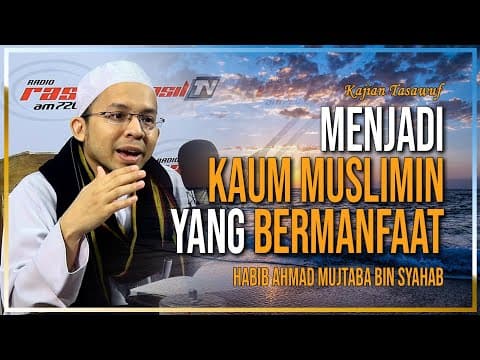
Transkrip diambil dari YouTube. Klik timestamp biru untuk melompat ke posisi tersebut di pemutar.
0:17 Alif Berhasil TV Praise be to Allah, 1:23 peace and blessings be upon the 1:24 Messenger of Allah, his family and his 1:26 companions. Peace be upon you, and 1:27 Allah's mercy and blessings, brothers 1:29 and sisters who are loved by Allah the 1:30 Almighty. How are you? Good morning, 1:32 brothers and sisters. Happy weekend. 1:34 Welcome to the Sufism study program 1:37 with the humble Isa Alkaf. We have Ondi 1:40 the cameraman and also Fajar at the 1:42 operator's desk. And praise be to Allah 1:44 , our teacher is with us in the studio, 1:46 Habib Ahmad Musytaba bin Sahab. Peace 1:48 be upon you, Habib. 1:50 Peace be upon you, and Allah's mercy 1:51 and blessings. Welcome, are you healthy 1:53 ? 1:53 Mashallah. We are continuing the book, 1:55 Bidayatul Hidayah. Habib. 1:57 Bidayatul Hidayah. Yes, Habib, God 1:59 willing, which chapter are we on today, 2:00 Habib? 2:01 Still early, still in the beginning, 2:02 Habib. Still regarding the intentions 2:04 for seeking knowledge. 2:05 The purpose of seeking knowledge. 2:07 The intention of seeking knowledge. 2:08 Purpose and intention of seeking 2:09 knowledge. Mashallah. Mashallah. 2:12 Allah. Indeed, it is true, in the 2:15 hadith which I am sure the listeners 2:17 are already familiar with. Actions are 2:21 based on intentions. Everything, every 2:24 deed 2:25 is measured by its intention. Brothers 2:27 and sisters. The quality of our work is 2:29 also measured by its intention. If the 2:33 intention is for Allah, surely we will 2:35 maximize all our effort. But if our 2:40 intention is for the world which is 2:42 fleeting, then our efforts will end in 2:45 something fleeting as well. Now, today 2:51 we will learn, brothers and sisters, 2:53 how to form intentions in seeking 2:56 knowledge, a noble deed. Do not let 3:00 this noble deed become vile and 3:02 fleeting because of our mistake in 3:05 intending. Brothers and sisters, before 3:08 that, it is good to open with the 3:10 reading of the Ummul Quran, Surah 3:12 al-Fatihah. May you lead it, Habib. 3:14 Mashallah. Al-Fatihah. I seek refuge in 3:16 Allah from the accursed Satan. In the 3:34 name of Allah, the Most Gracious, the 3:35 Most Merciful. Praise be to Allah, Lord 3:36 of the worlds, the Most Gracious, the 3:38 Most Merciful. Master of the Day of 3:39 Judgment. You alone we worship, and You 3:41 alone we ask for help. Guide us to the 3:43 straight path. Amen. Brother, who is 3:52 loved by Allah the Almighty. Please, if 3:55 you have the PDF of the book, open the 3:57 book Bidayatul Hidayah. What page, 3:59 Habib? 4:00 61, Habib. 4:01 Page 61. If you don't have it, it's 4:03 also okay. Just listen, God willing, 4:04 you will still be able to understand. 4:06 If you want to buy the translated book, 4:08 it is also available. You can get it 4:09 online. It is also in Gramedia. In 4:12 bookstores, God willing, it is 4:13 available. Bidayatul Hidayah. Let us 4:18 all listen to the explanation from 4:20 Habib Ahmad Musytaba. 4:23 In the name of Allah. In the name of 4:24 Allah, the Most Gracious, the Most 4:25 Merciful. Praise be to Allah, Lord of 4:26 the worlds. O Allah, send prayers and 4:27 peace upon our master Muhammad and upon 4:29 his family and all his companions. 4:30 Glory be to You, we have no knowledge 4:32 except what You have taught us. Indeed, 4:33 You are the Knowing, the Wise. Forgive 4:35 us, for You are the Oft-Returning, the 4:36 Merciful. O Allah, O Opener, O 4:38 All-Knowing, O Opener, O All-Knowing, O 4:40 Opener, O All-Knowing. Open our hearts, 4:42 O Most Merciful of the merciful. O 4:45 Allah, there is no ease except what You 4:47 make easy, and You make the difficult 4:49 easy. O Allah, make our knowledge easy, 4:51 and grant us broad understanding by the 4:53 status of the Prophet, may Allah bless 4:55 him and grant him peace. O Allah, we 4:58 ask You for beneficial knowledge and 5:00 good sustenance, O Giver, O Rich. And 5:03 we seek refuge in You, O Allah, from 5:04 knowledge that is not beneficial and 5:05 from a heart that does not fear. And 5:09 from a soul that is not satisfied, by 5:10 Your mercy, O Most Merciful of the 5:12 merciful, O Most Merciful of the 5:14 merciful, O Most Merciful of the 5:15 merciful. And sustenance. And intention 5:36 . Alhamdulillah, we always offer our 5:39 praise and gratitude to the presence of 5:41 Allah Subhanahu wa ta'ala for His 5:43 abundance of favors, the favor of 5:44 guidance, and His divine assistance. 5:47 And alhamdulillah, this morning we are 5:48 able to be together again in the study 5:50 of the book Bidayatul Hidayah. And 5:54 brothers, we are still discussing the 5:56 introduction of the book, where Imam 5:58 Ghazali rahimahullah ta'ala touches 6:00 upon the purpose of seeking knowledge 6:02 or the intentions for seeking knowledge 6:05 , starting with takhliah (cleansing) 6:07 and then tahliah (adornment). And the 6:11 proof of whether or not an intention in 6:14 seeking knowledge is good is through 6:17 the practice of what is learned and so 6:20 on. And this book is indeed a book of 6:23 practice; Bidayatul Hidayah is a book 6:25 that guides us to practice what we know 6:27 . Starting from matters that some might 6:30 consider trivial, even though they are 6:32 actually extraordinary. Starting from 6:35 daily etiquette, the etiquette of 6:38 waking up, then the etiquette of 6:40 preparing for prayer, the etiquette of 6:43 entering the bathroom, the etiquette of 6:46 istinja, the etiquette of wudu, and so 6:49 on, brothers. The etiquette of, what is 6:52 it called? Tayammum will also be 6:55 discussed by him, regarding our acts of 6:58 worship. Then he will also discuss 7:01 matters of the heart, the sins of the 7:03 heart, and the etiquette of the heart. 7:06 Now, that is the benchmark for whether 7:08 our intention in seeking knowledge is 7:10 good or not. Now, Imam Ghazali in the 7:13 previous meeting discussed that the 7:16 standard for whether your intention in 7:18 seeking knowledge is good or not is 7:21 when you read this book and you are 7:24 triggered to practice it. Ah, that 7:26 means your intention in seeking 7:28 knowledge is good. Yes. But if you read 7:32 a book like this and you actually 7:34 belittle it or disregard it, or when 7:37 you demand yourself to practice what is 7:39 in this book, you feel it is burdensome 7:41 . Well, this means be careful. This is 7:46 proof that your intention in seeking 7:48 knowledge is less than sincere, less 7:51 than well-aimed, and less than ikhlas. 7:54 And surely, there are elements there of 7:56 wanting to attain ephemeral things. In 8:00 the form of the world or other things. 8:02 Now, this is what is being discussed by 8:04 Imam Ghazali right now. He says in the 8:07 third section on page 61. minallahu 8:21 alaihi wasallam hudan minallahi ba. 8:27 When someone without realizing it, sets 8:32 an improper intention in seeking that 8:35 knowledge. Yes, he makes knowledge a 8:39 means to reach the world. He makes his 8:43 knowledge a means to reach honor from 8:46 people. So what he is looking for are 8:50 things other than Allah. Now, when this 8:53 happens and he is in the state of 8:54 seeking knowledge, he is actually 8:56 encouraged by the devil. That's right. 9:01 The devil actually reminds you of the 9:03 virtues of knowledge and the virtues of 9:06 the scholars and their proofs. Now, and 9:11 at that moment, when you are not right 9:13 in your intention, you set an improper 9:15 intention in seeking that knowledge. At 9:19 that moment, the devil will recite to 9:23 you, chant to you, what? The virtue of 9:26 knowledge. The virtues of the scholars, 9:29 the virtues of knowledge, where this 9:31 knowledge is supported by various 9:33 proofs. The status of the scholars and 9:35 the high degree of the scholars. In a 9:39 hadith, the blood of a martyr is 9:41 weighed against the ink of the scholars 9:43 . The ink of the scholars prevails, 9:46 being heavier in the scales of Allah 9:48 Ta'ala than the blood of a martyr. The 9:51 scholars are the inheritors of the 9:52 prophets. Scholars are the heirs of the 9:53 prophets. Exactly. The virtue of 9:55 knowledge and so on. What is knowledge? 9:57 It is a noble creation that Allah has 9:59 created. And knowledge is a sign of 10:04 goodness. Oh, it is explained at length 10:07 by the devil to make you more 10:09 enthusiastic about seeking knowledge. 10:12 Whether it is in the reports or other 10:14 proofs, whether from the Prophet 10:16 sallallahu alaihi wasallam, from the 10:18 companions, or others—the Quranic 10:19 verses and hadiths—the devil will 10:21 remind you of the virtues of that 10:23 knowledge. But remember the words of 10:26 the Prophet sallallahu alaihi wasallam. 10:28 And the devil tries to turn you away 10:31 from several very important hadiths 10:34 here. And here Imam Ghazali reminds us, 10:37 do not ever forget this hadith. He 10:40 brings forth three hadiths. The first 10:42 hadith: the Prophet sallallahu alaihi 10:43 wasallam said, "Whoever increases in 10:45 knowledge but does not increase in 10:46 guidance." Whoever increases in 10:49 knowledge, but at the same time does 10:52 not increase in guidance, meaning he 10:55 does not increase in his closeness to 10:58 Allah, then what? "He will not increase 11:01 except in distance from Allah." So with 11:03 that knowledge, instead of becoming 11:05 closer to Allah. In fact, it does not 11:08 add to his knowledge except that it 11:10 adds to his distance from Allah Ta'ala. 11:12 May Allah protect us from that. That is 11:14 how it is. That is why the devil 11:15 encourages us. Come on, study more, 11:17 study more. So you become further from 11:18 Allah. May Allah protect us from that. 11:21 That is why it is said, brothers, true 11:23 knowledge is fear (of Allah), all of it 11:25 is in the heart of its possessor, not 11:27 just in words and debates. As Imam 11:31 Abdullah bin Husain bin Thahir said, 11:33 the essence of knowledge is the quality 11:35 of khasyiah (fear of Allah) buried in 11:37 the heart. The more knowledge one has, 11:40 the greater the khasyiah, the fear of 11:42 Allah in that heart. And through that, 11:45 the true scholars who possess khasyiah 11:47 are known. "It is only those among His 11:50 servants who have knowledge who fear 11:51 Allah." That is what Allah Ta'ala 11:53 emphasizes clearly. Who are the 11:55 scholars? Those who possess the quality 11:56 of khasyiah in their hearts. So when 11:58 their knowledge increases, their 12:00 guidance increases, and their closeness 12:03 to Allah increases. They are more 12:06 diligent, more steadfast, more 12:08 consistent in performing the sunnah 12:11 acts. The obligatory ones, naturally, 12:14 are never abandoned. They strive to 12:16 perfect the sunnah, avoid the haram, 12:18 and try to steer clear of the makruh. 12:22 Thus, every time their knowledge 12:24 increases, their spirit to perfect the 12:26 sunnah and avoid the makruh increases, 12:29 as does their desire to draw closer to 12:31 Allah Ta'ala. Now, that is good 12:34 knowledge. But if it is knowledge that 12:37 does not produce guidance, then that 12:39 very knowledge will distance you from 12:42 Allah. The more you study, the more 12:44 distracted you become, leaving no time 12:46 for Dhuha prayer, no time for Witr, or 12:48 missing the sunnah prayers before or 12:50 after the obligatory ones, all under 12:51 the pretext of seeking knowledge. 12:54 Eventually, you'll find no time for 12:55 congregational prayers, again using 12:56 knowledge as the excuse. And eventually 12:58 , a day will come when you abandon your 13:00 prayers altogether, citing knowledge as 13:02 the reason. Well, may Allah protect us 13:04 from that, it is dangerous. That is 13:07 when the devil starts encouraging us to 13:09 prioritize this knowledge, claiming it 13:11 is better than two units of prayer. 13:13 True. Indeed, there is a hadith stating 13:15 that seeking knowledge is better than 13:17 two units of prayer. Not just two units 13:19 ; some narrations even mention a 13:20 thousand units. It is even better than 13:23 what is it called? Visiting 1,000 sick 13:25 people. Better than accompanying 1,000 13:27 funeral processions. Even just sitting 13:29 in a knowledge gathering once earns a 13:31 better reward. Everything is better. 13:33 But do not forget, knowledge is a means 13:35 to bring you closer to Allah Ta'ala. So 13:39 , it is strange if this very means that 13:40 should be used to draw you closer to 13:42 Allah actually distances you from Him. 13:45 It is completely contrary to the 13:47 purpose of that knowledge. Oh brothers, 13:50 true knowledge should make you more 13:52 eager to be consistent in Dhuha, sunnah 13:55 prayers, and Witr, or improve your 13:58 heart to be more humble, modest, and 14:00 generous. Like that. Those are the 14:04 things produced by such knowledge. But 14:05 if knowledge actually distances you 14:08 from the Sunnah, let alone the 14:09 obligatory acts? Indeed. Well, you have 14:14 to be careful. This means the knowledge 14:16 is of no benefit. Yes. In a well-known 14:20 hadith, the Prophet said, "The person 14:22 with the severest punishment on the Day 14:23 of Judgment is the scholar whom Allah 14:25 did not cause his knowledge to benefit 14:27 him." May Allah protect us from that. 14:29 Truly, the person with the most painful 14:31 punishment on the Day of Judgment. Do 14:33 you know who it is? Oh, the 14:35 disbelievers. Is that clear? There is 14:37 someone whose punishment is even more 14:38 painful than the disbelievers. There is 14:41 no god but Allah; it is the scholar 14:43 whose knowledge did not benefit him, 14:44 who will be punished before the 14:46 idolaters. Indeed, Ibn Ruslan said that 14:49 in his Zubad, did he not? Who is the 14:53 human being with the most painful 14:55 punishment on the Day of Judgment? 14:57 Among the Muslims. Correct. Not just 15:00 Muslims, but even among the scholars. 15:02 Really? Indeed. Which scholars? That is 15:05 the "alimun lam yanfa'hullahu bi ilmihi 15:07 ." A scholar, a learned person whom 15:09 Allah did not grant benefit through his 15:12 knowledge. His knowledge produces no 15:15 benefit for him. His knowledge does not 15:18 yield guidance for him. That is the 15:21 person whom Allah Ta'ala will punish 15:25 first, even before He punishes the 15:28 disbelievers. They will be punished 15:33 before the idolaters. May Allah protect 15:37 us from that. That is the danger, 15:38 brothers. Even the Prophet, peace be 15:40 upon him, sought refuge in Allah from 15:42 knowledge that is not beneficial. It is 15:43 truly dangerous. When knowledge is not 15:45 beneficial, it becomes something 15:46 negative. It distances you from Allah 15:48 and throws you into the Fire before the 15:50 idolaters. The Prophet prayed for this 15:52 in a well-known supplication. 15:54 Allahummanif'ni bima 'allamtani, 15:55 Allahumma inni a'udzubika min' ilmin la 15:56 yanfa '. O Allah, I seek refuge in You, 15:58 O Allah. From what? From knowledge. 16:01 Which knowledge? Knowledge that has no 16:03 benefit. Now, that is dangerous, 16:04 brothers. What is meant by knowledge 16:07 that has no benefit? Knowledge that is 16:08 not put into practice? Yes, just merely 16:11 knowledge. Uh, if knowledge is just 16:14 merely information. Well, actually if 16:17 that’s the case, then this cell phone 16:19 is more of a scholar than we are. Right 16:22 ? Yes. 16:24 It can store how many books, how many 16:26 books can it memorize? Thousands of 16:28 books. Oh, this phone, with its size, 16:30 is greater because it can memorize much 16:32 more. If the benchmark of knowledge is 16:34 just memorization, 16:35 just mere information. But, it only, 16:38 only stores it. Ah, now there is 16:41 something great, Bib, the ChatGPT. 16:44 Yes, that’s it. That’s an even 16:45 bigger scholar. You can ask anything. 16:47 You ask, it answers, yes. 16:49 It's already like a human, isn't it? 16:51 Even if you ask about fatwa, it answers 16:53 . 16:53 It could be. You can ask anything, 16:56 right? 16:57 It’s more than Google, isn't it? 16:58 Oh yes. 17:00 It's more of a scholar. 17:02 Now, if the benchmark of knowledge is 17:05 just information that is digested and 17:07 stored, 17:09 then it is more of a scholar than us, 17:11 right? However, what distinguishes a 17:13 scholar, a human being who has 17:14 knowledge from those tools, what 17:16 distinguishes them is that they 17:18 practice it. 17:20 Uh, not just storing, but also 17:21 practicing, applying that knowledge 17:23 within themselves, truly implementing 17:24 that knowledge. Now, that is what is 17:27 called the benefit of that knowledge. 17:28 That is called guidance in that 17:30 knowledge, brothers. Wow, so it is 17:33 dangerous if our knowledge increases 17:34 but our closeness to Allah Ta'ala does 17:36 not. That is the knowledge that the 17:39 Prophet asked Allah for refuge from. 17:42 Allahumma inni a'udzubika min' ilmin la 17:44 yanfa '. The third hadith, the devil 17:47 also tries to make you forget this 17:49 well-known hadith. This is the hadith, 17:52 uh, what is it called? Uh, Imam Ahmad 17:55 in his Musnad. Marru lailata usri. I 17:59 passed by on the night of Isra Mi'raj 18:01 when the Prophet—may peace be upon 18:04 him—in the Isra Mi'raj event, he 18:06 passed through three realms, brothers. 18:09 The first realm is the worldly realm, 18:11 the physical realm. From Masjidil Haram 18:12 to Masjidil Aqsa. The second, the 18:14 heavenly realm. True. Up to the first 18:16 heaven, the second, up to Sidratul 18:18 Muntaha. The third, the realm of 18:20 parables. It is called the realm of 18:22 parables. Now, during Isra Mi'raj, the 18:24 Prophet saw several parables. He saw a 18:26 cow or a large ox coming out of a small 18:28 hole. Then the ox tried to enter back 18:31 into the hole, but could not. That is a 18:33 parable. So the Prophet—may peace be 18:35 upon him—asked the Angel Jibril, " 18:36 What is this, O Jibril?" The Prophet 18:38 asked this. Uh, then Jibril replied, " 18:41 This, O Messenger of Allah, is a 18:44 parable for a person who lets out from 18:46 his mouth a word that has a huge impact 18:49 ." Then he regrets that word. He tries 18:53 to take back his words but cannot. Ah, 18:56 like that. That is what is called a 18:57 parable, brothers. Now, also among the 19:01 parables that the Prophet, peace be 19:04 upon him, saw during the night of Isra 19:08 and Mi'raj, which he described in this 19:11 hadith: "I passed by a people whose 19:14 lips were being cut off with scissors 19:17 made of fire." The scissors are hot, 19:23 scissors of fire, which are used to cut 19:25 their lips. Once cut, their lips grow 19:27 back, then they are cut again, they 19:29 grow back, and are cut again. The 19:31 Prophet, peace be upon him, could not 19:32 bear to see this. So he asked, who are 19:34 these people? Who are you? They replied 19:37 , we used to encourage good. We are the 19:44 ones who always ordered people to do 19:46 good, yet we did not do it ourselves. 19:49 And we are the ones who forbade people 19:52 from doing evil, yet we did it 19:54 ourselves. Now, that is, we seek refuge 19:56 in Allah from that. 19:57 Who are these? These are the scholars 19:59 who did not practice what they preached 20:00 . Yes, they knew of goodness and 20:03 conveyed it—not just knowing, but 20:05 conveying that goodness to others. Yet 20:08 they did not do it at all. There is no 20:11 desire or intention to do it. Like that 20:14 . And he knows of an evil and forbids 20:17 people from doing that evil. But at the 20:20 same time, he himself performs that 20:22 evil. And there is no sadness or regret 20:26 for what he does in terms of those sins 20:28 . Now, that is it. They will be 20:32 punished by Allah Ta'ala on the Day of 20:34 Judgment by having their lips cut with 20:36 scissors from hell. And so on. Now, 20:39 perhaps here often, brothers, many 20:41 questions are usually asked. Well, if 20:43 that's the case, then what? We are not 20:45 allowed to teach people unless we have 20:47 practiced it first, right? It's scary 20:51 if we teach people something that we 20:52 haven't practiced ourselves. It's scary 20:55 to fall into this hadith. And also 20:57 scary to fall into the verse of Allah 21:00 Ta'ala regarding being hateful to Allah 21:03 . It is a great wrath from Allah if you 21:11 teach something that you do not 21:13 practice, those are the verses. So it's 21:16 scary, then we shouldn't, let's not 21:18 teach people goodness. We should, what 21:21 you call it, try to improve ourselves 21:24 first. This is also a trick of the 21:26 devil. This, as previously discussed by 21:29 Imam Haddad, the perfect thing is for 21:32 you to learn, practice, and teach. That 21:36 is perfect and so on. But if you stop 21:40 spreading this knowledge because you 21:42 reason that you haven't practiced it 21:44 yet, then you have left two out of the 21:47 three. It is better for you to do two 21:51 out of three than for you to only do 21:53 one out of those three. And all three 21:56 are obligations, brothers: learning, 21:58 practicing, and spreading the da'wah. A 22:02 person who learns and performs da'wah 22:05 is better than someone who only learns. 22:08 Without performing da'wah and without 22:09 practicing. Those who practice two out 22:11 of three are better than those who 22:12 practice one out of three. That is what 22:14 Imam Haddad says. And here, when 22:16 someone teaches or spreads that, what 22:19 should be in their heart is to first 22:21 spur themselves to practice what they 22:23 teach. Striving to practice it. Even if 22:27 they are currently in a state of sin, 22:30 it is still their obligation to prevent 22:32 others from that sin and strive to, um, 22:34 what do you call it? To repent from 22:37 that sin. So, the benchmark here is the 22:40 effort of the heart, the determination 22:41 of the heart. The desire to practice 22:44 this goodness, the desire to leave this 22:47 evil behind. Now, when that 22:48 determination or intention exists in 22:50 the heart, then they are free. They do 22:52 not fall under this hadith or that 22:54 verse. Those who fall under this hadith 22:58 , or the verse we mentioned earlier, 23:00 are those whose hearts have absolutely 23:02 no desire to practice the good they 23:04 speak of, or to abandon the sin they, 23:07 um, explain to others. While they are, 23:10 um, committing that sin and have 23:12 nothing in themselves, and no 23:14 determination in themselves to leave 23:16 that sin. Now, that is what is included 23:18 in that hadith or verse, brothers. 23:19 Hm. As long as there is, um, a desire 23:22 in their heart to leave that sin, then 23:25 they are exempted from this hadith or 23:27 verse. As long as there is a 23:30 determination in their heart to 23:31 practice a good deed they encourage 23:33 others to perform, then they are 23:35 exempted from this verse. And actually, 23:38 brothers, precisely by preaching, by 23:40 practicing, by teaching what you know, 23:43 that is the main trigger for you to be 23:46 more motivated to practice that 23:48 knowledge, brothers. Yes. You will 23:52 realize it yourself. How can I teach 23:54 people about Duha prayer if I haven't 23:55 prayed Duha myself? That is an 23:58 extraordinary trigger for you to be 23:59 able to practice your knowledge, by 24:01 teaching it. Teach that knowledge 24:05 because it is the main trigger that 24:07 will strongly push you to practice that 24:10 knowledge. Truly, brothers, yes. Now, 24:14 here Imam Ghazali says, "Faka miskin." 24:22 When a person has knowledge they do not 24:24 practice, knowledge that is not 24:26 beneficial, the devil encourages them, 24:28 encourages them by saying, "Let's learn 24:30 more, learn more," for what? To get 24:33 further away from Allah. We seek refuge 24:34 in Allah from that. He says, "Fai iyaka 24:37 , so be careful, O poor human.""Iyaka" 24:43 is an*isim fi'il manqul*. So, *ihzar*, 24:47 meaning be careful, O poor human, do 24:50 not let yourself be influenced by his 24:53 deceptions. Meaning, hearing*tazwir*, 24:58 which means deception. Influenced by 25:00 the devil's deception. And do not let 25:05 yourself take the rope of deception 25:07 that the devil has extended toward you. 25:18 Woe to the learned person. Woe to the 25:21 ignorant person who lacks knowledge, 25:23 their misfortune is only once. But the 25:26 misfortune for those who have knowledge 25:28 and do not practice it is a thousand 25:30 times over. So, that is how it is, 25:33 brothers. Next, Imam Ghazali discusses 25:37 three types of people. Ah, Hajib ikhwan 25:41 . Every person who seeks knowledge will 25:44 inevitably fall into one of these three 25:46 categories. Waama rahimakallah anasa 25:50 fiil ilmi ahwal. Know, may Allah have 25:54 mercy on you, that people in seeking 25:56 knowledge fall into one of three states 25:59 . The first is, rajulunah. mahal minhum 26:04 . This is the first person, someone who 26:08 seeks knowledge with the goal that this 26:11 knowledge will be his provision for the 26:14 Hereafter. y bihi illa wajallah taala, 26:19 he has no purpose for his knowledge 26:21 other than the pleasure of Allah and 26:23 salvation in the hereafter. There is 26:28 absolutely nothing in his heart 26:29 regarding worldly intentions, none at 26:31 all. f minal faizina, these are the 26:34 group of the successful, O Allah. 26:35 jaalna minhum. 26:36 Amin. 26:37 Amin, the first, and now the second: 26:41 warulun thabahu liasta bihi hayatiilah. 26:45 The second person seeks knowledge with 26:49 the hope that it will help him. 26:53 In his worldly life. Exactly. Hayati 26:56 ajilah. Ajilah means the immediate or 26:58 the hastened life. Meaning, this world 26:59 here. bihil iz wal jah wal maal. And 27:04 through this knowledge, he wants to 27:07 attain honor among people, status, and 27:10 wealth. This is clearly the wrong 27:14 intention. Right, this is dangerous. 27:17 But that person is wahimun balika 27:19 mustasirun fiqiak. His goal, but this 27:24 second person is aware that his 27:27 intention is incorrect. He knows his 27:31 condition and is regretful. He feels in 27:34 his heart a certain weakness, a state 27:38 that is not right. And a base intention 27:43 . So, he is indeed seeking knowledge to 27:46 attain the world. It is wrong, but he 27:48 admits it's wrong. Now, this second 27:53 person is in a dangerous state. How is 27:56 it dangerous? If he dies before 28:01 repenting. ngerultimah. And his affair 28:10 is left to Allah's will, whether Allah 28:13 the Exalted forgives him or not; but if 28:16 he is granted the guidance to repent 28:19 before his time comes. And he practices 28:23 his knowledge. minual and he repairs 28:28 his past corruption, then he will catch 28:31 up with the first group, those who are 28:35 successful. Someone who repents from 28:40 sin is as if he has no sin. This second 28:42 person is wrong, but the good thing is 28:44 he admits he is wrong. That's decent, 28:47 Bib. 28:47 Yes. 28:48 Oh, so a step toward goodness is 28:49 admitting one's mistakes. 28:51 Yes. 28:52 Is that so, Bib? If a person doesn't 28:54 admit their mistakes, how can they 28:55 become better? 28:55 Exactly, exactly, exactly. So the story 28:57 is, there are people who are wrong, but 28:59 they think that mistake is the truth. 29:02 How do we prove to them that they are 29:03 wrong? 29:05 They don't agree to being accused of 29:07 being wrong. 29:08 They feel they are right. 29:09 They feel they are right. 29:11 That's the difficult part. But if a 29:13 person is wrong and they. 29:15 Know that they are wrong. 29:17 That is the first step. Yes. 29:18 Yes. So, the path toward the truth 29:22 begins with admitting one's mistakes. 29:25 Hm. So, this second one still admits it 29:28 . 29:28 Oh, they still admit it, Habib. They 29:30 still admit it, but, but they were 29:32 wrong. Correct. They were wrong, but 29:33 they admit their mistake. So, what is 29:35 their situation? Well, repent quickly 29:37 if possible. The scary thing is if the 29:39 Angel of Death comes before one repents 29:40 , that's dangerous, that’s a bad 29:41 ending. 29:41 H. 29:43 Uh, but if they repent and purify those 29:45 despicable intentions and practice 29:47 their knowledge, they catch up to the 29:49 first group, the successful ones. 29:52 Habib, what if they study a science, 29:54 for example, a professional one? 29:57 Yeah. Professional skills. For example, 29:59 they learn 30:01 let's say, they learn how to fly a 30:03 plane. 30:04 Yes. 30:05 What is that called? A pilot. Learning 30:07 to be a pilot. 30:08 Then, medical science, or engineering 30:11 or architecture. Outwardly, we see 30:15 those as sciences whose purpose is 30:17 indeed worldly, seeking the world. So, 30:20 how is that? Okay. Great. This is very, 30:23 very beautiful. Uh, like this. 30:25 Subhanallah, brothers. Indeed, what the 30:28 author is saying here is discussing 30:30 only the knowledge of the hereafter. 30:32 Not really, Habib. Actually, all 30:35 knowledge is good, even knowledge like 30:37 fiqh, hadith interpretation, Sharia law 30:39 , or the knowledge of what is it called 30:42 ? General studies, medicine, or other 30:45 things. Both of them can be made into 30:47 beneficial knowledge that brings us 30:49 closer to Allah Ta'ala. 30:51 Can it be both, Habib? 30:53 Yes. 30:53 Wait, how do you find that? Well, yes. 30:55 Someone who studies medicine, what is 30:57 their intention? For if I become a 30:59 doctor, I will help the Ummah of 31:01 Prophet Muhammad, peace be upon him. Or 31:03 someone says, "I want to be a pilot." 31:05 This is a communal obligation, a fardhu 31:07 kifayah, mandatory for a Muslim, for 31:09 the Muslim community to have pilots. I 31:12 want to fulfill that communal 31:13 obligation for the Muslim community. So 31:16 those intentions are actually good 31:17 intentions. Well, it's the same as me 31:19 wanting to learn fiqh, for what? To 31:22 practice Allah's knowledge and also, I 31:24 want people's worship to be correct. I 31:27 learn medicine, for what? So that I am 31:29 healthy and I also want people to be 31:30 healthy, Uncle. Now, that is also the 31:32 same. 31:33 H. 31:33 But at the same time, there is also, " 31:35 I'm studying to be a doctor." Why? 31:38 Doctors have big salaries, you know. So 31:40 , not caring at all about human health. 31:43 All that is sought is a big salary. Now 31:45 , this is what will happen. Doctors 31:47 selling incorrect medicine, doctors who 31:50 just want profit. Who don't care about 31:52 the patient's health. Now, this is 31:54 exactly the same as someone who studies 31:56 religious knowledge with the goal of 31:57 later giving lectures. Lectures have 31:59 big honorariums. It is exactly the same 32:01 . 32:01 Yes. Yes. Yes. 32:03 What if one studies economics, which is 32:05 clearly about how we trade and how we 32:07 get money, how is that, Habib? Manage 32:10 the intention. 32:10 Well, Jamil Jinan Sahal, Habib. Okay. 32:12 So, if we earn money, what is it for 32:14 afterwards? 32:15 Oh, 32:16 is money the main goal or not? I trade 32:19 to get rich, but for what? Wealth is 32:22 not the peak. It is to make the Muslims 32:24 , what do you call it? Economically 32:27 independent. So that we no longer have 32:29 to beg from others. 32:31 So, there is a goal beyond just 32:33 collecting wealth. 32:35 Ah, like that. 32:35 But if it stops there, just to get rich 32:37 , just to collect wealth. 32:39 Well, this means it is the world that 32:40 is being sought. 32:42 But if you seek the world and make it a 32:44 stepping stone to reach the afterlife. 32:46 Now, that is noble. Wow, that's 32:48 true. Because if the goal is to get 32:50 rich, then after getting rich, what 32:52 then? 32:53 Exactly. 32:53 Yes. Yes. 32:57 The third category. 32:58 This third category is dangerous, Habib 33:00 . Wow, this third group is funny. 33:03 He begins this third group. Istahwada' 33:05 alaihimusy-syaitan. The third group, 33:08 misled by Satan's deception. Wow. It's 33:11 full, really full. Who are they? 33:14 Fattakhadza 'ilmahu wasilatan 33:15 litakatsuril mal. He makes his 33:17 knowledge a means to multiply wealth. 33:21 Watafakhura bil jah, and brags about 33:24 status. Wata'azzuza bikatsratil atba', 33:28 and feels noble because of many 33:30 followers. 33:31 If now, followers. If now, followers. 33:33 Followers. If now, followers. 33:36 Subscribers. 33:37 Subscribers too. 33:39 But if subscribing works, don't forget 33:41 to subscribe, guys. Now, this third 33:46 person 33:49 is extraordinary. He tries to enter any 33:52 path with his knowledge. For what? In 33:57 the hope of obtaining the world, 33:59 satisfying his desire for the world, to 34:02 get as much of the world as possible. 34:04 This is clearly wrong, isn't it? But 34:06 what? Well, this is the vanity of the 34:12 scholars. But he thinks that he has a 34:14 position in the sight of Allah Ta'ala. 34:16 Why? Because he considers himself a 34:20 learned person, a scholar. Watasyabbaha 34:23 biziyyihim, and dresses like them. 34:25 Fiziyyi, ziyyun means clothing. Wal 34:27 mantiq, and speech. So he dresses like 34:31 a scholar, talks in the style of a 34:34 scholar, and his outward signs are the 34:37 signs of a scholar. So he feels he is 34:41 right. At the same time, he is 34:46 competing to get the world, both 34:48 outwardly and inwardly. So it's funny, 34:51 right? So the story is, his intention 34:53 is completely wrong, but he doesn't 34:55 consider it a mistake. Instead, he 34:57 considers himself to have rank in the 34:58 sight of Allah Ta'ala. 35:00 Wow, how do you make this person repent 35:02 ? 35:02 Yes, sir. You are wrong, sir. No, I'm 35:04 right. The proof is my clothes, they 35:06 are the clothes of a scholar. Oh, it's 35:07 like that, isn't it? He considers 35:10 himself a scholar because of his 35:12 clothes, or because of his way of 35:14 speaking, talking like a scholar, or 35:16 because of a scholar's gestures, and 35:18 brands himself as a scholar. Even 35:20 though his heart is filled with worldly 35:23 goals. Wow, what about this? He says, " 35:27 Fahum minal halikin.""Wow, this person 35:29 is doomed. Waminal hamqo almagrurin. 35:32 And this is from the group of Hamqo 35:33 people. Hamqo means foolish people, 35:35 Habib. Almagrurin means those who are 35:36 deceived. Wow, this is dangerous. Why? 35:42 Because, oh, the hope for them to 35:44 repent is cut off. Because they think 35:49 of themselves as good people. No 35:50 repentance. Repent from what? What is 35:52 the mistake? That’s how it is. Yeah. 35:55 Repentance is for sins. They don't 35:56 think they’ve sinned. What is the sin 35:57 ? Uh, they don't admit their faults. Eh 35:59 , so how can they take the path to 36:01 truth? 36:02 Yes. Yes. 36:03 Ah, Masha'Allah. La ilaha illallah, may 36:06 Allah protect us. Now, Habib, this will 36:08 be discussed at length by Imam Ghazali. 36:10 This third group is discussed at length 36:12 . He will categorize these people as 36:13 part of the Dajjal group. Part of the 36:16 group of—well, this is called the 36:17 Ulama Su '. 36:18 Now, we often hear of Ulama... 36:20 Ulama Su', worldly Ulama, or what do 36:22 you call them, usually they are called 36:24 Ulama Su ', right? 36:25 These Ulama, this is what will be 36:27 discussed here. They think they are 36:29 scholars, they call themselves scholars 36:31 because they look like scholars. Really 36:33 ? 36:34 What do they usually wear? They wear 36:36 all kinds of, what are they called, 36:37 attributes. 36:38 Scholar attributes. 36:40 The attributes of a scholar are used by 36:41 them. 36:41 The souvenirs of a scholar. A scholar. 36:47 Masha'Allah. 36:49 But... 36:50 But at the same time, what they are 36:52 aiming for is the world. 36:53 Allah. 36:54 There is absolutely no regard for the 36:55 hereafter. Absolutely no desire to 36:57 attain guidance. Now, this will be 36:59 discussed by Imam Ghazali, insha'Allah 37:01 we will discuss it in the next meeting, 37:03 insha'Allah. 37:03 Insha'Allah. Jazakumullah, Habib Ahmad 37:05 Mustofa bin Shihab, 37:07 for the advice this morning. Brothers 37:11 and sisters who are blessed by Allah 37:12 SWT. Thank you very much, Bib, for... 37:14 Masha'Allah, you're welcome, Bib. 37:16 Oh God, thank you for making the time 37:18 to come to Rasil early in the morning, 37:20 sorry for...Subuh time, right, Bib? 37:25 Masha'Allah. Straight here, and at 8:00 37:27 you have another event in Jakarta, 37:29 brothers and sisters. Now I will read 37:31 the greetings from Iwan Caniago. 37:34 Muhammad Anan sent coffee, Ustaz, 37:36 Masha'Allah, Mr. Herman. Fajsi in 37:40 Sukabumi, Muslim, Jumar, Aminah 37:43 Widodo, Ani Susmiati, Mulri Mugi, 37:46 Jumana, Omarid, Mukhtar, Mr. Mukhtar, 37:50 Mustofa Hasan, Fauzi, Tamim, Sodqin. 37:54 Wow, there are so many, Habib, if I 37:56 read them all, it might be Dhuhr by the 37:58 time I finish. Masha'Allah, 38:00 Jazakumullah khairan jaza to the 38:01 brothers and sisters who have been 38:03 listening wherever you are. For those 38:05 listening via Radio Satm 720 AM, Radio 38:09 Almas Magerang, Radio Madina Pontianak, 38:12 Radio Latansa Sukabumi, Rasil Palembang 38:15 , Radio Bondowoso, Suara Habibullah, 38:18 and Radio Silaturahim Yogyakarta. 38:22 Hopefully, what we have conveyed can be 38:24 a means of guidance for us all. Don't 38:27 forget, brothers and sisters, to like, 38:29 comment, and subscribe. And thank you 38:31 to the brothers and sisters who have 38:33 entrusted their donations. Thank you. 38:35 Wow, from a servant of Allah. 38:37 Jazakumullah khairan jaza. Prayed for 38:39 the late parents. Yes, naam. God 38:42 willing, their parents will be accepted 38:45 in the grave, their sins forgiven, and 38:47 their sustenance multiplied for those 38:50 who have donated. God willing. Amen. 38:53 Amen, O Lord of the worlds. For those 38:55 brothers and sisters who wish to 38:57 contribute to the missionary movement 39:00 of Radio Silaturahim, you may use the 39:02 Bank Syariah Indonesia account number 39:05 7222 3003 in the name of Yayasan Wakaf 39:10 Rumah Quran Silaturahim. Don't forget, 39:13 brothers and sisters, stay tuned. After 39:15 this, we will have our upcoming 39:18 programs. Mashallah. And we also greet 39:22 the brothers and sisters who are 39:24 currently doing Ling Tiengkung 39:26 exercises behind the Silaturahim 39:28 Islamic Elementary School. Mashallah. 39:32 Don't forget to listen to the Sufism 39:35 study afterward on your way home via 39:37 YouTube Rasil TV. Mashallah. Thanks 39:39 also to Kang Ondi the cameraman. Thanks 39:41 also to Kang Mas Fajar at the operator 39:44 desk. Thank you once again to the 39:47 brothers and sisters who have tuned in. 39:49 I am Isa Alkaf, and the crew on duty, 39:52 signing off. Peace be upon you, and 39:55 God's mercy and blessings.